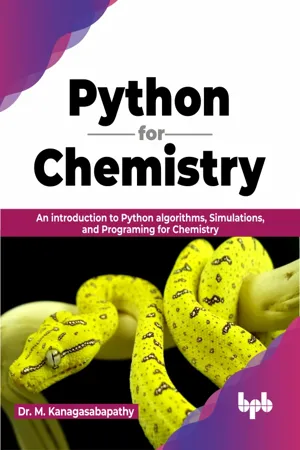
Python for Chemistry
eBook - ePub

Python for Chemistry

An introduction to Python algorithms, Simulations, and Programing for Chemistry (English Edition)

  1. English
  2. ePUB (mobile friendly)
  3. Available on iOS & Android
eBook - ePub

Python for Chemistry

An introduction to Python algorithms, Simulations, and Programing for Chemistry (English Edition)

About this book

A one-stop guide to teach chemists how to use Python for coding and iterations in a hands-on and practical manner

Key Features
? Understand the core Python functions and algorithms for the computation of chemical parameters.
? Learn how to use Cheminformatics modules to process and analyze elemental data and molecular structures.
? Get familiar with the algorithms for numerical and symbolic computations.

Description
Python is a versatile and powerful computer language without a steep learning curve. It can be deployed to simulate various physicochemical parameters or to analyze complex molecular, bio-molecular, and crystalline structures. The objective of this book is to give a gentle introduction to Python programming with relevant algorithms, iterations, and basic simulations from a chemist's perspective. This book outlines the fundamentals of Python coding through the built-in functions, libraries, and modules as well as with a few selected external packages for physical/materials/inorganic/analytical/organic/ nuclear chemistry in terms of numerical, symbolic, structural, and graphical data analysis using the default, Integrated Development and Learning Environment. You will also learn about the Structural Elucidation of organic molecules and inorganic complexes with specific Cheminformatics modules. In addition to this, the book covers chemical data analysis with Numpy and also includes topics such as SymPy and Matplotlib for Symbolic calculations and Plotting. By the end of the book, you will be able to use Python as a graphical tool or a calculator for numerical and symbolic computations in the interdisciplinary areas of chemistry.

What you will learn
? To fetch elemental, nuclear, atomic or molecular data with list or dictionary functions.
? Understanding the algorithms for the computation of Thermodynamic, Electrochemical, Kinetics, Molecular and Spectral parameters.
? Stoichiometrical calculation of the reactant and product coefficients from Matrices.
? Symbolic computations with reference to Physical Chemistry.
? With Matplotlib package, interpretation and plotting of the analyzed data in the desired graphical format.
? With various cheminformatics modules, correlate the structure of complex and bulkier molecules.

Who this book is for
This book is for Chemists, Chemical Engineers, Material Scientists, Bio-chemists, Biotechnologists, and Physicists. Students of Chemistry, Chemical Engineering, Materials Chemistry, Biochemistry, Biotechnology, and Physics will find this book resourceful.

Table of Contents
1. Understanding Python Functions for Chemistry
2. Computations in Chemistry with NumPy
3. Interpolation, Physico-chemical Constants, and Units with SciPy
4. SymPy for Symbolic Computations in Chemistry
5. Interactive Plotting of Physico-chemical Data with Matplotlib
6. Introduction to Cheminformatics with RDKit
7. ChemFormula for Atomic and Molecular Data
8. Chemlib for Physico-chemical Parameters
9. ChemPy for Computations in Chemistry
10. Mendeleev Package For Atomic and Ionic Data
11. Computations of Parameters of Electrolytes with PyEQL
12. STK Module for Molecular Structures

Frequently asked questions

Yes, you can cancel anytime from the Subscription tab in your account settings on the Perlego website. Your subscription will stay active until the end of your current billing period. Learn how to cancel your subscription.
No, books cannot be downloaded as external files, such as PDFs, for use outside of Perlego. However, you can download books within the Perlego app for offline reading on mobile or tablet. Learn more here.
Perlego offers two plans: Essential and Complete
  • Essential is ideal for learners and professionals who enjoy exploring a wide range of subjects. Access the Essential Library with 800,000+ trusted titles and best-sellers across business, personal growth, and the humanities. Includes unlimited reading time and Standard Read Aloud voice.
  • Complete: Perfect for advanced learners and researchers needing full, unrestricted access. Unlock 1.4M+ books across hundreds of subjects, including academic and specialized titles. The Complete Plan also includes advanced features like Premium Read Aloud and Research Assistant.
Both plans are available with monthly, semester, or annual billing cycles.
We are an online textbook subscription service, where you can get access to an entire online library for less than the price of a single book per month. With over 1 million books across 1000+ topics, we’ve got you covered! Learn more here.
Look out for the read-aloud symbol on your next book to see if you can listen to it. The read-aloud tool reads text aloud for you, highlighting the text as it is being read. You can pause it, speed it up and slow it down. Learn more here.
Yes! You can use the Perlego app on both iOS or Android devices to read anytime, anywhere — even offline. Perfect for commutes or when you’re on the go.
Please note we cannot support devices running on iOS 13 and Android 7 or earlier. Learn more about using the app.
Yes, you can access Python for Chemistry by Dr. M. Kanagasabapathy in PDF and/or ePUB format, as well as other popular books in Computer Science & Computer Science General. We have over one million books available in our catalogue for you to explore.

Table of contents

  1. Cover Page
  2. Title Page
  3. Copyright Page
  4. About the Author
  5. About the Reviewer
  6. Acknowledgement
  7. Preface
  8. Errata
  9. Table of Contents
  10. 1. Understanding Python Functions for Chemistry
  11. 2. Computations in Chemistry with NumPy
  12. 3. Interpolation, Physico-chemical Constants, and Units with SciPy
  13. 4. SymPy for Symbolic Computations in Chemistry
  14. 5. Interactive Plotting of Physico-chemical Data with Matplotlib
  15. 6. Introduction to Cheminformatics with RDKit
  16. 7. ChemFormula for Atomic and Molecular Data
  17. 8. Chemlib for Physico-chemical Parameters
  18. 9. ChemPy for Computations in Chemistry
  19. 10. Mendeleev Package For Atomic and Ionic Data
  20. 11. Computations of Parameters of Electrolytes with PyEQL
  21. 12. STK Module for Molecular Structures
  22. Index