eBook - ePub
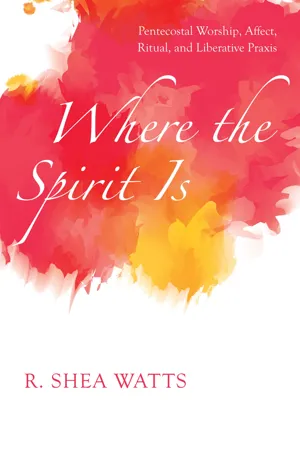
Where the Spirit Is
Pentecostal Worship, Affect, Ritual, and Liberative Praxis
- 190 pages
- English
- ePUB (mobile friendly)
- Available on iOS & Android
eBook - ePub
About this book
This dissertation explores the experiential contours of Pentecostalism as a liberative praxis. The connection between Pentecostalism and social change is a burgeoning line of inquiry, particularly in the Global South, but this study focuses on the history of Pentecostalism in the US, beginning with the production and circulation of the African American Spirituals. Bringing theories of affect into conversation with ritual studies, this interdisciplinary work traces personal stories and experiences from the author and examines them in light of Pentecostal traditions that stem from the Azusa Street Revival in Los Angeles, California, the birthplace of the Pentecostal movement. William J. Seymour's vision at Azusa was egalitarian and transgressed the societal boundaries and norms of race and gender in the early twentieth century. Pentecostalism was and is informed by Black, queer, female, and other voices often silent or rendered invisible. Without this representation, Pentecostalism is simply one tradition among many co-opted and appropriated for the ongoing colonial projects of the modern Western world. Therefore, this book explores Blackpentecostal tradition: specifically, The Fellowship of Affirming Ministries (TFAM), a predominately Black LGBTQ+ movement that integrates Pentecostal worship and theology with an inclusive, liberative theology.
Information
Topic
Theology & ReligionSubtopic
Christian DenominationsTable of contents
- Title Page
- Acknowledgments
- Introduction
- Chapter 1: A Move of the Spirit
- Chapter 2: Dance-Possible Epistemologies of Sound and Space
- Chapter 3: “A Queer Faith”
- Chapter 4: A Liberating Spirit and Political Pentecost
- Conclusion
- Bibliography
Trusted by 375,005 students
Access to over 1.5 million titles for a fair monthly price.
Study more efficiently using our study tools.
Frequently asked questions
Yes, you can cancel anytime from the Subscription tab in your account settings on the Perlego website. Your subscription will stay active until the end of your current billing period. Learn how to cancel your subscription
No, books cannot be downloaded as external files, such as PDFs, for use outside of Perlego. However, you can download books within the Perlego app for offline reading on mobile or tablet. Learn how to download books offline
Perlego offers two plans: Essential and Complete
- Essential is ideal for learners and professionals who enjoy exploring a wide range of subjects. Access the Essential Library with 800,000+ trusted titles and best-sellers across business, personal growth, and the humanities. Includes unlimited reading time and Standard Read Aloud voice.
- Complete: Perfect for advanced learners and researchers needing full, unrestricted access. Unlock 1.5M+ books across hundreds of subjects, including academic and specialized titles. The Complete Plan also includes advanced features like Premium Read Aloud and Research Assistant.
We are an online textbook subscription service, where you can get access to an entire online library for less than the price of a single book per month. With over 1.5 million books across 990+ topics, we’ve got you covered! Learn about our mission
Look out for the read-aloud symbol on your next book to see if you can listen to it. The read-aloud tool reads text aloud for you, highlighting the text as it is being read. You can pause it, speed it up and slow it down. Learn more about Read Aloud
Yes! You can use the Perlego app on both iOS and Android devices to read anytime, anywhere — even offline. Perfect for commutes or when you’re on the go.
Please note we cannot support devices running on iOS 13 and Android 7 or earlier. Learn more about using the app
Please note we cannot support devices running on iOS 13 and Android 7 or earlier. Learn more about using the app
Yes, you can access Where the Spirit Is by R. Shea Watts in PDF and/or ePUB format, as well as other popular books in Theology & Religion & Christian Denominations. We have over 1.5 million books available in our catalogue for you to explore.