eBook - ePub
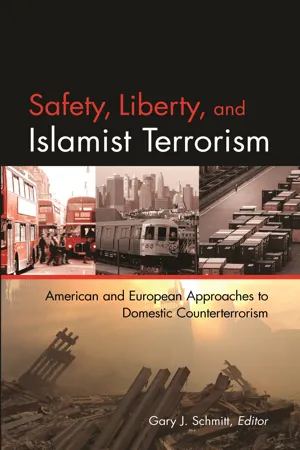
Safety, Liberty, and Islamist Terrorism
American and European Aproaches to Domestic Counterterrorism
- 208 pages
- English
- ePUB (mobile friendly)
- Available on iOS & Android
eBook - ePub
Safety, Liberty, and Islamist Terrorism
American and European Aproaches to Domestic Counterterrorism
About this book
The terrorist attacks of September 11, 2001, produced a revolution in domestic security in the United States. The Bush administration responded quickly by aggressively enforcing existing laws, sponsoring new legislation, overhauling domestic intelligence, and employing the president's executive power in ways that drew criticism from civil libertarians on both the left and right. Many hoped that the succeeding administration would adopt a more 'European' approach to domestic security-an approach typically understood to be more compatible with the rule of law and friendlier to civil liberties. But Europe has suffered major terrorist attacks as well-in Madrid in 2004 and London in 2005-and terrorist plots continue to plague America's European allies. Has this shared experience engendered a common approach to domestic security, or, as many believe, is there a transatlantic divide in counterterrorism strategy? In Safety, Liberty, and Islamist Terrorism: American and European Approaches to Domestic Counterterrorism, Gary J. Schmitt leads a group of security and intelligence experts in analyzing the domestic counterterrorism regimes of the United Kingdom, France, Spain, Germany, and the United States. The author's in-depth analysis provides a unique window into the similarities and differences among the counterterrorism efforts of these major democracies and explores the possibilities (and limitations) of applying one country's lessons to another. Safety, Liberty, and Islamist Terrorism concludes with a broad assessment of the changes made to U.S. counterterrorism strategy since 9/11 in comparison with current European laws, institutions, and practices, and with policies instituted during past American domestic security crises. The analysis uncovers evidence of a shared strategic imperative: preemption. For the United States, preemption occurs both at home and on battlefields abroad, while for Europe, preemption is primarily a domestic affair, often resulting in laws that allow more aggressive policing of terrorist actvity than occurs in the United States. The comparison also yields insights about how the transatlantic community has balanced the need to address the jihadist threat with maintaining civic order at home. Although no country has a perfect record, Schmitt contends that changes made to domestic security policy in response to the terrorist threat have not undermined the United States and Europe's shared commitment to democracy and liberty. 'Certainly, tradeoffs have been made between individual liberties and domestic security,' Schmitt writes. 'But if we take the broad view, we are struck by how minimal those intrusions on our liberties have been, given the threat we face.'
Information
Table of contents
- Acknowledgments
- Introduction
- 1 United Kingdom: Once More unto the Breach
- 2 France: In a League of Its Own
- 3 Spain: From 9/11 to 3/11 and Beyond
- 4 Germany: The Long and Winding Road
- 5 United States: Facing the Threat at Home
- 6 U.S. Counterterrorism in Perspective
- Notes
- About the Authors
Trusted by 375,005 students
Access to over 1.5 million titles for a fair monthly price.
Study more efficiently using our study tools.
Frequently asked questions
Yes, you can cancel anytime from the Subscription tab in your account settings on the Perlego website. Your subscription will stay active until the end of your current billing period. Learn how to cancel your subscription
No, books cannot be downloaded as external files, such as PDFs, for use outside of Perlego. However, you can download books within the Perlego app for offline reading on mobile or tablet. Learn how to download books offline
Perlego offers two plans: Essential and Complete
- Essential is ideal for learners and professionals who enjoy exploring a wide range of subjects. Access the Essential Library with 800,000+ trusted titles and best-sellers across business, personal growth, and the humanities. Includes unlimited reading time and Standard Read Aloud voice.
- Complete: Perfect for advanced learners and researchers needing full, unrestricted access. Unlock 1.5M+ books across hundreds of subjects, including academic and specialized titles. The Complete Plan also includes advanced features like Premium Read Aloud and Research Assistant.
We are an online textbook subscription service, where you can get access to an entire online library for less than the price of a single book per month. With over 1.5 million books across 990+ topics, we’ve got you covered! Learn about our mission
Look out for the read-aloud symbol on your next book to see if you can listen to it. The read-aloud tool reads text aloud for you, highlighting the text as it is being read. You can pause it, speed it up and slow it down. Learn more about Read Aloud
Yes! You can use the Perlego app on both iOS and Android devices to read anytime, anywhere — even offline. Perfect for commutes or when you’re on the go.
Please note we cannot support devices running on iOS 13 and Android 7 or earlier. Learn more about using the app
Please note we cannot support devices running on iOS 13 and Android 7 or earlier. Learn more about using the app
Yes, you can access Safety, Liberty, and Islamist Terrorism by Gary J. Schmitt in PDF and/or ePUB format, as well as other popular books in Politics & International Relations & International Relations. We have over 1.5 million books available in our catalogue for you to explore.