eBook - ePub
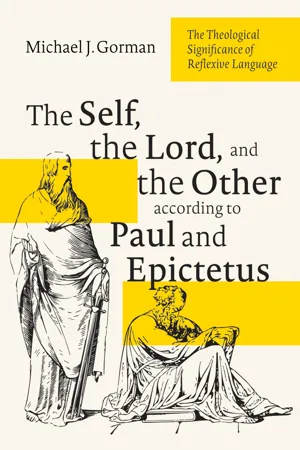
The Self, the Lord, and the Other according to Paul and Epictetus
The Theological Significance of Reflexive Language
- 540 pages
- English
- ePUB (mobile friendly)
- Available on iOS & Android
eBook - ePub
The Self, the Lord, and the Other according to Paul and Epictetus
The Theological Significance of Reflexive Language
About this book
This study explores the relationship between the individual person (the self), the divine, and other people in the writings of the apostle Paul and the Roman Stoic Epictetus. It does so by examining self-involving actions expressed with reflexive pronouns (myself, yourself, etc.) in various kinds of sentences: for example, "Examine yourself" and "You do not belong to yourself." After situating the topic within the fields of linguistics and ancient Greek, the study then examines the reflexive constructions in Epictetus's Discourses, showing that reflexive texts express fundamental aspects of his ethic of rational self-interest in imitation of the indwelling rational deity. Next, the investigation examines the 109 reflexive constructions in Paul, providing an exegesis of each reflexive text and then synthesizing the results. Paul's reflexive phrases are essential statements of his theology and ethics, expressing an interconnected narrative Christology, narrative apostolic identity, and narrative ethic. Most importantly, the study finds that for Epictetus, concern for others is a rational means to self-realization, whereas for Paul, concern for others is a community ethic grounded in the story of the indwelling Christ and is the antithesis of self-interest.
Information
Table of contents
- Title Page
- Preface
- Acknowledgments for the Original Study
- Acknowledgments for the Present Book
- Abbreviations
- Original Abstract
- Introduction
- Part One: The Syntax and Semantics of the Reflexive Pronoun and Reflexive Phrases
- Part Two: Reflexive Pronoun Constructions in the Discourses of Epictetus
- Part Three: Reflexive Pronoun Constructions in the Letters of Paul
- Part Four: The Significance of the Reflexive Pronoun and Reflexive Phrases in Paul’s Letters Compared to Epictetus’s Discourses
- Summary and Conclusions
- Original Bibliography
- Supplemental Bibliography
Trusted by 375,005 students
Access to over 1.5 million titles for a fair monthly price.
Study more efficiently using our study tools.
Frequently asked questions
Yes, you can cancel anytime from the Subscription tab in your account settings on the Perlego website. Your subscription will stay active until the end of your current billing period. Learn how to cancel your subscription
No, books cannot be downloaded as external files, such as PDFs, for use outside of Perlego. However, you can download books within the Perlego app for offline reading on mobile or tablet. Learn how to download books offline
Perlego offers two plans: Essential and Complete
- Essential is ideal for learners and professionals who enjoy exploring a wide range of subjects. Access the Essential Library with 800,000+ trusted titles and best-sellers across business, personal growth, and the humanities. Includes unlimited reading time and Standard Read Aloud voice.
- Complete: Perfect for advanced learners and researchers needing full, unrestricted access. Unlock 1.5M+ books across hundreds of subjects, including academic and specialized titles. The Complete Plan also includes advanced features like Premium Read Aloud and Research Assistant.
We are an online textbook subscription service, where you can get access to an entire online library for less than the price of a single book per month. With over 1.5 million books across 990+ topics, we’ve got you covered! Learn about our mission
Look out for the read-aloud symbol on your next book to see if you can listen to it. The read-aloud tool reads text aloud for you, highlighting the text as it is being read. You can pause it, speed it up and slow it down. Learn more about Read Aloud
Yes! You can use the Perlego app on both iOS and Android devices to read anytime, anywhere — even offline. Perfect for commutes or when you’re on the go.
Please note we cannot support devices running on iOS 13 and Android 7 or earlier. Learn more about using the app
Please note we cannot support devices running on iOS 13 and Android 7 or earlier. Learn more about using the app
Yes, you can access The Self, the Lord, and the Other according to Paul and Epictetus by Michael J. Gorman in PDF and/or ePUB format, as well as other popular books in Theology & Religion & Biblical Criticism & Interpretation. We have over 1.5 million books available in our catalogue for you to explore.