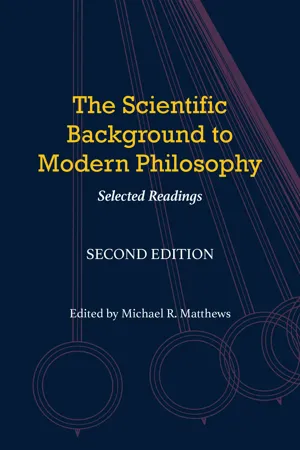
Through a collection of works from key thinkers in natural philosophy, the second edition of The Scientific Background to Modern Philosophy illuminates the central role scientific writing played in developing modern philosophical thought. This revised and expanded edition includes many new translations and incorporates works by foundational eighteenth- and nineteenth-century thinkers not in the first edition, including selections from works by Jean-Baptiste le Rond d'Alembert, Denis Diderot, Émilie Du Châtelet, Jean-Jacques Rousseau, Joseph Priestley, Immanuel Kant, Carl Linnaeus, William Paley, and Charles Robert Darwin. These new additions provide students with a more comprehensive understanding of the scientific context in which the major philosophical works of the modern era were written and complement the selections from works by Nicolaus Copernicus, Francis Bacon, Galileo Galilei, René Descartes, Robert Boyle, Christiaan Huygens, and Isaac Newton that are retained from the first edition.
- 208 pages
- English
- ePUB (mobile friendly)
- Available on iOS & Android
eBook - ePub
About this book
Information
Table of contents
- Front Cover
- Half Title
- Title Page
- Copyright
- Titles of Related Interest Available from Hackett Publishing
- Contents
- Acknowledgments
- Sources
- Introduction
- I Copernicus (1473–1543)
- II Bacon (1561–1626)
- III Galileo (1564–1642)
- IV Descartes (1596–1650)
- V Boyle (1627–1691)
- VI Huygens (1629–1695)
- VII Newton (1642–1727)
- VIII D’Alembert (1717–1783)
- IX Diderot (1713–1784)
- X Du Châtelet (1706–1749)
- XI Rousseau (1712–1778)
- XII Priestley (1733–1804)
- XIII Kant (1724–1804)
- XIV Linnaeus (1707–1778)
- XV Paley (1743–1805)
- XVI Darwin (1809–1882)
- Bibliography
- Chronology
- Back Cover
Trusted by 375,005 students
Access to over 1.5 million titles for a fair monthly price.
Study more efficiently using our study tools.
Frequently asked questions
Yes, you can cancel anytime from the Subscription tab in your account settings on the Perlego website. Your subscription will stay active until the end of your current billing period. Learn how to cancel your subscription
No, books cannot be downloaded as external files, such as PDFs, for use outside of Perlego. However, you can download books within the Perlego app for offline reading on mobile or tablet. Learn how to download books offline
Perlego offers two plans: Essential and Complete
- Essential is ideal for learners and professionals who enjoy exploring a wide range of subjects. Access the Essential Library with 800,000+ trusted titles and best-sellers across business, personal growth, and the humanities. Includes unlimited reading time and Standard Read Aloud voice.
- Complete: Perfect for advanced learners and researchers needing full, unrestricted access. Unlock 1.5M+ books across hundreds of subjects, including academic and specialized titles. The Complete Plan also includes advanced features like Premium Read Aloud and Research Assistant.
We are an online textbook subscription service, where you can get access to an entire online library for less than the price of a single book per month. With over 1.5 million books across 990+ topics, we’ve got you covered! Learn about our mission
Look out for the read-aloud symbol on your next book to see if you can listen to it. The read-aloud tool reads text aloud for you, highlighting the text as it is being read. You can pause it, speed it up and slow it down. Learn more about Read Aloud
Yes! You can use the Perlego app on both iOS and Android devices to read anytime, anywhere — even offline. Perfect for commutes or when you’re on the go.
Please note we cannot support devices running on iOS 13 and Android 7 or earlier. Learn more about using the app
Please note we cannot support devices running on iOS 13 and Android 7 or earlier. Learn more about using the app
Yes, you can access The Scientific Background to Modern Philosophy by Michael R. Matthews in PDF and/or ePUB format, as well as other popular books in Philosophy & Medieval & Renaissance Philosophy. We have over 1.5 million books available in our catalogue for you to explore.