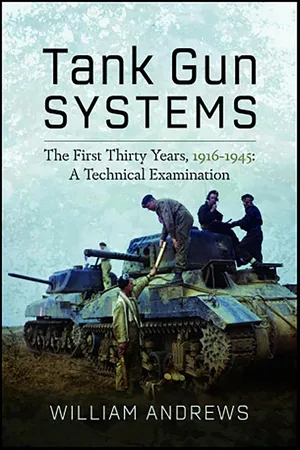
Tank Gun Systems
eBook - ePub

Tank Gun Systems

The First Thirty Years, 1916–1945: A Technical Examination

  1. 576 pages
  2. English
  3. ePUB (mobile friendly)
  4. Available on iOS & Android
eBook - ePub

Tank Gun Systems

The First Thirty Years, 1916–1945: A Technical Examination

About this book

A technical study of medium & heavy tank gun systems used from World War I to World War II.

Much has been written about the use of tanks in battle. Little, however, has appeared about the gunnery systems that are at their core. This book describes and examines the main gun systems of medium and heavy tanks from first use in 1916 in World War I to those fielded in numbers to the end of World War II in 1945, including tanks of the interwar period. Specifically considered are guns of a caliber greater than thirty-five mm, which have been deployed in numbers greater than one hundred. The emphasis is on guns mounted in turrets on heavier tracked armored fighting vehicles (greater than fifteen tonnes) which were considered tanks. There are, though, exceptions, in that the naval six pounder guns in First World War British tanks, as well as the seventy-five mm guns in French medium tanks of the same period (all turretless) are included.

The treatment of gun systems includes sighting and fire control equipment, gun laying equipment, mounts and the array of munitions fired, as well as the actual gun, including its, barrel, cradle, breech, firing mechanism, sights and recoil system. Related to this are issues of gun handling (loading and unloading), ammunition design and rates of fire. Also examined are the maximum impulse and energy generated by firing some of the munitions available that must be absorbed by the gun recoil system.

Frequently asked questions

Yes, you can cancel anytime from the Subscription tab in your account settings on the Perlego website. Your subscription will stay active until the end of your current billing period. Learn how to cancel your subscription.
No, books cannot be downloaded as external files, such as PDFs, for use outside of Perlego. However, you can download books within the Perlego app for offline reading on mobile or tablet. Learn more here.
Perlego offers two plans: Essential and Complete
  • Essential is ideal for learners and professionals who enjoy exploring a wide range of subjects. Access the Essential Library with 800,000+ trusted titles and best-sellers across business, personal growth, and the humanities. Includes unlimited reading time and Standard Read Aloud voice.
  • Complete: Perfect for advanced learners and researchers needing full, unrestricted access. Unlock 1.4M+ books across hundreds of subjects, including academic and specialized titles. The Complete Plan also includes advanced features like Premium Read Aloud and Research Assistant.
Both plans are available with monthly, semester, or annual billing cycles.
We are an online textbook subscription service, where you can get access to an entire online library for less than the price of a single book per month. With over 1 million books across 1000+ topics, we’ve got you covered! Learn more here.
Look out for the read-aloud symbol on your next book to see if you can listen to it. The read-aloud tool reads text aloud for you, highlighting the text as it is being read. You can pause it, speed it up and slow it down. Learn more here.
Yes! You can use the Perlego app on both iOS or Android devices to read anytime, anywhere — even offline. Perfect for commutes or when you’re on the go.
Please note we cannot support devices running on iOS 13 and Android 7 or earlier. Learn more about using the app.
Yes, you can access Tank Gun Systems by William Andrews in PDF and/or ePUB format, as well as other popular books in History & 20th Century History. We have over one million books available in our catalogue for you to explore.

Information

Table of contents

  1. Cover
  2. Title
  3. Copyright
  4. Contents
  5. About the Author
  6. Acknowledgements
  7. INTRODUCTION
  8. FIRST WORLD WAR (1915–1918)
  9. INTERWAR PERIOD (1919–1939)
  10. SECOND WORLD WAR (1939–1945)
  11. CONCLUSION
  12. Bibliography