eBook - ePub
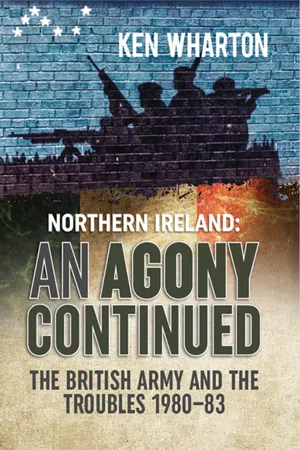
Northern Ireland: An Agony Continued
The British Army and the Troubles 1980–83
- 448 pages
- English
- ePUB (mobile friendly)
- Available on iOS & Android
eBook - ePub
About this book
This book is called 'An Agony Continued' because it was simply that: an agony. It was an agony which commenced at the end of the 1960s and as the new decade of the 80s arrived, so the pain, the grief, the loss and the economic destruction of Northern Ireland continued. Little did any of us know at the time, but it was to do so for almost a further two decades. Between January 1980 and December 1989, around 1,000 people died; many were soldiers and policemen; some were Prison Officers; some were paramilitaries; and some were innocent civilians. The Provisional IRA (PIRA) and their slightly more psychopathic cousins in the Irish National Liberation Army (INLA) would continue to kill innocent civilians by the score during this decade. Across the sectarian divide the Ulster Freedom Fighters (UFF) and the equally vicious Ulster Volunteer Force (UVF) would continue to slaughter Catholics in streets, in pubs and in restaurants. This book will look at the period which encompassed the 48 months of 1980 and 1983. It was a near half-decade which saw the Hyde Park and Regent's Park massacre of soldiers and horses from the Blues and Royals and the cowardly bombing of the Royal Green Jackets' band. It further witnessed the murder of 18 people by the INLA at a disco held in the Droppin' Well in Ballykelly and also the death of the leader of the Shankill Butchers: Lenny Murphy. The years under study include the 1981 deaths of ten Republican paramilitaries who starved themselves to death in protest against the loss of their status as 'political prisoners'. As ever, this book pulls no punches in its absolute detestation of both Republican and Loyalist paramilitaries. This book continues Ken Wharton's epic journey through the Troubles in Northern Ireland, viewed primarily through the eyes of the British Army squaddies on the ground.
Information
Part One
1980
Whereas the total number of deaths fell in this year, there were, nevertheless 46 soldiers or former soldiers killed, with the UDR paying an unacceptably high toll. A further nine Police officers were killed as well as 45 civilians. It was a year which witnessed the sickening spectacle of the murder of an off-duty Green Jacket by the Provisionals, as he visited his grieving wife in hospital following the stillbirth of their baby. This author will not hold his breath awaiting an apology from either Mr Adams or Mr McGuinness – or, for that matter, their PIRA comrades. The New Year commenced with the tragedy of a ‘blue on blue’ as two soldiers from the Parachute Regiment were killed.
1
January
During the Troubles, every New Year’s Eve with the promise of a new dawn to follow, came the fresh hope that this particular one might be the one which brought peace. There were 29 such New Years’ Eves over the long and tortuous course of the Troubles and, as the final minutes of 1979 ticked away, so there was fresh hope in the hearts of those who wanted an end to the violence. 1 January, 1980 arrived – and by the end of the day three people would be dead and two would be badly injured. Two soldiers would be among those whose lives had been ended prematurely and two more CVOs were being dispatched to Hampshire and Dorset with the news that soldiers’ loved ones did not wish to hear. It would also see the death of Anne Maguire, mother of the three children killed in Andersonstown in 1976. Their tragic deaths were the catalyst behind the Peace People’s Movement.
In the very early hours of the 1st, an eight-man patrol group from the Parachute Regiment had set up an ambush position in wooded country at Tullydonnell, South Armagh, close to the Irish border. Lieutenant Simon Bates (25) and his Signaller, Private Gerald Hardy (18) had located themselves a short distance away from the others. Standard Operating Procedure (SOP) is that once an ambush position is set, no further movement should be made unless ordered. For reasons which will remain known only to the two men, they moved and approached the others. In the pitch black – it was 0130 hours – and ‘cammed up’, their comrades thought that they were IRA gunmen and after a quick challenge, opened fire on the two men and both were killed. A member of the patrol told the later inquest: “Two blokes walked into the ambush. We positively identified weapons and we had to open fire.” Why SOP was broken by the two dead Paras will never be known as both died fairly instantly. Lieutenant Bates was from Christchurch, Dorset and Private Hardy was from Southampton.
TRAGIC START TO THE NEW YEAR
Marcus Townley, Welsh Guards
On December 31st, I found myself on QRF [Quick Reaction Force] at Bessbrook Mill and all ready for the New Year of 1980. After patrolling around the ‘cuds’ [rural ops], we rotated on to Mill security (i.e. sangar protection) as well as QRF.
Anyway, as midnight approached we were allowed our two cans of beer to celebrate the New Year and new decade. The church bells chimed and we all shook hands, but because I was on stag [guard duty] at 0100 on the PVCP [permanent vehicle checkpoint], I decided to get my head down. At about 0015 the helicopters started to warm up and I thought: “Fuck me; something has kicked off.” We made our way to the ready room, and sure enough we were to be crashed out, as there had been a shooting on the border.
We boarded the helicopters just as we were about to lift off. ‘Kestrel’ [code name for the helicopter ops team] came out of his ops room and told us that the flight had been scrubbed. We very soon learned that it had been a ‘blue on blue’1 involving two members of 2 Para. By all accounts the Platoon Commander had decided to have a chat to his platoon, and approached from the front, which was designated as the killing zone. Sadly, he had got himself shot and killed along with a young private. Believe you me, it put a real dampener on the festive period.
A couple of hours later a brick returning back to the Mill asked why we were so glum on New Year’s Day; on being told they too were pissed off. The effect of that one incident is that for the last 33 years now, I never celebrate New Year’s Day. Come midnight I always walk away from the celebrations; yes, I toast those two Paras, perhaps shed a tear. But celebrate – no.
The scene then shifted further north, this time to Belfast. As this author has commented in his books, passim, ‘joyriding’ during the Troubles was a lethal pastime. As 1980 began, so ended the life of Doreen McGuinness (16) after the car in which she was a passenger ran through a VCP manned by soldiers from the Parachute Regiment and was fired upon. The VCP was placed on the Whiterock Road between the Ballymurphy (‘Murph) and Turf Lodge Estates in order to deter the transfer of arms and explosives. The car approached the VCP and accelerated through, forcing the soldiers to leap out of the way. Under the in place Rules of Engagement (ROE) they were entitled to open fire and did so, striking the car several times. The bullet-riddled car was abandoned at the Royal Victoria Hospital (RVH) on the Falls Road and the driver ran off. Ms McGuinness was already dead and a fellow passenger had had most of his foot shot away. The practice was always dangerous, but the price of failing to stop at a VCP when ordered to do so by armed – and sometimes nervous – soldiers could be fatal and was often so.2
VCPs
Rifleman ‘L’ Royal Green Jackets
I did a fair few of these on my two tours of NI, both times in West Belfast and I was always on edge. The truth is that you didn’t always know what to expect. It could be a couple of hours – sometimes less – of sheer mind-numbing boredom, but it could also be a time when you were pissing yourself and worried about the next car to come along. Most times we would flag a driver down and ask for his docs and then ‘P’ check him and then wave him on the way; true you would often get the usual comments of “Fuckin’ Brits; youse got nothing better to do?” or “Fuck off back ter England!” Other times, we would get a cheery “What about yez, lads?” or “God bless yez, lads; youse take care, now.” We stopped one guy and his Mrs and we knew straight away we were in for trouble. He was just sullen, but she was what the Belfast people would call a “gob-shite!” It was “Brit-this, fucking Brit that” for a minute or two while we ‘P’ checked them. She then informed me that she knew my name and my mother was going to be shot by the boyos when she shopped at Tesco! I thought: “Fuck me; how does she know where my Mum shops?” Then she said: “You are fuckin’ dead you English fuck-pig!” At that, I’d had enough and shouted to a mate: “Fuck it, Yorkie: shoot the bitch!” I only did it for effect, but the other lad cocked his SLR [self-loading rifle] and pointed it straight at her head. Fortunately, he knew what I was up to and shouted: “In her head or chest?” She went white and clamped her obscene lips together and we didn’t hear a peep from her after that. We waved them away and I called into the car: “The Royal Green Jackets thank you for your co-operation and patience.” I bet the husband was happy with it, because at least he wouldn’t have to listen to her bitching!
The worst times were when a car would approach us at speed and the arse muscles would tighten up and then they would screech to a halt; always testing us, pushing us. Mind, as soon as one of the lads stuck the business end of his SLR into the driver’s face, he would turn white and hopefully soil his underpants! Other times you would see a car stop a hundred yards away as he saw us and do a ‘U’ turn or pull out of a queue of traffic and roar away. Was it someone impatient who was late for somewhere or something, or was it a player with arms in the boot trying to get away? After I came out of the Army, I saw on the news that several joyriders had been killed for trying to crash through VCPs and I can honestly say that although I feel for the people killed, I can understand the actions of the soldiers who felt that their lives were threatened. That’s why I never condemned Private Clegg for what happened in September 1990;3 been there and done that as they say.
Far too frequently, the Provisionals – as well as the Loyalist paramilitaries – set up illegal VCPs in their areas of influence. It was a show of bravado, a show of strength to send a message to their supporters and to snub the SF. On the news of the approach by an Army patrol, the signs, the guns and the masks all disappeared and the IRA men would melt into the background. The following is an account of what one soldier thought was an IVCP and led to a hilarious, although nearly tragic, incident.
IVCP OR WAS IT?
Ken Pettengale, Royal Green Jackets
I married a WRAC driver who was based in Aldergrove. After a whirlwind romance, we got married in Hexham. As I had been refused permission to marry, I did anyway as I always did when I was told I couldn’t. To keep us apart, she was posted to Londonderry, so one night I borrowed my mate’s car (a covert bright orange 2.0 Capri), ‘persuaded’ two pistols from the armourer and set off for a night of passion. I got completely lost once I got to Londonderry, and didn’t fancy stopping for directions. I did know however, that I was on the wrong side of the river and the wrong side of town! After driving around for ages, I finally got pulled over by the RUC and after a bit of finger wagging and chest beating, they escorted me to my destination, only to find I had no fucking ID card and they wouldn’t let me in! My new wife came to the gates, we had a kiss and I set off back to Belfast.
Schlepping down the M1 motorway in the pitch black, up ahead I could see torches going on and off in the middle of the road. However, it seemed amateurish and not the way we were taught to flag vehicles at night! I had an instant ‘arse twitch’ because I thought that I was heading straight into an IRA VCP!
I put both pistols on the passenger seat and – fucking dangerously – cocked one and jammed it between my knees! I decided to slow down and get to the check and then put my toe down and crash through. By this time I was truly in a panic; on my own and wondering if I would get out alive. As I got closer, the car in front caught figures in his headlights before he turned them off; they were in uniform! As I slowed down and stopped, I was relieved to find they were UDR, until one of them shone his/her torch through the passenger window and saw the 9-mls! Fucking hell! Then I knew how close you can come to being an own goal! After being checked out (no ID remember?) I was told to report to the duty room at Aldergrove. That is when the trouble really started! I am sure Martin Brookes who was one of the Mortar Platoon Serjeants4 who will remember this incident. My knob has led me into many a problem in my life; he’s a good mate, but boy, does he drop me in it at times!
There was clearly a touch of black humour about the above incident, but one has to remember, that when a minibus driver stopped at what appeared to be a legitimate VCP but what turned into an IRA ambush in Kingsmills in January, 1976, the men doing the stopping were wearing stolen British Army uniforms; the result was 10 dead. When the driver of the Miami Showband’s minibus was stopped near Newry in July of the previous year, the UVF killers were also wearing stolen British Army uniforms; three band members were killed. Both incidents are dealt with in detail in Wasted Years, Wasted Lives by the same author5. The Provisionals also used stolen uniforms to ‘smoke out’ a suspected tout (informer) in South Armagh. In this one particular incident, a PIRA member had been suspected of touting for some time and a fake VCP was set up. When his car was stopped at the fake VCP, he was told that the ‘soldiers’ were SAS and were going to kill him. In a panic, he identified himself as an informer for the RUC and that sealed his death warrant. He was taken away by the ‘nutting squad’ and during torture was likely to have been asked ‘which road do you want to close?’ This was a sickening reference to the fact that the SF would close a road off after the discovery of a body for fear it may be booby-trapped. That particular man was later hooded and then shot twice in the back of the head while a ‘tame’ Catholic priest added ‘dignity’ to the murder by reading him the last rites.
This sickening act of making ‘respectable’ the sordid and brutal interrogation, torture and finally shooting of a ‘tout’ or ‘suspected tout’ by inviting or intimidating a Catholic priest into giving the condemned man the action of contrition or final rites was a favourite of the Provisionals. Often after the ‘nutting squad’ had carried out the above, a priest was summoned to hear the beaten suspect make his final confession. In his excellent God and the Gun, Martin Dillon perfectly illustrates one such event where the squad had all but finished their dirty business and the bleeding and bruised man wished to make his peace. Dillon interviewed a priest known only as ‘Father Pat’ who had been summoned to a PIRA safe house and led upstairs to the bathroom which had clearly been employed as a torture room:
I froze when the bathroom door closed. I was suddenly dealing with evil and not just talking about it. The man in the chair was one of my parishioners. I remember looking at the bath filled with water wondering what they had done with him. He was stripped to a pair of wet underpants. His hair and body were wet so they’d obviously been holding him under the water … He was badly bruised and his eyes were so swollen he could hardly see me … The victim was incapable of walking. I put my arm around him … it seemed the only loving thing I could do. His lips were swollen and I heard him murmur: ‘Please help me, Father’. I felt so helpless. Leaving that room was a nightmare I have to live with.6
These torture rooms according to the priests which Martin Dillon interviewed, along with accounts from some of the informers and agents, as well as other contemporary accounts, were places of almost mediaeval barbarity. Some of the methods employed by the ‘nutting squad’ might well have been taken from the handbook of the Middle Ages torturer or the despicable ‘Spanish Inquisition’. Witnesses speak of stained and soiled clothes where the tortured suspect had lost control of their bodily functions; vomit-ridden areas; blood-stained clothes and bedding, pools of blood and broken teeth and blood-covered saws, chisels and screwdrivers. This was hardly the image with which to impress their Irish-American backers, and those ‘romantic’ priests in the Catholic faith who saw them as freedom-fighters.
On the 2nd of the month, Gerry Adams, later President of Sinn Féin, who was apparently never a Company Commander of the Ballymurphy IRA and later was apparently not Belfast Brigade Commander, was arrested by soldiers and RUC officers in the Andersonstown area. He and another Sinn Féin member were found in a house which the SF was attempting to search. Several knocks had been made at the door of the house and Police identified themselves. Neither man in the house made an effort to respond and when officers broke in, the two men were arrested although later released. Adams – or ‘Teflon man’...
Table of contents
- Cover
- Title Page
- Copyright
- Dedication
- Contents
- List of Maps & Illustrations
- Foreword
- Preface
- Quotations
- The Author’s Personal Thoughts
- Note by Michael Sangster, Royal Artillery
- Abbreviations
- Maps
- Introduction
- Part One: 1980
- Part Two: 1981
- Part Three: 1982
- Part Four: 1983
- Appendices
- Select Bibliography
Trusted by 375,005 students
Access to over 1.5 million titles for a fair monthly price.
Study more efficiently using our study tools.
Frequently asked questions
Yes, you can cancel anytime from the Subscription tab in your account settings on the Perlego website. Your subscription will stay active until the end of your current billing period. Learn how to cancel your subscription
No, books cannot be downloaded as external files, such as PDFs, for use outside of Perlego. However, you can download books within the Perlego app for offline reading on mobile or tablet. Learn how to download books offline
Perlego offers two plans: Essential and Complete
- Essential is ideal for learners and professionals who enjoy exploring a wide range of subjects. Access the Essential Library with 800,000+ trusted titles and best-sellers across business, personal growth, and the humanities. Includes unlimited reading time and Standard Read Aloud voice.
- Complete: Perfect for advanced learners and researchers needing full, unrestricted access. Unlock 1.5M+ books across hundreds of subjects, including academic and specialized titles. The Complete Plan also includes advanced features like Premium Read Aloud and Research Assistant.
We are an online textbook subscription service, where you can get access to an entire online library for less than the price of a single book per month. With over 1.5 million books across 990+ topics, we’ve got you covered! Learn about our mission
Look out for the read-aloud symbol on your next book to see if you can listen to it. The read-aloud tool reads text aloud for you, highlighting the text as it is being read. You can pause it, speed it up and slow it down. Learn more about Read Aloud
Yes! You can use the Perlego app on both iOS and Android devices to read anytime, anywhere — even offline. Perfect for commutes or when you’re on the go.
Please note we cannot support devices running on iOS 13 and Android 7 or earlier. Learn more about using the app
Please note we cannot support devices running on iOS 13 and Android 7 or earlier. Learn more about using the app
Yes, you can access Northern Ireland: An Agony Continued by Ken Wharton in PDF and/or ePUB format, as well as other popular books in History & Military & Maritime History. We have over 1.5 million books available in our catalogue for you to explore.