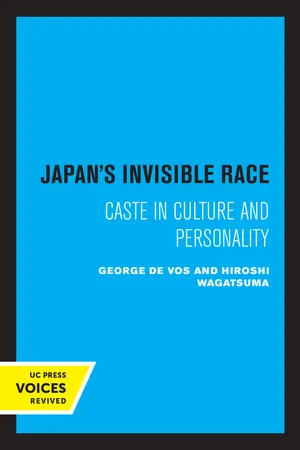
Modern Japanese share a myth to the effect that they harbor in their midst an inferior race less "human" than the stock that fathered their nation as a whole. These pariahs, numbering more than two million, are segregated by caste just as firmly as the Negro is in the United States.The present volume, to which several Japanese and American social scientists have contributed, offeres an interdisciplinary description and analysis of this strangely persistent phenomenon, inherited from feudal times. Its main thesis is that caste and racism are derivatives of identical psychological processes in human personality, however differently structure they may be in social institutions. It finds that what it terms status anxiety, related to defensively held social values, leads to a need to segregate disparaged parts of the population on grounds of innate inferiority.Until the time of their official emancipation in 1871, the so-called eta were distinguished visibly by their special garb. Today few clues to their identity are visible; yet, they remain a distinguishable, segregated segment of the population and bear inwardly, in a psychological sense, the stigma resulting from generations of oppression.This volume traces the story of the outcastes in complete detail--their origin, their stormy post-emancipation history, and their present leftist political significance. Large populations of outcasts live in urban ghettoes within the major cities of south-central Japan. In some of these metropolitan centers they comprise up to 5 percent of the population but contribute 60 to 65 percent of unemployment and relief roles. They have periodic trouble with the police; they manifest a delinquency rate more than three times that of the ordinary population; their children do poorly in school; they are subject to various forms of job discrimination; and few marriages are successfully consummated across the caste barrier.Some try to escape their past identity by becoming prostitutes or by entering the underworld. Those who survive discrimination to achieve status in society either live in fear of exposure [if they are "passing"] or overtly maintain their identity in proud isolation. Some who live in rural communities have achieved equal economic status with their neighbors but not full social acceptance.In their theoretical closing discussion the authors offer a challenging critique of Marxian class theory in introducing the concept of "expressive" exploitation--that is, the psychological use of a subordinate group as a repository of what is disavowed by the values of a culture in a caste society--as distinct in form and function from the "instrumental" economic or political exploitation of subjected minorities in class societies.Contributors: Gerald BerremanJohn B. CornellJohn DonoghueEdward NorbeckJohn PriceYuzuru SasakiGeorge O. TottenThis title is part of UC Press's Voices Revived program, which commemorates University of California Press's mission to seek out and cultivate the brightest minds and give them voice, reach, and impact. Drawing on a backlist dating to 1893, Voices Revived makes high-quality, peer-reviewed scholarship accessible once again using print-on-demand technology. This title was originally published in 1966.
- 464 pages
- English
- PDF
- Available on iOS & Android
eBook - PDF
About this book
Information
Publisher
University of California PressYear
2023Print ISBN
9780520357303
Edition
1eBook ISBN
9780520310841
Table of contents
- CONTRIBUTORS
- Preface
- Contents
- Introduction
- Part One Caste in Japan: A Descriptive Cultural Analysis
- SECTION I. Historical Perspective
- INTRODUCTION
- CHAPTER I. A History of the Outcaste: Untouchability in Japan
- SECTION II. Attempts at Political and Social Solutions to the Outcaste Problem
- INTRODUCTION
- CHAPTER 2. Emancipation: Growth and Transformation of a Political Movement
- CHAPTER 3. Postwar Political Militarice
- CHAPTER 4. Non-Political Approaches: The Influences of Religion and Education
- SECTION III. Ethnographic Studies of the Japanese Outcastes
- INTRODUCTION
- CHAPTER 5. The Ecology of Special Buraku
- CHAPTER 6. A Traditional Urban Outcaste Community
- CHAPTER 7. The Social Persistence of Outcaste Groups
- CHAPTER 8. Buraku Relations and Attitudes in a Progressive Farming Community
- CHAPTER 9. Little-Known Minority Groups of Japan
- CHAPTER 10. Japan's Outcastes in the United States
- SECTION IV. Psychological Perspectives
- INTRODUCTION
- CHAPTER 11. Socialization, Self-Perception, and Burakumin Status
- CHAPTER 12. Group Solidarity and Individual Mobility
- CHAPTER 13. Minority Status and Attitudes Toward Authority
- SECTION V. Caste in Cross-Cultural Perspective: Organizational Components
- INTRODUCTION
- CHAPTER 14. Structure and Function of Caste Systems
- CHAPTER 15. Concomitants of Caste Organization
- SECTION VI. Motivational Components of Caste
- INTRODUCTION
- CHAPTER 16. Essential Elements of Caste: Psychological Determinants in Structural Theory
- CHAPTER 17. Toward a Cross-Cultural Psychology of Caste Behavior
- Bibliography
- Index
Trusted by 375,005 students
Access to over 1.5 million titles for a fair monthly price.
Study more efficiently using our study tools.
Frequently asked questions
Yes, you can cancel anytime from the Subscription tab in your account settings on the Perlego website. Your subscription will stay active until the end of your current billing period. Learn how to cancel your subscription
No, books cannot be downloaded as external files, such as PDFs, for use outside of Perlego. However, you can download books within the Perlego app for offline reading on mobile or tablet. Learn how to download books offline
Perlego offers two plans: Essential and Complete
- Essential is ideal for learners and professionals who enjoy exploring a wide range of subjects. Access the Essential Library with 800,000+ trusted titles and best-sellers across business, personal growth, and the humanities. Includes unlimited reading time and Standard Read Aloud voice.
- Complete: Perfect for advanced learners and researchers needing full, unrestricted access. Unlock 1.5M+ books across hundreds of subjects, including academic and specialized titles. The Complete Plan also includes advanced features like Premium Read Aloud and Research Assistant.
We are an online textbook subscription service, where you can get access to an entire online library for less than the price of a single book per month. With over 1.5 million books across 990+ topics, we’ve got you covered! Learn about our mission
Look out for the read-aloud symbol on your next book to see if you can listen to it. The read-aloud tool reads text aloud for you, highlighting the text as it is being read. You can pause it, speed it up and slow it down. Learn more about Read Aloud
Yes! You can use the Perlego app on both iOS and Android devices to read anytime, anywhere — even offline. Perfect for commutes or when you’re on the go.
Please note we cannot support devices running on iOS 13 and Android 7 or earlier. Learn more about using the app
Please note we cannot support devices running on iOS 13 and Android 7 or earlier. Learn more about using the app
Yes, you can access Japan's Invisible Race by Hiroshi Wagatsuma,George De Vos in PDF and/or ePUB format, as well as other popular books in Social Sciences & Cultural & Social Anthropology. We have over 1.5 million books available in our catalogue for you to explore.