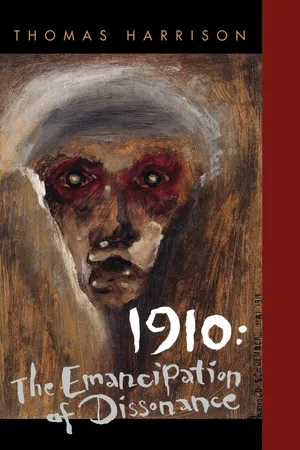
The year 1910 marks an astonishing, and largely unrecognized, juncture in Western history. In this perceptive interdisciplinary analysis, Thomas Harrison addresses the extraordinary intellectual achievement of the time. Focusing on the cultural climate of Middle Europe and paying particular attention to the life and work of Carlo Michelstaedter, he deftly portrays the reciprocal implications of different discourses—philosophy, literature, sociology, music, and painting. His beautifully balanced and deeply informed study provides a new, wider, and more ambitious definition of expressionism and shows the significance of this movement in shaping the artistic and intellectual mood of the age. 1910 probes the recurrent themes and obsessions in the work of intellectuals as diverse as Egon Schiele, Georg Trakl, Vasily Kandinsky, Georg Lukàcs, Georg Simmel, Dino Campana, and Arnold Schoenberg. Together with Michelstaedter, who committed suicide in 1910 at the age of 23, these thinkers shared the essential concerns of expressionism: a sense of irresolvable conflict in human existence, the philosophical status of death, and a quest for the nature of human subjectivity. Expressionism, Harrison argues provocatively, was a last, desperate attempt by the intelligentsia to defend some of the most venerable assumptions of European culture. This ideological desperation, he claims, was more than a spiritual prelude to World War I: it was an unheeded, prophetic critique.
The year 1910 marks an astonishing, and largely unrecognized, juncture in Western history. In this perceptive interdisciplinary analysis, Thomas Harrison addresses the extraordinary intellectual achievement of the time. Focusing on the cultural climate of
- 280 pages
- English
- ePUB (mobile friendly)
- Available on iOS & Android
eBook - ePub
About this book
Information
Publisher
University of California PressYear
2023Print ISBN
9780520200432
Edition
1eBook ISBN
9780520341098
Table of contents
- Title
- Copyright
- Contents
- Illustrations
- Acknowledgments
- Introduction
- CHAPTER ONE The Emancipation of Dissonance
- CHAPTER TWO The Deficiency of Being
- CHAPTER THREE The Hole Called the Soul
- CHAPTER FOUR An Ethics of Misunderstanding
- Afterword and Aftermath
- Primary Sources
- Secondary Sources
- Index
Trusted by 375,005 students
Access to over 1.5 million titles for a fair monthly price.
Study more efficiently using our study tools.
Frequently asked questions
Yes, you can cancel anytime from the Subscription tab in your account settings on the Perlego website. Your subscription will stay active until the end of your current billing period. Learn how to cancel your subscription
No, books cannot be downloaded as external files, such as PDFs, for use outside of Perlego. However, you can download books within the Perlego app for offline reading on mobile or tablet. Learn how to download books offline
Perlego offers two plans: Essential and Complete
- Essential is ideal for learners and professionals who enjoy exploring a wide range of subjects. Access the Essential Library with 800,000+ trusted titles and best-sellers across business, personal growth, and the humanities. Includes unlimited reading time and Standard Read Aloud voice.
- Complete: Perfect for advanced learners and researchers needing full, unrestricted access. Unlock 1.5M+ books across hundreds of subjects, including academic and specialized titles. The Complete Plan also includes advanced features like Premium Read Aloud and Research Assistant.
We are an online textbook subscription service, where you can get access to an entire online library for less than the price of a single book per month. With over 1.5 million books across 990+ topics, we’ve got you covered! Learn about our mission
Look out for the read-aloud symbol on your next book to see if you can listen to it. The read-aloud tool reads text aloud for you, highlighting the text as it is being read. You can pause it, speed it up and slow it down. Learn more about Read Aloud
Yes! You can use the Perlego app on both iOS and Android devices to read anytime, anywhere — even offline. Perfect for commutes or when you’re on the go.
Please note we cannot support devices running on iOS 13 and Android 7 or earlier. Learn more about using the app
Please note we cannot support devices running on iOS 13 and Android 7 or earlier. Learn more about using the app
Yes, you can access 1910 by Thomas Harrison in PDF and/or ePUB format, as well as other popular books in Literature & European Literary Criticism. We have over 1.5 million books available in our catalogue for you to explore.