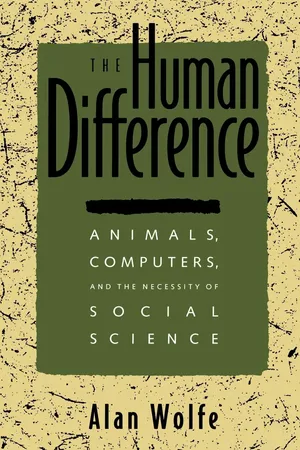
Are we losing touch with our humanity? Yes, contends Alan Wolfe in this provocative critique of modern American intellectual life. From ecology, sociobiology, and artificial intelligence to post-modernism and the social sciences, Wolfe examines the antihumanism underlying many contemporary academic trends. Animal rights theorists and "ecological extremists" too often downplay human capacities. Computers are smarter than we are and will soon replace us as the laws of evolution continue to unfold. Even the humanities, held in sway by imported theories that are explicitly antihumanistic in intention, have little place for human beings. Against this backdrop, Wolfe calls for a return to a moral and humanistic social science, one in which the qualities that distinguish us as a species are given full play.Tracing the development of modern social theory, Wolfe explores the human-centered critical thinking of eighteenth- and nineteenth-century scholars, now eclipsed by post-modern and scientistic theorizing. In the work of Durkheim, Marx, Weber, and Mead, human beings are placed on the center stage, shaping and interpreting the world around them. Sociology in particular emerged as a distinct science because the species it presumed to understand was distinct as well.Recent intellectual trends, in contrast, allow little room for the human difference. Sociobiology underlines the importance of genetics and mathematically governed evolutionary rules while downplaying the unique cognitive abilities of humans. Artificial intelligence heralds the potential superiority of computers to the human mind. Post-modern theorizing focuses on the interpretation of texts in self-referential modes, rejecting humanism in any form. And mainstream social science, using positivist paradigms of human behavior based on the natural sciences, develops narrow and arid models of social life.Wolfe eloquently makes a case for a new commitment to humanistic social science based on a realistic and creative engagement with modern society. A reconstituted social science, acknowledging our ability to interpret the world, will thrive on a recognition of human difference. Nurturing a precious humanism, social science can celebrate and further refine our unique capacity to create morality and meaning for ourselves.
- 264 pages
- English
- PDF
- Available on iOS & Android
eBook - PDF
About this book
Information
Publisher
University of California PressYear
2023Print ISBN
9780520089419
Edition
1eBook ISBN
9780520915619
Table of contents
- Contents
- Preface
- Acknowledgments
- Chapter One. A Distinct Science for a Distinct Species
- Chapter Two. Other Animal Species and Us
- Chapter Three. Mind, Self, Society, and Computer
- Chapter Four. Putting Nature First
- Chapter Five. The Post-modern Void
- Chapter Six. Social Science as a Way of Knowing
- Chapter Seven. Society on Its Own Terms
- Notes
- Bibliography
- Index
Trusted by 375,005 students
Access to over 1.5 million titles for a fair monthly price.
Study more efficiently using our study tools.
Frequently asked questions
Yes, you can cancel anytime from the Subscription tab in your account settings on the Perlego website. Your subscription will stay active until the end of your current billing period. Learn how to cancel your subscription
No, books cannot be downloaded as external files, such as PDFs, for use outside of Perlego. However, you can download books within the Perlego app for offline reading on mobile or tablet. Learn how to download books offline
Perlego offers two plans: Essential and Complete
- Essential is ideal for learners and professionals who enjoy exploring a wide range of subjects. Access the Essential Library with 800,000+ trusted titles and best-sellers across business, personal growth, and the humanities. Includes unlimited reading time and Standard Read Aloud voice.
- Complete: Perfect for advanced learners and researchers needing full, unrestricted access. Unlock 1.5M+ books across hundreds of subjects, including academic and specialized titles. The Complete Plan also includes advanced features like Premium Read Aloud and Research Assistant.
We are an online textbook subscription service, where you can get access to an entire online library for less than the price of a single book per month. With over 1.5 million books across 990+ topics, we’ve got you covered! Learn about our mission
Look out for the read-aloud symbol on your next book to see if you can listen to it. The read-aloud tool reads text aloud for you, highlighting the text as it is being read. You can pause it, speed it up and slow it down. Learn more about Read Aloud
Yes! You can use the Perlego app on both iOS and Android devices to read anytime, anywhere — even offline. Perfect for commutes or when you’re on the go.
Please note we cannot support devices running on iOS 13 and Android 7 or earlier. Learn more about using the app
Please note we cannot support devices running on iOS 13 and Android 7 or earlier. Learn more about using the app
Yes, you can access The Human Difference by Alan Wolfe in PDF and/or ePUB format, as well as other popular books in Social Sciences & Sociology. We have over 1.5 million books available in our catalogue for you to explore.