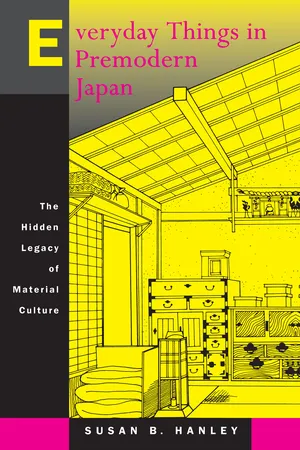
Japan was the only non-Western nation to industrialize before 1900 and its leap into the modern era has stimulated vigorous debates among historians and social scientists. In an innovative discussion that posits the importance of physical well-being as a key indicator of living standards, Susan B. Hanley considers daily life in the three centuries leading up to the modern era in Japan. She concludes that people lived much better than has been previously understood—at levels equal or superior to their Western contemporaries. She goes on to illustrate how this high level of physical well-being had important consequences for Japan's ability to industrialize rapidly and for the comparatively smooth transition to a modern, industrial society. While others have used income levels to conclude that the Japanese household was relatively poor in those centuries, Hanley examines the material culture—food, sanitation, housing, and transportation. How did ordinary people conserve the limited resources available in this small island country? What foods made up the daily diet and how were they prepared? How were human wastes disposed of? How long did people live? Hanley answers all these questions and more in an accessible style and with frequent comparisons with Western lifestyles. Her methods allow for cross-cultural comparisons between Japan and the West as well as Japan and the rest of Asia. They will be useful to anyone interested in the effects of modernization on daily life.
- 230 pages
- English
- PDF
- Available on iOS & Android
eBook - PDF
About this book
Information
Publisher
University of California PressYear
2023Print ISBN
9780520204706
Edition
1eBook ISBN
9780520922679
Table of contents
- Contents
- Illustrations
- Preface
- Note on Transliteration
- CHAPTER ONE. The Level of Physical Well-Being in Tokugawa Japan
- CHAPTER TWO. Housing and Furnishings
- CHAPTER THREE. A Resource-Efficient Culture
- CHAPTER FOUR. A Healthful Lifestyle
- CHAPTER FIVE. Urban Sanitation and Physical Well-Being
- CHAPTER SIX. Demographic Patterns and Well-Being
- CHAPTER SEVEN. Stability in Transition
- CHAPTER EIGHT. Physical Weil-Being
- Glossary
- Index
Trusted by 375,005 students
Access to over 1.5 million titles for a fair monthly price.
Study more efficiently using our study tools.
Frequently asked questions
Yes, you can cancel anytime from the Subscription tab in your account settings on the Perlego website. Your subscription will stay active until the end of your current billing period. Learn how to cancel your subscription
No, books cannot be downloaded as external files, such as PDFs, for use outside of Perlego. However, you can download books within the Perlego app for offline reading on mobile or tablet. Learn how to download books offline
Perlego offers two plans: Essential and Complete
- Essential is ideal for learners and professionals who enjoy exploring a wide range of subjects. Access the Essential Library with 800,000+ trusted titles and best-sellers across business, personal growth, and the humanities. Includes unlimited reading time and Standard Read Aloud voice.
- Complete: Perfect for advanced learners and researchers needing full, unrestricted access. Unlock 1.5M+ books across hundreds of subjects, including academic and specialized titles. The Complete Plan also includes advanced features like Premium Read Aloud and Research Assistant.
We are an online textbook subscription service, where you can get access to an entire online library for less than the price of a single book per month. With over 1.5 million books across 990+ topics, we’ve got you covered! Learn about our mission
Look out for the read-aloud symbol on your next book to see if you can listen to it. The read-aloud tool reads text aloud for you, highlighting the text as it is being read. You can pause it, speed it up and slow it down. Learn more about Read Aloud
Yes! You can use the Perlego app on both iOS and Android devices to read anytime, anywhere — even offline. Perfect for commutes or when you’re on the go.
Please note we cannot support devices running on iOS 13 and Android 7 or earlier. Learn more about using the app
Please note we cannot support devices running on iOS 13 and Android 7 or earlier. Learn more about using the app
Yes, you can access Everyday Things in Premodern Japan by Susan B. Hanley in PDF and/or ePUB format, as well as other popular books in History & Asian History. We have over 1.5 million books available in our catalogue for you to explore.