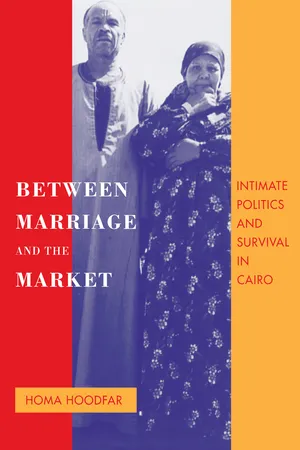
Homa Hoodfar's richly detailed ethnography provides a rare glimpse into the daily life of Arab Muslim families. Focusing on the impact of economic liberalization policies from 1983 to 1993, she shows the crucial role of the household in survival strategies among low-income Egyptians. Hoodfar, an Iranian Muslim by birth, presents research that undermines many of the stereotypes associated with traditional Muslim women. Their apparent conservatism, she says, is based on rational calculation of the costs and benefits of working within formal and informal labor markets to secure household power. She posits that increasing adherence to Islam and taking up the veil on the part of women has been partially motivated by women's desire to protect and promote their interests both within and beyond households.
- 322 pages
- English
- PDF
- Available on iOS & Android
eBook - PDF
About this book
Information
Publisher
University of California PressYear
2023Print ISBN
9780520208254
Edition
1eBook ISBN
9780520918863
Table of contents
- Contents
- Acknowledgments
- Glossary
- Introduction
- CHAPTER I. The Research and Its Social and Physical Setting
- CHAPTER 2. Marriage, Family, and Household
- CHAPTER 3. In Search of Cash
- CHAPTER 4. Women and Employment
- CHAPTER 5. Money Management and Patterns of Household Budgeting
- CHAPTER 6. Nonmonetary Contributions to the Household Pool
- CHAPTER 7. Expenditure and Consumption Patterns
- CHAPTER 8. Social Networks and Informal Associations
- CHAPTER 9. Fertility and Sexual Politics
- CHAPTER 10. Conclusion
- References
- Index
Trusted by 375,005 students
Access to over 1.5 million titles for a fair monthly price.
Study more efficiently using our study tools.
Frequently asked questions
Yes, you can cancel anytime from the Subscription tab in your account settings on the Perlego website. Your subscription will stay active until the end of your current billing period. Learn how to cancel your subscription
No, books cannot be downloaded as external files, such as PDFs, for use outside of Perlego. However, you can download books within the Perlego app for offline reading on mobile or tablet. Learn how to download books offline
Perlego offers two plans: Essential and Complete
- Essential is ideal for learners and professionals who enjoy exploring a wide range of subjects. Access the Essential Library with 800,000+ trusted titles and best-sellers across business, personal growth, and the humanities. Includes unlimited reading time and Standard Read Aloud voice.
- Complete: Perfect for advanced learners and researchers needing full, unrestricted access. Unlock 1.5M+ books across hundreds of subjects, including academic and specialized titles. The Complete Plan also includes advanced features like Premium Read Aloud and Research Assistant.
We are an online textbook subscription service, where you can get access to an entire online library for less than the price of a single book per month. With over 1.5 million books across 990+ topics, we’ve got you covered! Learn about our mission
Look out for the read-aloud symbol on your next book to see if you can listen to it. The read-aloud tool reads text aloud for you, highlighting the text as it is being read. You can pause it, speed it up and slow it down. Learn more about Read Aloud
Yes! You can use the Perlego app on both iOS and Android devices to read anytime, anywhere — even offline. Perfect for commutes or when you’re on the go.
Please note we cannot support devices running on iOS 13 and Android 7 or earlier. Learn more about using the app
Please note we cannot support devices running on iOS 13 and Android 7 or earlier. Learn more about using the app
Yes, you can access Between Marriage and the Market by Homa Hoodfar in PDF and/or ePUB format, as well as other popular books in Social Sciences & Islamic Theology. We have over 1.5 million books available in our catalogue for you to explore.