- English
- ePUB (mobile friendly)
- Available on iOS & Android
eBook - ePub
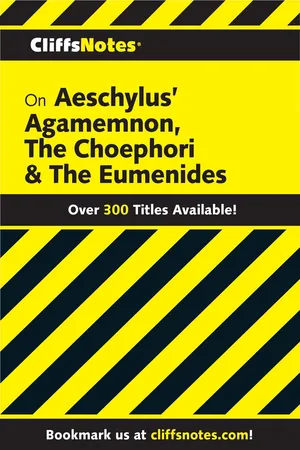
CliffsNotes on Aeschylus' Agamemnon, The Choephori & The Eumenides
Information
Topic
Study AidsSubtopic
Study GuidesAgamemnon: Prologue (Lines 1–39)
Summary
The play opens with a watchman standing on the roof of the palace of Agamemnon at Argos. He explains that Clytaemestra has ordered him to keep a lookout each night for the light from a series of beacon fires that will signal the long-awaited fall of Troy. He has carried out this duty faithfully for several years already and is getting demoralized. Suddenly he observes a beacon burning in the distance and realizes that the war is over. The watchman is excited for a moment by the happy thought that his long vigil is ended and that his king will finally return home, but then a feeling of gloom comes over him. He refuses to state aloud the cause of his foreboding but remarks that the walls of the palace could tell the story if they were able to speak. The watchman determines to remain silent. He will be satisfied to welcome his beloved king home again. He goes out to tell the news to Clytaemestra.
Analysis
The watchman’s speech sets the gloomy, tense mood that will be maintained throughout the play. There is skillful artistry evident in this powerful opening and full use is made of dramatic irony. Moreover, the watchman has been made into a real man instead of a mechanical giver of information. His ambiguous reaction and brooding thoughts are genuine in the circumstances. They immediately arouse the interest of the audience and give added poignancy to his guarded comments.
Agamemnon: Parodos (Lines 40–82)
The Chorus of Argive Elders enter. The old men say that ten years have passed since Agamemnon and his brother Menelaus sailed to Troy with their army. Zeus ordained that a bloody war be fought to avenge the seduction of Helen by Paris. Many men have already suffered and died “for one woman’s promiscuous sake,” and the war still goes on. The elders add that they were too old and weak to serve in the expedition to Troy.
Agamemnon: First Stasimon (Lines 83–269)
Summary
Clytaemestra comes out of the palace. The elders ask why she has ordered sacrifices to be offered at all the altars in the city. Before she is able to answer, they repeat the story of a portent that was observed when Agamemnon and his army left Argos. Two giant eagles attacked and ripped apart a pregnant hare, killing her and her unborn young. Calchas, the soothsayer, claimed that the eagles represented Agamemnon and Menelaus, while the hare was a symbol of Troy; thus the omen was a sign of victory. Calchas added that Artemis, the virgin goddess of hunting, might become angered at Zeus because his eagles had destroyed the hare, her sacred animal. He warned that Artemis might seek vengeance by demanding a sacrifice from Agamemnon. If he refused, she would prevent the Greek fleet from sailing to Troy, in an effort to thwart the will of Zeus.
The elders ponder on the suffering that so often seems to accompany divine intervention in human affairs. The problem is a perplexing one that cannot be solved although it is known that Zeus has ultimate responsibility for all that happens. They conclude, “From the gods who sit in grandeur / grace comes somehow violent.”
Resuming their story, the elders tell how the Greek fleet was unable to sail from Aulis, the assembly place of the expedition, because of adverse winds sent by Artemis. Calchas told Agamemnon that it would be necessary for him to sacrifice his daughter Iphigenia to placate the angry goddess. Agamemnon and the other chieftains were horrified by this advice. Agamemnon was faced by a terrible dilemma, for he had conflicting sacred obligations to his family and his army, and whichever decision he made was bound to be sinful. Finally, “when necessity’s yoke was put upon him,” Agamemnon chose to ignore his feelings as a father. Iphigenia, an innocent maiden, was slaughtered on the altar. The pitiful scene tore the hearts of all who were present. Shortly afterward, the wind changed and the fleet sailed for Troy.
The elders disapprove of Agamemnon’s decision. They say that his mind was warped by lust for power and prestige, and warn that “Justice so moves that those only learn who suffer.” They turn to Clytaemestra and repeat their question, asking the reason for the sacrifices.
Analysis
In Agamemnon, the parodos is followed immediately by the first stasimon; both together constitute one of the longest lyrical passages in all Greek tragedy. The story told by the chorus helps to clarify some of the allusions in the watchman’s speech although the elders seem to have many of the same ambiguous feelings. The choral account of the events before the expedition to Troy is a reminder of the curse on the House of Atreus, for the sacrifice of Iphigenia is an example of how one crime breeds another and provides a history of sinfulness for which Agamemnon must eventually be punished. It is worth noting that Agamemnon freely made the decision to sacrifice his daughter. Fate and the curse circumscribed his choice, but the final responsibility for Iphigenia’s death and his own downfall is his.
The choral passage on Zeus is an attempt to justify the ways of God to man and introduces one of the main philosophical ideas of the trilogy—that wisdom is learned through suffering and that affairs on earth are controlled by the divine will. There are many mysteries that man cannot solve, but God is the source of all things. It is possible that Aeschylus viewed the gods of the Olympian pantheon as symbols of some kind, for here he seems to see one god, “Zeus: whatever he may be,” as the primary moral power in the universe.
Agamemnon: First Episode (Lines 270–366)
Summary
Clytaemestra informs the elders that Troy has fallen. They accept this news doubtfully and ask for proof. She tells them about the system of beacons on hilltops and islands between Troy and Argos that she arranged with Agamemnon and gives a vivid description of how the news reached her.
Clytaemestra gives free rein to her imagination and goes on to describe the situation in the conquered city. She visualizes the Greek army looting and pillaging in the ruins of Troy while the defeated inhabitants mourn. Clytaemestra points out that the voyage home is long and dangerous, and expresses the hope that the Greeks have not committed any sacrilege in Troy that would offend the gods.
Analysis
The first speech of Clytaemestra is particularly appropriate after the story of the sacrifice of Iphigenia, for she is the human embodiment of the bitterness and wrath engendered by the sacrifice and the curse that lies behind it. Clytaemestra is a majestic and powerful woman whose personality dominates the whole tragedy. She is the only character to appear in all three plays of the trilogy. Aeschylus is not too interested in her psychological motivation, however, because his drama is based on the conflict and interplay of important ethical and philosophical principles rather than the emotional development of an individual. His portrayal of Clytaemestra is strikingly human, but he does not explore her thoughts or feelings to any great extent.
In this scene, the strength of Clytaemestra’s character is shown by her ease in convincing the elders that her news is true, and by the “masculine” efficiency with which she arranged the complicated system of beacons. Clytaemestra’s hope that the conquering Greeks will not be guilty of impiety can be read in several ways—it is a conventional expression intended to delude the chorus, but it may also indicate that she hopes nothing will interfere with Agamemnon’s return so that she will not lose her chance for revenge, and that she really does hope the Greeks will offend the gods, for then she will have divine sanction when she kills their leader. Such complex meanings are typical of all Clytaemestra’s main speeches. They emphasize her audacious subtlety, for she is so proud and confident that she is not afraid to hint at her plans, and they also heighten the dramatic irony of many scenes.
Agamemnon: Second Stasimon (Lines 367–480)
Summary
The elders attribute Troy’s fall to the wrath of Zeus. He always punishes mortal impiety and pride, and Paris sinned by violating the sacred obligations of a guest when he kidnapped Helen from Menelaus. But he was repaid, for the dowry that Helen brought to Paris and the Trojans was death. A terrible war took place in which Greeks as well as Trojans suffered. This war has dragged on for many years and the people of Argos are restive. Their sons and husbands are gone. Every ship brings back the ashes of more dead soldiers. All this hardship has been endured for the sake of a worthless woman, but now the Argives are bitter and war-weary. The elders fear that Agamemnon will be punished for inflicting this burden on his people. The gods, they say, take note of those who are responsible for bloodshed and punish them. The only security is to avoid fame and power.
Analysis
The images of this ode foreshadow the death of Agamemnon and the sorrows that will continue to afflict the House of Atreus (for example, the description of Zeus casting the net of destruction over Troy also alludes to how Clytaemestra will trap Agamemnon in a net before killing him). The story of the horrors brought down on Troy because of Paris’ sin is meant to parallel the story of the destructive forces brought into action by Agamemnon’s sacrifice of his daughter. The main point of the ode is that retribution comes to all sinners. This universal moral law applies as well to Agamemnon as it does to Priam and the Trojans although only Troy is used as an example. The stasimon begins as a hymn of joy on the downfall of Troy but ends as a tacit condemnation of Agamemnon and a hint that worse things are still in store.
The portion of the ode beginning “The god of war, money changer of dead bodies” is one of the most famous lyrics written by Aeschylus. It is a simple but moving description of the horrors of war. One critic has said of it, “no greater lyric poetry than this has survived from ancient Greece.”
Agamemnon: Second Episode (Lines 481–685)
Summary
Several days have gone by. The elders chatter excitedly together about the rumors that are spreading through the news-starved city now that everyone knows that the war is over. They begin to doubt Clytaemestra’s information and suspect that she has been guilty of feminine impetuosity in announcing the war’s end.
At this moment, a herald enters bringing definite news that the war is over. Agamemnon and the army have just landed on the beach below the city and he has been sent ahead with the message. The herald tells the elders of his happiness at being home again and describes the hardships that the army endured during the long siege. He gives an unromantic and bitter account of the war, then tells about the destruction of Troy and mentions that the temples of the fallen city were desecrated by the victorious army.
The elders welcome the herald and express joy at his news. They hint that affairs in Argos are in bad order and hope that the returning soldiers will solve the city’s problems, but the herald does not understand what they mean.
Clytaemestra steps forward and mocks the Chorus for having doubted her. She claims to be gratified by Agamemnon’s safe return and gives the herald a message for her husband, welcoming him home and announcing that she will give him a triumphal reception when he enters the city. Clytaemestra adds ironically, “may he find a wife within his house as true / as on the day he left her” and praises her own fidelity to Agamemnon.
After Clytaemestra exits, the herald tells the elders about the fate of Menelaus. The fleet encountered a violent storm on its return voyage. The ships were scattered and many went down during the tempest. In fact, Agamemnon has reached Argos with only one ship of his whole contingent. Menelaus is still missing, but the herald is certain that he will get home safely. He leaves to deliver Clytaemestra’s message to Agamemnon.
Analysis
The herald’s message confirms the fall of Troy, but his offhand admission that the Greek conquerors were guilty of sacrilege heightens the general tension. The elders sense that something is wrong but are reluctant to speak openly because they have just been humiliated by Clyaemestra after the herald’s arrival. Clytaemestra’s message to Agamemnon is filled with double meanings and veiled threats that are comprehensible only to the audience.
The long digression about Menelaus is important because his absence will make it easier for Clytaemestra and Aegisthus to murder Agamemnon and take over the state. It also provides the theme for Proteus, the satyr-play that followed the Oresteia trilogy.
Agamemnon: Third Stasimon (Lines 686–773)
Summary
The chorus chants an ode on Helen and the destruction caused by her beauty. Helen’s very name means “death,” they say, and it is appropriate for one who was responsible for so much devastation. At first the Trojans welcomed her, but they regretted their generosity when the war began. The elders tell a parable to illustrate what happened. Once a man raised a lion cub in his house. In the beginning, it was a source of pleasure for him and his family. Later, when the cub grew up, its destructive instincts became dominant. The lion ravished itself ferociously among the man’s sheep, then attacked the defenseless family. “This thing they raised...
Table of contents
- Title Page
- Contents
- Copyright
- Play Summary
- About Agamemnon, The Choephori, and The Eumenides
- Character List
- Summary and Analysis
- The Oresteia: Introductory Note
- Agamemnon: Prologue (Lines 1–39)
- Agamemnon: Parodos (Lines 40–82)
- Agamemnon: First Stasimon (Lines 83–269)
- Agamemnon: First Episode (Lines 270–366)
- Agamemnon: Second Stasimon (Lines 367–480)
- Agamemnon: Second Episode (Lines 481–685)
- Agamemnon: Third Stasimon (Lines 686–773)
- Agamemnon: Third Episode (Lines 774–965)
- Agamemnon: Fourth Stasimon (Lines 966–1018)
- Agamemnon: Fourth Episode (Lines 1019–1410)
- Agamemnon: Exodos (Lines 1411–1673)
- The Choephori, or The Libation Bearers: Prologue (Lines 1–21)
- The Choephori, or The Libation Bearers: Parodos (Lines 22–82)
- The Choephori, or The Libation Bearers: First Episode (Lines 83–304)
- The Choephori, or The Libation Bearers: First Stasimon (Lines 305–476)
- The Choephori, or The Libation Bearers: Second Episode (Lines 477–582)
- The Choephori, or The Libation Bearers: Second Stasimon (Lines 583–648)
- The Choephori, or The Libation Bearers: Third Episode (Lines 649–778)
- The Choephori, or The Libation Bearers: Third Stasimon (Lines 779–836)
- The Choephori, or The Libation Bearers: Fourth Episode (Lines 837–933)
- The Choephori, or The Libation Bearers: Fourth Stasimon (Lines 934–970)
- The Choephori, or The Libation Bearers: Exodos (Lines 971–1074)
- The Eumenides: Prologue (Lines 1–63)
- The Eumenides: First Episode (Lines 64–142)
- The Eumenides: First Stasimon (Lines 143–178)
- The Eumenides: Second Episode (Lines 179–243)
- The Eumenides: Parodos (Lines 244–275)
- The Eumenides: Second Episode, Continued (Lines 276–306)
- The Eumenides: Second Stasimon (Lines 307–395)
- The Eumenides: Third Episode (Lines 396–489)
- The Eumenides: Third Stasimon (Lines 490–565)
- The Eumenides: Fourth Episode (Lines 566–776)
- The Eumenides: Fourth Stasimon (Lines 777–792)
- The Eumenides: Fifth Episode and Exodos (Lines 793–1047)
- Aeschylus Biography
- Surviving Dramatic Works of Aeschylus
- Critical Essay
- Aristotle on Tragedy
- Study Help
- Quiz
- Essay Questions
Trusted by 375,005 students
Access to over 1.5 million titles for a fair monthly price.
Study more efficiently using our study tools.
Frequently asked questions
Yes, you can cancel anytime from the Subscription tab in your account settings on the Perlego website. Your subscription will stay active until the end of your current billing period. Learn how to cancel your subscription
No, books cannot be downloaded as external files, such as PDFs, for use outside of Perlego. However, you can download books within the Perlego app for offline reading on mobile or tablet. Learn how to download books offline
Perlego offers two plans: Essential and Complete
- Essential is ideal for learners and professionals who enjoy exploring a wide range of subjects. Access the Essential Library with 800,000+ trusted titles and best-sellers across business, personal growth, and the humanities. Includes unlimited reading time and Standard Read Aloud voice.
- Complete: Perfect for advanced learners and researchers needing full, unrestricted access. Unlock 1.5M+ books across hundreds of subjects, including academic and specialized titles. The Complete Plan also includes advanced features like Premium Read Aloud and Research Assistant.
We are an online textbook subscription service, where you can get access to an entire online library for less than the price of a single book per month. With over 1.5 million books across 990+ topics, we’ve got you covered! Learn about our mission
Look out for the read-aloud symbol on your next book to see if you can listen to it. The read-aloud tool reads text aloud for you, highlighting the text as it is being read. You can pause it, speed it up and slow it down. Learn more about Read Aloud
Yes! You can use the Perlego app on both iOS and Android devices to read anytime, anywhere — even offline. Perfect for commutes or when you’re on the go.
Please note we cannot support devices running on iOS 13 and Android 7 or earlier. Learn more about using the app
Please note we cannot support devices running on iOS 13 and Android 7 or earlier. Learn more about using the app
Yes, you can access CliffsNotes on Aeschylus' Agamemnon, The Choephori & The Eumenides by Cliff Notes in PDF and/or ePUB format, as well as other popular books in Study Aids & Study Guides. We have over 1.5 million books available in our catalogue for you to explore.