A sound understanding of public international law is indispensable for any lawyer, whether working in an international or domestic context. It is therefore important that students have a thorough theoretical understanding of international law issues, and are able to apply the relevant international legal rules to a given set of facts, so as to arrive at a legally coherent conclusion. This practical aspect of learning international law is often neglected in favour of more theoretical aspects - which is where this book comes in. The book offers a series of hypothetical practical cases in public international law, including some of its specialised branches, such as international human rights law and international criminal law. It challenges students to practise and familiarise themselves with the methodology and to write solutions to practical international legal questions. The book is in two parts: part one contains practical (exam-like) questions, while part two contains the solutions. The practical questions in part one are organised by subject, such as treaty law or state responsibility. One chapter is dedicated to more complex 'interconnected' cases, where students are asked to tackle problems which span multiple potential cases and topics.
ENDORSEMENT
'An extremely interesting and innovative text that students studying Public International Law should find invaluable.'
Associate Professor Joanne Sellick
Associate Dean for Teaching and Learning, University of Plymouth
eBook - ePub
The Public International Law Study Guide for Students
Exercises and Answers
- 474 pages
- English
- ePUB (mobile friendly)
- Available on iOS & Android
eBook - ePub
The Public International Law Study Guide for Students
Exercises and Answers
About this book
Information
Part I
CASES
Chapter 1
Subjects of Public International Law: States and International Organisations
General plan: how to solve cases relating to subjects of international law
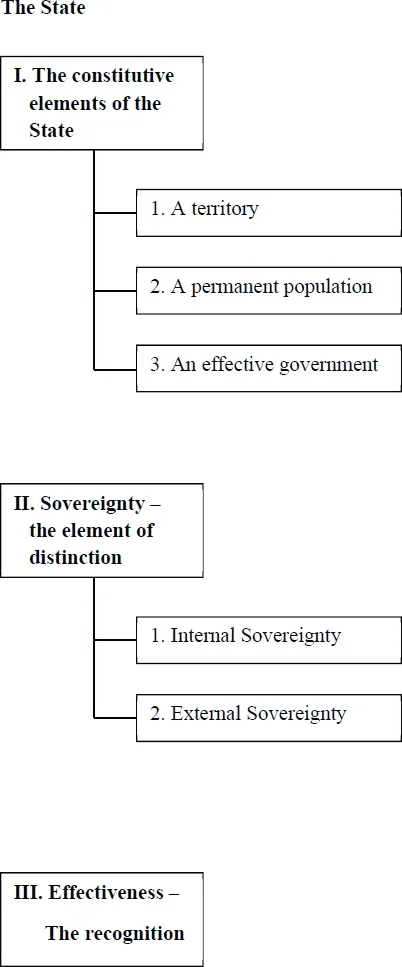
Figure 1. The State.
The International Organisation
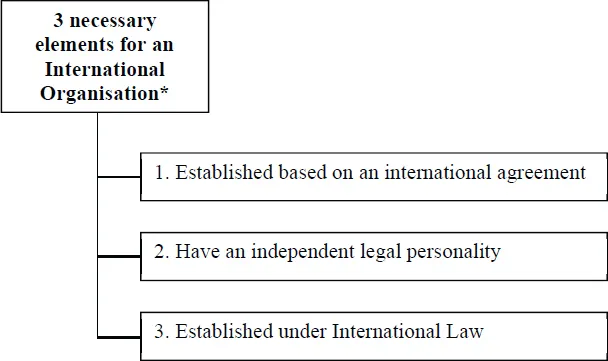
Figure 2. The international organisation.
*Based on the following definitions: ‘The term “international organisation” means a collectivity of States established by treaty, with a constitution and common organs, having a personality distinct from that of its member-States, and being a subject of international law with treaty-making capacity’ (Special Rapporteur G Fitzmaurice, Yearbook of the International Law Commission 1956, Vol II, 108); ‘For the purposes of the present draft articles [ie the draft articles on the Responsibility of International Organisations], the term “international organisation” refers to an organisation established by a treaty or other instrument governed by international law and possessing its own international legal personality. International organisations may include as members, in addition to States, other entities’. (International Law Commission, Report of the 55th session (2003), UN Doc A/58/10, 38). Also see H Schermers and N Blokker, International Institutional Law: Unity within Diversity, 5th edn (Leiden, Martinus Nijhoff Publishers, 2011) 21–36, which establish basically the same three criteria.
The State and its constitutive elements
Case 1.1
The region of Merland is populated by four different peoples: the Alphas, the Betas, the Gammas and the Deltas. Although these peoples have different cultures, religions and ways of life they have been living in perfect harmony for many years.
Until 2000 the State of Oneland was responsible for the administration of the territory of the region of Merland. In May 2000, however, the Council of Merland, composed of the heads of the four peoples, proclaimed the region’s independence. They thereby also decided to take over the tasks previously executed by Oneland. The Council created a series of different institutions to administer the territory of Merland. Among other institutions the Council also created a Parliament where all the four Merlandian peoples are equally represented.
In 2002, the Council of Merland acquired the capacity to carry out almost all administrative tasks on its territory. However, Oneland retained the management of the Merlandian police forces. The latter were essentially composed of policemen from Oneland. At the end of 2003, Merland signed a treaty with Oneland on the withdrawal of the Onelandian police forces. The treaty established, among other things, that the police forces from Oneland would no longer exercise their support function in relation to the police of Merland after 30 April 2004. This was meticulously respected, and from 1 May 2004 onwards, the Council of Merland had its own police forces.
At the same time, during 2003, Merland became a party to several international conventions and signed different bilateral treaties, especially of a commercial nature, with various States. At the end of 2004, the majority of the international community had recognised Merland as an independent State.
Can we say that Merland is a State according to international law? If yes, from when on?
International organisations
Case 1.2
Abbreviation used
IFPO = International Fund for the Protection of Orchids
The International Fund for the Protection of Orchids (IFPO) has been established recently. The founding members are 24 States with large and varied populations of orchids and the Orchid Society—a well-known international organisation. They decided to create the IFPO in order to improve research on but also the protection of various orchid species. To set up the IFPO the founding members concluded an international treaty. The treaty starts by saying: ‘The International Fund for the Protection of Orchids (IFPO) is thereby established. It is open to all States interested in the research and protection of orchids as well as to intergovernmental or scientific organisations active in that field’ (Article 1). Article 3 establishes that the IFPO should be headed by a Director, which, together with the permanent Secretariat set up under Article 4, should be responsible for the good functioning of the IFPO. Article 5 then provides that ‘In performing their tasks attributed to them under the present treaty, the Director as well as the Secretariat shall under no circumstances seek or receive instruction from governments or other organisations or authorities.’ After this, a detailed explanation of the tasks of the IFPO follows. Towards the end, Article 37 declares that the permanent seat of the IFPO was to be Monocot, a city in a particular orchid-rich State. Article 38, just before the final provisions, provides that ‘The IFPO shall have international legal personality as well as the necessary legal capacity to carry out all its functions and realise its purposes wherever it is active.’
Orchid clubs all over the world have welcomed the creation of the IFPO and various specialised newspapers have written long articles about ‘the newest member in the family of international organisations’. However, other journalists have questioned whether the IFPO is really an international organisation, ‘since it is not called an “organisation” but a “fund”, thereby clearly indicating that it was not the intention of the founders to create an international organisation as such’.
You are a well-known specialist in international law. Some journalists approach you and ask you to clarify the debate on whether or not the IFPO is an international organisation under international law.
Case 1.3
Abbreviations used
ODE = Organisation for the Defence of the Environment
TODE = Treaty on the Organisation for the Defence of the Environment
The region of Vertarea is composed of twenty States. These States have always supported very bold environmental policies and have often been precursors concerning the protection of the natural environment.
In 2005, the States of Vertarea met for an international conference. They decided to work together in the noble cause of protecting the natural environment. Therefore, they created the Organisation for the Defence of the Environment (ODE). Established based on a multilateral treaty (the TODE) ratified by all twenty States of Vertarea, the goal of the ODE was to seek common solutions in environmental matters, in clean energy policies, and in the protection of plant and animal species in the region of Vertarea. The ODE had three main organs: the Main Secretariat, the Assembly of State Parties and the Decision-making Council.
After four years of research and development in environmental protection, the ODE decided through its Secretariat to send a certain number of its agents to different States of the international community in order to investigate their respective environmental policies. The goal of these investigations was to show that it was necessary to adopt a common global line in the matter of environmental protection.
One agent, Ecoloboy, was sent to the State of Hydrocarbu, which implemented very opaque energy policies. It was very difficult to collect information on this topic and several local journalists, who subsequently disappeared mysteriously, had only been able to find various parties apparently trading in nuclear waste for large sums of money. In addition, a very powerful nuclear and oil lobby existed in Hydrocarbu, which in fact made up the government of this State. Thus, the arrival of an agent of the ODE was highly unpopular with the government.
After a few days in Hydrocarbu, Ecoloboy was about to discover what was hidden behind the energy policies of this State. However, he was murdered before he was able to contact the Secretariat of the ODE.
Outraged by this crime, the Decision-making Council and the Assembly of State Parties decided to present an international claim against Hycdrocarbu in order to obtain reparations for the damage suffered by the loss of the ODE’s agent Ecoloboy.
Hydrocarbu replied by saying that the ODE was only a small regional association of States and could not be equal to a State. In addition, according to Hydrocarbu, the ODE could not present any claim against Hydrocarbu, since this State was not a member of this organisation.
You are an eminent international lawyer and legal advisor to the Decision-making Council. The Council asks you to write a legal opinion on the following question: ‘Is the ODE entitled to present an international claim against Hydrocarbu in order to obtain reparation for the damages suffered by the organisation?’
Nota bene
— According to Article 87 paragraph 1 of the TODE: ‘The Organisation enjoys full legal personality and has especially the capacity: (i) to contract; (ii) to acquire movable goods and to dispose of them; (iii) to bring claims in justice.’
In order to reply to the question you are only asked to pronounce yourself on the legal personality of the ODE.
Recommended reading on subjects of public international law
Articles
Guido Aquaviva, ‘Subjects of International Law: A Power-Based Analysis’ (2005) 38 Vanderbilt Journal of Transnational Law 345.
Georges Berlia, ‘Admission d’un Etat aux Nations Unies’ (1948) 52 Revue Générale de Droit International Public 481.
Mark Janis, ‘Individuals as Subjects of International Law’, (1984) 17 Cornell International Law Journal 61.
Books
Andrew Clapham, Human Rights Obligations of Non-State Actors (Oxford, Oxford University Press, 2006).
Hent Kalmo and Quentin Skinner (eds), Sovereignty in Fragments: the Past, Present and Future of a Contested Concept (Cambridge, Cambridge University Press, 2010).
Henry Schermers and Nils Blokker, International Institutional Law: Unity Within Diversity, 5th edn (Leiden, Martinus Nijhoff Publishers, 2011).
Chapter 2
Diplomatic Protection
General plan to solve diplomatic protection cases, based on the ILC’s Draft Articles on Diplomatic Protection from 2006

Figure 3. Diplomatic protection.
Case 2.1
Oscar Lai is a national of the State of Saoseo. He was born and has lived most of his life in Saoseo, but after high school he left his home to study at the prestigious national university of the State of Alzasca.
During his studies in Alzasca Oscar becomes politically interested and joins the Green Party of Alzasca as a volunteer. The Green Party organises various demonstrations against the government, especially against their energy and environmental politics. During one of these peaceful protests, the police start to beat and randomly arrest protesters. Oscar Lai is also arrested and put in jail. For several days he is not informed why he is imprisoned, nor does he have the right to make phone calls. On the fourth day, three police officers interrogate Oscar, still without explaining the charges against him. When they find that Oscar is not capable of giving the expected answer, the policemen violently beat him, breaking several of his ribs. After two weeks Oscar is finally released and can contact his family in Saoseo. His family has not been informed about his whereabouts despite repeated requests to the authorities of Alzasca.
A friend of Oscar advises him to start proceedings against Alzasca for his mistreatment and for violations of his human rights. Oscar does this, but the courts in Alzasca, including the High Court, all reject his case for different but equally obscure reasons. Oscar wants to get justice and again on the advice of his friend asks the Embassy of Saoseo in Alzasca whether Saoseo would be ready to exercise diplomatic protection on his behalf.
You are working for the Embassy of Saoseo in Alzasca. The Ambassador, who has never been confronted with a similar case, asks you whether in your opinion Saoseo could exercise diplomatic protection on behalf of Oscar Lai or not.
Nota bene
— Both States are parties to the International Covenant on Civil and Political Rights (ICCPR) as well as to the Convention on Torture and Other Cruel, Inhuman or Degrading Treatment or Punishment (CAT).
Case 2.2
Lily Fenix was born in Behem in 1960. The national law of this State provides that every person born in its territory automatically acquires Behemese nationality. The parents of Lily are originally from Mantiko, a State that transmits its nationality according to the jus sanguinis rule. Therefore, little Lily is a national both of Mantiko and of Behem.
Lily Fenix receives all her education in Behem, but when she is 25 years old she meets Ricardo Dahu from Thoris, whom she marries. When Ricardo moves back to Thoris, Lily follows him in 1986. Lily quickly finds work in a bank in the capital and Ricardo works in a security company. Lily frequently goes back to Behem during her holidays to visit friends and family. Furthermore, she is still executing her civic duties in Behem. Sometimes she also visits more distant aunts and uncles in Mantiko, but since she has never lived there she cannot vote in this country.
After 15 years in Thoris, Lily submits an application to be granted Thorisian nationality. This request is, however, rejected.
In 2006, after having lived in Thoris for 20 years, Ricardo suddenly disappears. Two days later, the Thoris police appear at the house of the couple in order to arrest Ricardo. Finding t...
Table of contents
- Cover
- Title Page
- Contents
- Introduction and General Presentation
- Part I: CASES
- Part II: SUGGESTED SOLUTIONS
- eCopyright
Trusted by 375,005 students
Access to over 1.5 million titles for a fair monthly price.
Study more efficiently using our study tools.
Frequently asked questions
Yes, you can cancel anytime from the Subscription tab in your account settings on the Perlego website. Your subscription will stay active until the end of your current billing period. Learn how to cancel your subscription
No, books cannot be downloaded as external files, such as PDFs, for use outside of Perlego. However, you can download books within the Perlego app for offline reading on mobile or tablet. Learn how to download books offline
Perlego offers two plans: Essential and Complete
- Essential is ideal for learners and professionals who enjoy exploring a wide range of subjects. Access the Essential Library with 800,000+ trusted titles and best-sellers across business, personal growth, and the humanities. Includes unlimited reading time and Standard Read Aloud voice.
- Complete: Perfect for advanced learners and researchers needing full, unrestricted access. Unlock 1.5M+ books across hundreds of subjects, including academic and specialized titles. The Complete Plan also includes advanced features like Premium Read Aloud and Research Assistant.
We are an online textbook subscription service, where you can get access to an entire online library for less than the price of a single book per month. With over 1.5 million books across 990+ topics, we’ve got you covered! Learn about our mission
Look out for the read-aloud symbol on your next book to see if you can listen to it. The read-aloud tool reads text aloud for you, highlighting the text as it is being read. You can pause it, speed it up and slow it down. Learn more about Read Aloud
Yes! You can use the Perlego app on both iOS and Android devices to read anytime, anywhere — even offline. Perfect for commutes or when you’re on the go.
Please note we cannot support devices running on iOS 13 and Android 7 or earlier. Learn more about using the app
Please note we cannot support devices running on iOS 13 and Android 7 or earlier. Learn more about using the app
Yes, you can access The Public International Law Study Guide for Students by Cristina Verones,Sébastien Rosselet in PDF and/or ePUB format, as well as other popular books in Law & International Law. We have over 1.5 million books available in our catalogue for you to explore.