This is the fifth edition of the leading work on transnational and comparative commercial and financial law, covering a wide range of complex topics in the modern law of international commerce, finance and trade. As a guide for students and practitioners it has proven to be unrivalled. Since the fourth edition, the work has been divided into three volumes, each of which can be used independently or as part of the complete work.
Volume one covers the roots and foundations of private law; the different orientations and structure of civil and common law; the concept, forces, and theoretical basis of the transnationalisation of the law in the professional sphere; the autonomous sources of the new law merchant or modern lex mercatoria, its largely finance-driven impulses; and its relationship to domestic public policy and public order requirements.
Volume two deals with transnational contract, movable and intangible property law.
Volume three deals with financial products and financial services, with the structure and operation of modern commercial and investment banks, and with financial risk, stability and regulation, including the fall-out from the recent financial crisis and regulatory responses in the US and Europe.
All three volumes may be purchased separately or as a single set.
From the reviews of previous editions:
"...synthesizes and integrates diverse bodies of law into a coherent and accessible account...remarkable in its scope and depth. It stands alone in its field not only due to its comprehensive coverage, but also its original methodology. Although it appears to be a weighty tome, in fact, in light of its scope, it is very concise. While providing a wealth of intensely practical information, its heart is highly conceptual and very ambitious...likely to become a classic text in its field."
American Journal of Comparative Law
"Dalhuisen's style is relaxed...what he writes convinces without the need for an excess of references to sources...a highly valuable contribution to the legal literature. It adopts a useful, modern approach to teaching the young generation of lawyers how to deal with the increasing internationalisation of law. It is also helpful to the practising lawyer and to legislators."
Uniform Law Review/Revue de Droit Uniforme
"this is a big book, with big themes and an author with the necessary experience to back them up. ... Full of insights as to the theories that underlie the rules governing contract, property and security, it is an important contribution to the law of international commerce and finance."
Law Quarterly Review
"...presents a very different case: that of a civilized and cultivated cosmopolitan legal scholar, with a keen sense of international commercial and financial practice, with an in-depth grounding in both comparative legal history and comparative law, combined with the ability to transcend conventional English black-letter law description with critical judgment towards institutional wisdom and intellectual fashions. ...a wide-ranging, historically and comparatively very deep and comprehensive commentary, but which is also very contemporary and forward-looking on many or most of the issues relevant in modern transnational commercial, contract and financial transactions..."
International and Comparative Law Quarterly
This title is included in Bloomsbury Professional's International Arbitration online service.
eBook - ePub
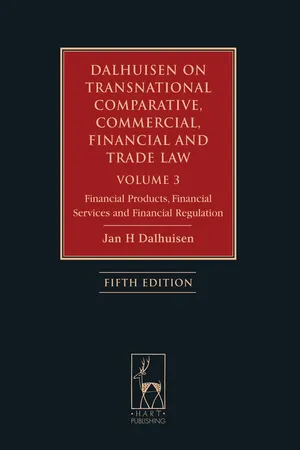
Dalhuisen on Transnational Comparative, Commercial, Financial and Trade Law Volume 3
Financial Products, Financial Services and Financial Regulation
- 814 pages
- English
- ePUB (mobile friendly)
- Available on iOS & Android
eBook - ePub
Dalhuisen on Transnational Comparative, Commercial, Financial and Trade Law Volume 3
Financial Products, Financial Services and Financial Regulation
About this book
Information
1 Financial Products and Services
Part I Secured Transactions, Finance Sales and Other Financial Products and Services
1.1 Civil and Common Law Approaches. Credit Cultures and Transnationalisation
1.1.1Introduction
It should be evident from what has been said in the previous two volumes that the evolution of modern commercial law is now largely finance- rather than trade- or mercantile-driven. Much of what was said earlier on contract and property law in respect of movable assets, including intangible monetary claims, serves in this connection as a basis for the discussion of the contractual and especially proprietary or preferential (or bankruptcy-resistant—in German, Insolvenzfestigkeit) aspects of modern financial products and facilities, their creation, transfer, and effect or protection, especially in an insolvency of the counterparty.
The combination of contract and property poses in particular the issue of party autonomy in proprietary matters in finance, conceivably allowing new types of funding to arise, especially through finance sales and the use of future cashflows, but it raises no less the question of the status of contractual netting clauses and their effect in terms of bankruptcy protection or resistance of the netting principle and the preferences it creates for capital providers as we shall see. It was said before that the equitable proprietary rights as developed in common law countries serve here best as an example for greater flexibility. They allow indeed for a larger measure of party autonomy in these matters, subject, in so far as charges in assets so being created are concerned, to the protection of bona fide purchasers or now even purchasers in the ordinary course of business of commoditised products. In this manner, private parties may be able to create all kinds of collateral backing for indebtedness in what may be called asset-backed financing, leading to priorities in execution. Party autonomy of this nature becomes, in truth, a major risk-management tool but is not allowed to affect the normal commercial flows and the liquidity of the assets operating therein. Floating charges are in common law countries the prime example of this possibility; finance sales are another as we shall see, but the essence is that, whatever parties may agree in this connection, the commercial flows are always protected against these types of charges (whether in movable or even immovable property or in intangible claims, such as receivables). In common law terms, these charges are equitable and only have this limited reach,1 which means that they are only effective against professional insiders such as other banks and suppliers. The protection of the ordinary commercial flows is considered here the higher interest, and a matter of public order. Charges of this nature operate therefore only amongst professional parties who have a search duty. They do not then affect outsiders, therefore the public, who may ignore them and have no investigation duty either, even if there is a register or other form of filing: see more particularly the discussion in Volume II, chapter 2, section 1.10.
In the area of set-off and netting, we face similar issues although they may be differently resolved. It should first be understood that the set-off itself implies an important preference in an insolvency of the counterparty, in the sense that a creditor is protected in this manner to the extent it owes the bankrupt something too. Thus mutual claims are offset with the result that the non-bankrupt party will only be a creditor for the difference (if any), which means that its exposure in bankruptcy may be much reduced. This type of set-off is normally limited to mutual mature claims in the same currency, but by contract, thus as a matter of party autonomy, it may be possible in many legal systems to extend the set-off to immature and other claims (eg in other currencies or even to the delivery of other assets like investment securities in repos) whilst including valuation clauses in such contracts. These are called netting agreements particularly important as risk-management tools in the swap and repo markets as we shall see. Again, it is a form of party autonomy through which extra protection is created. It should be realised, however, that here, bona fide interested parties are not or no longer much protected. In this instance, they are the other creditors. As we shall see below in section 1.1.10, the tendency is indeed better to protect bona fide purchasers (or purchasers in the ordinary course of business of commoditised products), but bona fide creditors are increasingly losing out as a result of newer financial products or structures. This is ultimately also a matter of public order as will be shown below, motivated by the needs of better modern risk management in banks.
Newer insights and ways of dealing thus affect the creation, status and operation of financial instruments or products such as floating charges directed towards the use of future cash-flows as security, and finance (or conditional/temporary) sales, but then also of repos and finance leases, derivatives, securitisations and credit derivatives, and no less of (electronic) payments, set-off and netting mechanisms. It is the characterisation of these newer products and facilities into law (local or preferably transnational law as we shall see), their status in bankruptcy which remains local (and poses in international cases the question of proper bankruptcy jurisdiction), and thus in particular the legal risk concerning modern financial products or techniques, that will concern us in this chapter. In international finance, the ultimate issue is here indeed transnationalisation, which is likely to be pragmatic favouring in the above forms of party autonomy to operate. Again, for the practical aspects and details, it is posited that the approach in equity in common law countries is then often the better guide and analogy as was more fully covered in Volume II, chapter 2.
In this connection, important other trends have also already been identified. First, the law in this area is professional law as most clearly borne out in the USA by the Uniform Commercial Code (UCC).2 It is best, therefore, to clearly separate the discussion from consumer issues (important as they may be, also in finance). Another aspect of these modern developments, driven by modern finance, is that the proprietary regime, meant to provide security or similar support for financiers in a bankruptcy of the party seeking funding, is becoming increasingly product-specific. This was also highlighted in Volume II, chapter 2. In this connection, it is quite possible, and is in fact the American approach, to maintain different proprietary notions and concepts according to product.3 The increasing impact of party autonomy or financial structuring manifests itself here also. The common law is by its very nature much less interested in systemic limitations and system thinking in that sense. This was also identified as a special feature of modern transnational professional law—see Volume I, section 1.1.4 and Volume II, sections 1.3.8 and 1.10, and it will be further examined in part II below.
Yet another important aspect in these modern trends in international finance is that in respect of professional creditors and their rights, it is necessary not to confuse the discussion with issues concerning the protection of common creditors. This discussion is also quite separate from the protection of bona fide creditors of all types which is traditionally often connected with the concept of the debtor’s appearance of creditworthiness, as we shall see later, but now receding in importance. As far as common creditors are concerned, they are here often taken to be consumer or smaller creditors, raising their own special protection concerns, but in this connection it should be realised first that in practice the most important common creditors are not small trading parties but rather large banks or professional suppliers who remain unsecured in much of their lending or credit-providing functions (because this may give a higher yield for banks, or debtors may not have enough valuable security available). In a bankruptcy, they usually get nothing or at best a small percentage. That is their risk and was always so.4 Thus, although the common creditors’ interests are now often considered special public concern, notably in the bankruptcy of a counterparty (where it translates into greater protection of the paritas or par conditio creditorum), it may be questioned whether, as a general proposition, that is correct. Contrary to what is often still thought in civil law analysis, no major public order issue or fundamental principle appears to be at stake here, at least not in respect of the largest creditors of this nature. One consideration is here indeed that, since in practice and statistically common creditors get very little in a bankruptcy and have accepted that, it is better to put the emphasis on proper risk management instead and therefore on a system of priorities and established preferences, even allowing their variation through a substantial degree of party autonomy.
In fact, it is a serious misconception to think that bankruptcy is about equality of creditors. It is often repeated but was never true; it was always about ranking. Bankruptcy distribution was never equal (except per class) but (in common law terminology) it is equitable, and what is equitable in this respect has mostly become a matter of statutory definition in national bankruptcy laws, and therefore a matter of public policy, not in terms of equality, therefore, but rather in terms of defining the different rights of separation/repossession or the segregation possibilities and for the rest the different priorities or preferences in the context of distribution, reinforced by modern set-off and netting concepts or facilities. That even applies to bankruptcy reorganisations (and the concessions that are to be made by various creditors in that context). It is possible that as a consequence of the foregoing, bankruptcy will play out quite differently amongst professionals, particularly in their financial dealings, especially if they benefit from forms of party autonomy in rearranging their risks in the manner just described. Indeed, it is now not uncommon for bankruptcy statutes to give way to special needs in this connection, especially in the area of set-off and netting. The various amendments to the US Bankruptcy Code, notably in these areas, further testify to this, as did the EU Settlement Finality Directive and Collateral Directive in Europe.
These facilities and notably the increasing role of party autonomy in this context were previously mentioned in Volume I, section 1.1.4 and in Volume II, chapter 2, section 1.10. They are at the heart of legal flexibility in the area of modern financial products and facilities. Party autonomy therefore also provides greater sensibility in international finance, it is submitted, when international pools or classes of assets located in different countries are used as asset backing or claims in different countries must be set off. It would allow for the use of international cashflows, originating in different countries to back up modern financing. Indeed party autonomy as one of the sources of the modern lex mercatoria is itself an important tool in the transnationalisation of the law concerning these facilities as will be shown throughout. These tendencies now break through although this development is only in its infancy, at least in civil law countries. It challenges in particular the traditional numerus clausus notion of proprietary rights (always subject to better protection of the commercial flows against these charges) and more limited notions of set-off and netting, at the same time as redefining the notion of paritas creditorum. In terms of international market practice or custom it may increasingly have significant consequences in modern bankruptcy. Even if bankruptcy itself remains a matter of domestic law, it cannot ignore the international market place nor should it frustrate greater party autonomy for professionals to manage their risk at the international level. This is the area of the modern lex mercatoria, as just mentioned, and of its sources and hierarchy, as were extensively discussed in Volume I.
We may first see the consequences in floating charges concerning pools of assets in different jurisdictions (see s 2.2 below), which facility entails in civil law thinking a significant departure from established general proprietary notions and their limitations in terms of identification, specificity, existence, disposition rights, the inclusion of future goods, and the shifting of the interest into replacement assets. In truth it concerns the use of future cashflows subject to a simple description of what they are. A similar transforming force as far as civil law is concerned happens in finance sales (see s 2.1.2 below), which has a particular bearing on finance leases, repos and forms of receivable financing. Here forms of conditional and temporary ownership operate breaking through the civil law idea of a numerus clausus of proprietary rights (again subject to the protection of the ordinary commercial flows). But we see the consequences no less in the law of assignments for financial purposes, as in receivable financing and in securitisations (see s 2.2.4 below), where bulk assignments of future claims become necessary and consequently individual notice requirements are increasingly abandoned (in countries like France and the Netherlands, which still had them), whilst many other aspects of assignment now also need reconsideration: see earlier Volume II, chapter 1, section 1.5. Finally, new thinking is also apparent in the area of payments, set-off and netting facilities and in the types of investment securities (shares and bonds) and their holding through security accounts and their transfer in modern book-entry systems, discussed in Volume II, chapter 2, part III, which in many respect resembles payment through the banking system. They will be further discussed in sections 3.1 and 3.2 below.
In fact, these various modern financial products or facilities, and the way they operate even domestically are becoming increasingly disconnected from the general (domestic) systems of (proprietary) law, long so, even domestically, in common law jurisdictions like the US but pragmatically ever more so also in civil law countries like France through a multitude of incidental statutory amendments geared towards special products like repos and securitisations. It has already been said that their status in a bankruptcy, especially of a party needing funding, is then another major focus and potentially acquires an altogether different dimension at the international or rather transnational level. To repeat, equity—a facility civil law never had and where as a consequence the greatest differences between civil and common law may be found—is more important here than typical notions of commercial law, which never developed that far, not even in common law countries such as England. It is demonstrable that especially in transnational commercial and financial law and practice, these notions and interests increasingly assert themselves and are then borrowed predominantly from the equity tradition in common law countries. In Volume I, section 1.1.4, it has already been said that these developments and the dynamics they bring to movable property law are moving to the centre of the transnationalisation of the law amongst professionals, particularly important in their financial dealings. Here, traditional references to the lex situs of the assets (if at all identifiable if they are moving or intangible) as the applicable (domestic) law of these structures become increasingly redundant or unmanageable as we shall see.
1.1.2Financial Products in Commercial Banking and Capital Markets
In the previous section reference was made to several financial structures. Financial products of this nature typically emerge in the commercial banking industry or in the capital markets. These are the two environments in which capital is recycled from savers or capital providers to those who are in need of ...
Table of contents
- Cover
- Title Page
- Contents
- Table of Cases
- Table of Legislation
- Chapter 1: Financial Products and Services
- Chapter 2: Financial Risk, Financial Stability and the Role of Financial Regulation
- eCopyright
Trusted by 375,005 students
Access to over 1.5 million titles for a fair monthly price.
Study more efficiently using our study tools.
Frequently asked questions
Yes, you can cancel anytime from the Subscription tab in your account settings on the Perlego website. Your subscription will stay active until the end of your current billing period. Learn how to cancel your subscription
No, books cannot be downloaded as external files, such as PDFs, for use outside of Perlego. However, you can download books within the Perlego app for offline reading on mobile or tablet. Learn how to download books offline
Perlego offers two plans: Essential and Complete
- Essential is ideal for learners and professionals who enjoy exploring a wide range of subjects. Access the Essential Library with 800,000+ trusted titles and best-sellers across business, personal growth, and the humanities. Includes unlimited reading time and Standard Read Aloud voice.
- Complete: Perfect for advanced learners and researchers needing full, unrestricted access. Unlock 1.5M+ books across hundreds of subjects, including academic and specialized titles. The Complete Plan also includes advanced features like Premium Read Aloud and Research Assistant.
We are an online textbook subscription service, where you can get access to an entire online library for less than the price of a single book per month. With over 1.5 million books across 990+ topics, we’ve got you covered! Learn about our mission
Look out for the read-aloud symbol on your next book to see if you can listen to it. The read-aloud tool reads text aloud for you, highlighting the text as it is being read. You can pause it, speed it up and slow it down. Learn more about Read Aloud
Yes! You can use the Perlego app on both iOS and Android devices to read anytime, anywhere — even offline. Perfect for commutes or when you’re on the go.
Please note we cannot support devices running on iOS 13 and Android 7 or earlier. Learn more about using the app
Please note we cannot support devices running on iOS 13 and Android 7 or earlier. Learn more about using the app
Yes, you can access Dalhuisen on Transnational Comparative, Commercial, Financial and Trade Law Volume 3 by Jan H Dalhuisen in PDF and/or ePUB format, as well as other popular books in Law & International Trade Law. We have over 1.5 million books available in our catalogue for you to explore.