This casebook presents a deep comparative analysis of property law systems in Europe (ie the law of immovables, movables and claims), offering signposts and stepping stones for the reader wishing to explore this fascinating area. The subject matter is explained with careful attention given to its history, foundations, thought-patterns, underlying principles and basic concepts. The casebook focuses on uncovering differences and similarities between Europe's major legal systems: French, German, Dutch and English law are examined, while Austrian and Belgian law are also touched upon. The book combines excerpts from primary source materials (case law and legislation) and from doctrine and soft law. In doing so it presents a faithful picture of the systems concerned. Separate chapters deal with the various types of property rights, their creation, transfer and destruction, with security rights (such as mortgages, pledges, retention of title) as well as with harmonising and unifying efforts at the EU and global level. Through the functional approach taken by the Ius Commune Casebooks this volume clearly demonstrates that traditional comparative insights no longer hold. The law of property used to be regarded as a product of historical developments and political ideology, which were considered to be almost set in stone and assumed to render any substantial form of harmonisation or approximation very unlikely. Even experienced comparative lawyers considered the divide between common law and civil law to be so deep that no common ground - so it was thought - could be found. However economic integration, in particular integration of financial markets and freedom of establishment, has led to the integration of particular areas of property law such as mortgage law and enforceable security instruments (eg retention of title). This pressure towards integration has led comparative lawyers to refocus their interest from contract, tort and unjustified enrichment to property law and delve beneath its surface. This book reveals that today property law systems are closer to one another than previously assumed, that common ground can be found and that differences can be analysed in a new light to enable comparison and further the development of property law in Europe.
eBook - ePub
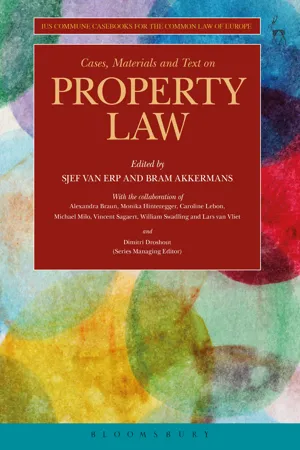
Cases, Materials and Text on Property Law
- 1,252 pages
- English
- ePUB (mobile friendly)
- Available on iOS & Android
eBook - ePub
Cases, Materials and Text on Property Law
About this book
Information
CHAPTER ONE
GENERAL ISSUES: SETTING THE SCENE
Sjef van Erp*
I. Introductory remarks
I.A What is ‘property’ law?
I.B Terminology and the use of English
I.C The nature of property rights
II. Importance of understanding the history of property law
II.A The French Revolution
II.B Abolishing the feudal system does not always mean abolishing feudal concepts
II.C A fragmented or a unified system of property law?
III. Numerus clausus
III.A Numerus clausus in theory
III.B Limitations on party autonomy
III.C Legal provisions on numerus clausus
III.D Is the list of property rights really closed?
IV. Transparency: specificity and publicity
V. Ground rules
This chapter deals with the first of the six leading essential questions: what is property law? In doing so, it deals with several complicated matters. When we study the law of property, especially from a comparative perspective, a considerable divergence between legal systems can be found. However, there are also many similarities. This chapter seeks to explain what is property law and to raise awareness of the most important pitfalls when comparing property law systems, such as the use of English terminology to describe non-English legal systems. Finally, the chapter provides a framework for analysis of property law systems by introducing the fundamental principles of numerus clausus and transparency, as well as some ground rules that are present in all property law systems.
I. INTRODUCTORY REMARKS
Property law is the law that deals with entitlements to property. Property in this sense means an object such as a car or a table, but also land and buildings such as houses constructed on that land. Moreover, it also concerns intangible or incorporeal ‘objects’ such as intellectual property and rights to performance by another party arising from a contract (claims). In general, there is always demand for these objects, creating what economists refer to as scarcity of resources. Because of this scarcity, there are rules on the entitlement to these objects individuals may hold and on how these entitlements are created, transferred and destroyed.
Moreover, these entitlements, or better, rights to objects, are different from other rights as they are created in respect to an object and not vis-à-vis specific other persons. Property rights, to put it differently, have effect against third parties by their nature. Personal rights, which are rights arising from a contract, and even though they also concern an object (the ‘performance’ of that contract), are generally only binding between two or more specific parties. This is something that is shared universally between systems of property law.
However, the answer to the question as to what precisely is included in property law differs from country to country, or better from legal system to legal system. Property lawyers hold that because of their different historical orgins and development, legal systems have chosen different routes and have ended up with different results. The outcome is that, unlike other areas of private law, such as contract law, there are more pronounced differences between systems of property law.
This casebook focuses on German, French, Dutch and English law. We will soon discover that even though many similarities exist between these four systems, there are also many differences. Occasionally we will take an excursion into other legal systems, such as Austrian, Belgian, Scots and US law, which will complicate the picture even further.
Property lawyers traditionally use an historical approach to illustrate how a certain system of property law came about and how it has developed over time. This casebook certainly adheres to this method of explanation. Increasingly, however, there are also other areas, such as law and economics, that seek to offer explanations of what constitutes property law and how differences between property law systems have come about.1
This chapter will first introduce the question of what is property law (I.A), but will also offer insights into the complications created by using English terminology (I.B) and by using the concept of a property right (I.C). Furthermore, this chapter will deal with the importance of understanding the historical development of property law, especially in the light of modern developments (II).
Most important of all, this chapter will offer a framework for analysis of property law systems that can be used to describe and explain all the systems of property law dealt with in this casebook.2 This framework consists of two fundamental principles of property law. The principle of numerus clausus which limits the number and content of property rights that are available in a property law system (III), and the principle of transparency, which ensures that third parties can determine which person(s) hold a property right and as to which object(s) a property right is held (IV). Besides these fundamental principles (III and IV), the framework contains a set of four ground rules, which are also present in all property law systems dealt with. These are discussed in the final section of this chapter (V).
I.A WHAT IS ‘PROPERTY’ LAW?
In this casebook property law is used in a very wide sense: it concerns rights that a person has against a considerable group of other persons concerning an object. Property law includes land law, the law of personal property, and the law relating to claims, trust law and the law on security rights. All of these terms, as well as their corresponding legal areas, will be more fully explained in the following chapters of this casebook.
In English law the term ‘property law’ still frequently only refers to land law. In continental European legal systems, property law sometimes covers land law as well as personal property law, but not the law relating to claims, whereas in some civil law systems it does cover claims. In English law, property and trust are intimately connected, but as the continental legal systems do not know the so-called ‘common law trust’, trust law in the English legal sense of the word is unknown in the civil law. In general, the law on security rights is everywhere considered to be a part of property law.
Traditionally, land has always been an object of property law, later also movables and sometimes claims. However, ‘new’ forms of property are also being discussed: entitlements to social security benefits, the right to an unpolluted environment, the right to ‘roam’ in forests and fields, public law licenses (eg emission rights) and ‘virtual’ property (eg e-mail accounts, objects in virtual worlds).
I.A.1 CLASSIC APPROACHES
KH Schwab and H Prütting, Property Law—Physical Things as Objects of Property Law3
1.1 (DE)
1. The concept of an object is the essential foundation of property law, which is defined in §90 as a physical thing. With this the law considers the concept of a thing to be an overarching notion which encompasses the (corporeal) objects and (incorporeal) rights. Finally, in addition to individual things sometimes also unities of objects (Sachgesamtheiten) or even an entire patrimony can be subject to legal regulations … All of these notions are covered by the overarching concept of ‘legal subject’ (Rechtssubjekt). The concept of an object is therefore primarily determined by its ‘physicality’ feature. Here, it is not the physical state (solid, liquid, gas) that is important. In the negative sense, the concept of an object is limited in the meaning that everything that is an individual or his right is not an object. There are some boundary issues (after natural consideration) regarding incorporeal objects. For instance, electric energy is not considered an object, … On the other hand it is possible for a computer program (that is, the software) to be an object, if it is saved on a data carrier. …
3. Animals were always treated as objects in the German Civil Code (BGB). Since 1.9.1990 they have been withdrawn from the concept of objects in property law, but remain legal objects (Rechtsobjekte), ie they cannot be bearers of rights and obligations (as can legal subjects). Ultimately they are treated in accordance with the rules on moveables (§90a).
4. The human body of a living person is not an object. By contrast, parts of the human body that are separated from a living body (for example cut off hair, donated blood, transplanted organs) are objects. Once separated they are owned, analogous to §953, by the ‘donor’. A controversial question is to what extent a human corpse can be considered an object. One will have to answer in the affirmative. The (continuing) deceased’s right to individuality (Persönlichkeitsrecht) and the power of decision of the next of kin (which does not have to coincide with that of the heirs) lead, however, to the fact that a human corpse is not marketable, and cannot be sold nor transferred. …
5. Objects for public use, such as public roads, streets or the beach are commonly owned by public sector bodies. They can, however, also be privately owned as well as transferred and burdened by private law means. Private ownership of these objects can however be superimposed and limited by public law competence.
Ch Atias, Private Law. Property Law—Patrimony4
1.2 (FR)
The first feature of the composition of a patrimony is that it is limited to economic values. As diverse as these values might be, all patrimonial components share the possibility of being converted into money. The elements belonging to a patrimony, especially its active side display complementary characteristics, both individually and cumulatively. They have a pecuniary value. They can be taken from their owner in order to be transferred inter vivos, which means they can be sold or donated. Consequently, they can be seized by the unpaid creditor who will recover the debt by the sale of the object. Finally, upon the death of the owner, they pass to his heirs: they are transmissible mortis causa. In the analysis of patrimony, one must forget any personal implications. All the rights which cannot be converted into money thus escape the patrimony, and the same is true for all values which are too intimately linked to the person to be able to participate in the economic traffic. Political rights of the citizen, as well as personal rights (honor, name, affection …), are extra-patrimonial. The patrimonial and extra-patrimonial categories seem to be divided in opposition. In reality, intermediary categories are far from being excluded: there are ‘possible degrees of patrimony’. For instance, physical integrity tends to become a patrimonial value when its violation can be compensated or repaired by the allocation of a sum of money. …
The second feature of the composition of the patrimony is that it is as general as possible. A patrimony combines all rights and all obligations of any one person. A patrimony cannot be defined and its content cannot be identified without reference to its owner. On the active side, one must add, without any exclusion, all rights, whatever their nature or purpose. The generality of the existing assets of a person are included in his patrimony. Because the patrimony is the pecuniary representation of a person, and not of his fortune upon a given moment, the active part of the patrimony is extended to all future assets. That which will not belong to the owner until a later time, already has a certain presence in his patrimony. This composition is never legally non-existent: better yet, it cannot be accurately evaluated.
From the perspective of its passive side, the patrimony presents the same general feature: it comprises all the debs of its owner. All of the latter must be placed next to his assets. Debts are patrimonial, whatever their object may be, some can consist of money, but there are also obligations to procuring a thing or a service. The debt appears in the patrimony of the debtor when it has arisen: it is sufficient, for instance, that the seller and the buyer agree over the thing and the price. In that moment, the payment obligation is created and it gives rights to the creditor. It is present in the patrimony of the buyer, even if it is not yet due, because a delay has been granted for payment (debt to be performed after a specific time period), even if it is not yet certain, because the existence of the contract is conditioned by the occurrence of an event (conditional debt), and even if it is not yet liquid, which is to say not yet valued or convertible.
Ch Atias, Private Law. Property Law—Movables, Going Concern as Object of Property Law5
1.3 (FR)
Tangible movable things generally have a legal regime that is less precise and developed than that of immovable things. The free circulation of movable things has only been maintained because of legislative and doctrinal discretion. These goods are only seized by law in the moment when they become objects of contracts (sale, rent, …) or more generally of transfer; it is still the common contractual law that applies. Consumer protection policy has only led to the creation of several special rules. Above all, the principles governing tangible movable goods can seem inconsistent by any analysis. There are no common aspects as to the legal provisions governing instruments for work, household property, vehicles, weapons, boats and ships, aircraft, medicines. The difficulties left to be resolved share a certain connection. This is user safety, the security of the purchasers of rights over these goods, the fight against theft, fiscal controls. …
The fonds de commerce can be defined as the intangible movable thing created by the reunion of the necessary elements of attraction and conservation of a commercial clientele in the patrimony of the commercial owner. This context recognizes in fonds de commerce a type of existence which is similar to that granted to all things governed by law. For this reason, authors generally blame the French legistator: for a long, very long time, it has demonstrated blindness or unrealism, since the first laws relating to the fonds date from the XXth century, although the fonds existed well before.
C Lebon, The Proprietary Nature of Claims6
1.4 (BE)
In classical doctrinal legal thinking personal rights are given (a usually undifferentiated) relative character, whereas property rights are considered to be of an absolute nature. The distinction between property rights and personal rights is, therefore, that personal rights do not bind every other person (they are not effective erga omn...
Table of contents
- Cover
- Title
- Copyright
- Acknowledgements
- Preface
- Contents
- Table of Cases
- Table of Legislation
- Introduction Essential Directions on Using the Casebook
- Chapter One: General Issues: Setting the Scene
- Chapter Two: the Protection of Property Rights
- Chapter Three: Types of Property Rights—Immovables and Movables (Goods)
- Chapter Four: Property Rights in Respect of Claims
- Chapter Five: Security Interests
- Chapter Six: Management: Trust, Treuhand and Fiducie
- Chapter Seven: Creation
- Chapter Eight: Transfer
- Chapter Nine: Destruction
- Chapter Ten: Uniform or Harmonised Property Law
- Index
Trusted by 375,005 students
Access to over 1.5 million titles for a fair monthly price.
Study more efficiently using our study tools.
Frequently asked questions
Yes, you can cancel anytime from the Subscription tab in your account settings on the Perlego website. Your subscription will stay active until the end of your current billing period. Learn how to cancel your subscription
No, books cannot be downloaded as external files, such as PDFs, for use outside of Perlego. However, you can download books within the Perlego app for offline reading on mobile or tablet. Learn how to download books offline
We are an online textbook subscription service, where you can get access to an entire online library for less than the price of a single book per month. With over 1.5 million books across 990+ topics, we’ve got you covered! Learn about our mission
Look out for the read-aloud symbol on your next book to see if you can listen to it. The read-aloud tool reads text aloud for you, highlighting the text as it is being read. You can pause it, speed it up and slow it down. Learn more about Read Aloud
Yes! You can use the Perlego app on both iOS and Android devices to read anytime, anywhere — even offline. Perfect for commutes or when you’re on the go.
Please note we cannot support devices running on iOS 13 and Android 7 or earlier. Learn more about using the app
Please note we cannot support devices running on iOS 13 and Android 7 or earlier. Learn more about using the app
Yes, you can access Cases, Materials and Text on Property Law by Sjef van Erp,Bram Akkermans, Sjef van Erp, Bram Akkermans in PDF and/or ePUB format, as well as other popular books in Law & Property Law. We have over 1.5 million books available in our catalogue for you to explore.