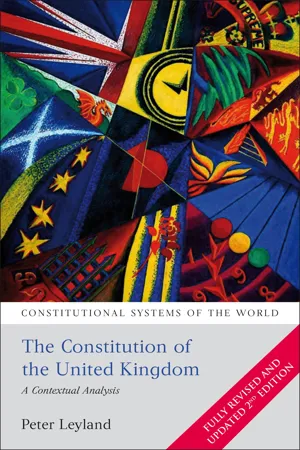
This acclaimed book provides a topical and contextual outline of the principles, doctrines and institutions that underpin the United Kingdom constitution. The second edition of The Constitution of the United Kingdom has been extensively rewritten to take account of recent constitutional developments, particularly changes made following the 2010 general election. The chapters are written in sufficient detail for anyone coming to the subject for the first time to develop a clear and informed view of how the constitution is arranged and how it operates. The main themes include: discussion of the history, sources and conventions of the constitution; later chapters deal with: constitutional principles, the role of the Crown, Parliament and the electoral system, government and the executive, the constitutional role of courts including the protection of human rights, the territorial distribution of power between central, devolved and local government, and the European Union dimension. In addition, the book offers an analytical discussion of the development of the constitution, its strengths and perceived weaknesses, and of reforms aimed at its modernisation.
- 362 pages
- English
- ePUB (mobile friendly)
- Available on iOS & Android
eBook - ePub
About this book
Information
1
UK Constitution
Context and History

PART I: CONSTITUTIONAL CONTEXTS Introduction – What is Liberal Democracy? – Freedom of Expression, and the Broadcasting and Print Media – Media Influence in Public Life and the News of the World Hacking Scandal – The UK Constitution, Constitutionalism, and Good Governance PART II: HISTORY – The Importance of History – Qualifying Absolute Monarchy – The Emergence of Parliament and the Path to Democracy – Defining the Nation: What is the United Kingdom? – Empire, Commonwealth, and Europe – Conclusion
PART I: CONSTITUTIONAL CONTEXTS
INTRODUCTION
OUR DISCUSSION BEGINS by explaining why the unwritten UK constitution is unusual. In general the constitution is the text which sets out the fundamental and superior law of the nation. It not only describes the main institutions of the state, but also provides a framework of basic rules which determine the relationship between these institutions. In addition, it will usually provide in outline the legal and non-legal rules and procedures that define the system of central and local government. At the same time, the constitution normally places limits on the exercise of power and sets out the rights and duties of individual citizens. Tom Paine explained that it is the property of a nation, and not of those who exercise the government: ‘A constitution is a thing antecedent to the government, and always distinct there from.’1 In nearly every other state the term constitution refers to this document (or series of documents) which contains this fundamental and superior law of the nation. The constitution of the United Kingdom is unwritten/uncodified in the sense that it is not contained in any single document. Furthermore, a codified constitution, as a form of higher order law, will generally be entrenched. A specified procedural device (eg a referendum or a higher majority plus federal ratification) must be followed to introduce changes, which makes a codified constitution relatively difficult to amend. In contrast to most others, the UK constitution is not entrenched. In consequence, it is relatively flexible, in the sense that any aspect can be changed by way of ordinary legislation and certain aspects can be modified by convention (discussed in Chapter 2).
The next point to stress is that constitutions will often be designed to deliver a particular system of government, and, at the same time, respond to prevailing local conditions. The founding fathers who drafted the constitution of the United States were keen to include strong institutional inhibitions on the exercise of anything approximating to kingly powers, while also creating a federation with a territorial division of authority between central government and state governments. On the other hand, the Soviet constitutions in Russia under Lenin and Stalin following the revolution in 1917 were conceived to deliver an ideological commitment to a socialist state of workers and peasants. The capitalist system of economics and individual property is expressly rejected in the text of these constitutions. We might compare the South African constitution, which followed a protracted struggle to overturn a previous regime based on apartheid. The 1996 constitution seeks to achieve a reconciliation between ethnic groups, and it is intended to create a democratic state committed to non-racialism and non-sexism and to the advancement of human rights and freedoms and the achievement of equality. The United Kingdom lacks a written constitution which has been custom-built to achieve particular goals, but rather the nation has acquired in piecemeal fashion over the span of several centuries a constitution which supports a liberal democratic system of government.
WHAT IS LIBERAL DEMOCRACY?
Next, we need to be clear about what is meant by liberal democracy2 In setting out a model of democracy Professor Sunstein has recently opined that ‘the central goal of a constitution is to create the preconditions for a well functioning democratic order, one in which citizens are genuinely able to govern themselves,’3 and he advocates a form of deliberative democracy which is marked out by political accountability and a high degree of reflectiveness and a general commitment to reason giving. More commonly, this term liberal democracy refers to the fact that power and legitimacy are reached through the indirect consent of the population as a whole. The consent to be governed is achieved after an electoral process delivers representatives to a Parliament. The majority in Parliament vote for laws which, to some extent at least, reflect the will of the majority. However, when looking at constitutional systems, it would be a mistake to believe that a system of majority rule, in itself, satisfies the credentials of liberal democracy. This is because, while it may be accepted that in some matters the will of the majority should prevail, in regard to others, a crucial feature of ‘liberal democracy’ is that there are limitations on majority rule. For example, the interests of minorities must always be protected to some degree. In practical terms, this means that political parties may offer policy choices to the electorate regarding say, higher or lower levels of taxation, the role of the public sector, and particular policies to pursue in education, health, social services, and law and order. However, the constitutional arrangements in a liberal democratic system must prevent the tyranny of the majority from prevailing by establishing strong constitutional guarantees. This is normally achieved in the field of civil liberties by means of a charter or bill of rights, which will set out the extent of rights which will be protected (eg freedom of speech and religion, freedom to demonstrate, freedom from arbitrary arrest, and so on). However, the United Kingdom with its uncodified constitution has relied on ordinary laws, and a tradition of restraint demonstrated by the executive organs of the state, until the Human Rights Act (HRA) 1998 incorporated the European Convention on Human Rights into domestic law.
FREEDOM OF EXPRESSION AND THE
BROADCASTING AND PRINT MEDIA
BROADCASTING AND PRINT MEDIA
A key hallmark of liberal democratic systems is the recognition of basic freedoms and, in particular, freedom of expression. It is worth briefly pausing to see how the role of press and broadcasting media operates and is regulated under the UK constitution. First, as we just noted, this right to free expression, included under Article 10 of the European Convention on Human Rights, has become integrated as part of domestic law since the enactment of the HRA 1998 (which is discussed in Chapter 7). Although this freedom might be limited under specific laws (eg incitement to racial hatred, or defamation) freedom of expression must allow for a general right to project opinions through the publication of newspapers, pamphlets, and magazines and through access to television, radio, and cinema. The magnification of the political function of the media might be understood in terms of its ‘capacity to discover and publish what authority wished to keep quiet, and to give expression to public feelings which were not, or could not be, articulated by the formal mechanisms of democracy.’4 It was this potential which turned the broadcasting media into major actors on the public scene. Politicians employ the mass media to further their ends, but they are also extremely wary of the capacity of the press and broadcasting media to bring the mighty down by rooting out incompetence and wrongdoing. The demise of Richard Nixon as President of the United States, following the exposure of the Watergate break-in, and its cover-up, is a classic example of investigatory reporting providing the basis for subsequent official action, eventually resulting in the President’s resignation. Ministerial resignations in recent years have been attributable in part at least, to campaigns pursued in the press and broadcasting media.5
In an investigatory capacity the media go beyond providing readers, listeners and viewers with information and the range of ideas and opinions which enables them to participate in a political democracy by performing a vital role as public watchdog.6 The scandal in 2009 which erupted over the excessive and in some cases fraudulent expenses claimed by MPs can be cited as a high-profile example at the core of the political system.7 The disclosure of these abuses was triggered by journalists from the Sunday Times (Heather Brooke and Jon Ungoed-Thomas) and Sunday Telegraph (Ben Leapman) making use of the Freedom of Information Act 2000. They had requested further information on MPs’ expenses, including the disclosure of claim forms and supporting documents. These applications had been refused. They followed the procedure under section 50 to refer the matter to the Information Commissioner and then to the Information Tribunal. Both decided that a fuller breakdown of the expenses should be provided. On final appeal to the High Court it was confirmed that a correct balance had been reached between the privacy of MPs and the legitimate public interest in the disclosure of this information given the deep flaws in the additional costs allowance system for MPs which had been identified.8 Not only did this reporting result in a revision of the system for claiming expenses but a number of MPs and peers were successfully prosecuted for fraudulent claims. In other words, in a positive way the media is capable of acting as an important counterweight to politicians/government in a system where, as we shall see, the executive organs of the state are strong. (For further discussion of this scandal in relation to Parliament, see Chapter 5.)
This capacity of the media to act as a check on the democratic process is clearly very important. The experience in Italy over the past decade draws attention to the potential problems if the independence of the broadcasting media is undermined: ‘In a country resting on universal suffrage, . . . the corruption of information—through the overwhelming control of the media, especially television, both private and state—is a pre-condition for the debasement of democracy.’9 The Italian state institutions operating under the constitution were not able adequately to withstand the conflicts of interest that arose with the election of a Prime Minister who was not only in a position as the owner of national TV channels to manipulate opinion in his favour, but also, as Prime Minister, capable of using his influence to make appointments to the state broadcasting channels to suit his interests.
Perhaps surprisingly, there is no specific constitutional protection in the UK, but could a comparable situation arise in the United Kingdom? First, as Members of Parliament, ministers already have a duty to act in the interests of the nation as a whole, as well as special duties to their constituents. Second, under the ministerial code of practice (referred to in Chapter 6) all ministers, including the Prime Minister, must ensure that no conflict arises, or appears to arise, between their public duties and their private interests. The list of declared personal interests must cover all kinds of financial interests, as well as relevant non-financial private interests, such as links with outside organisations (including broadcasting organisations).
However, there have never been any formal restrictions on private ownership of the print media, and the press is subject to a form of self-regulation carried out be the Press Complaints Commission. Many national newspapers continue to be strongly partisan. For example, the Daily Telegraph and Daily Mail have consistently supported the Conservative Party, while the Daily Mirror has endorsed Labour. On the other hand, The Sun, the News of the World, The Times and the Sunday Times, owned by Rupert Murdoch, switched allegiance from Conservative to Labour in 1997 and then back to the Conservatives in 2010. As the discussion of the News of the World scandal below demonstrates newspapers reflect the views of their owners in their editorials, and they seek to influence the political opinions of their readers, especially at election times. However, by way of contrast, cinema, radio, and television have been subject to varying kinds of statutory regulation. Technical progress has made the media increasingly difficult to control. Such regulation has to address the conflicts of interest that inevitably arise in the quest to open up markets by allowing bidding for broadcast channels. The Communications Act 2003 lays down the conditions for the granting of licences and, in doing so, it sets limits on cross-media ownership (eg combining print media with broadcast media).10 Equally, the legislation seeks to protect a wider public interest by controlling the editorial line. It sets out special impartiality requirements relating to elections and referendums.11 Further, it requires that the news generally on broadcast television and radio is reported with due accuracy.12 Moreover, the Office of Communications (OFCOM) as regulator is under a statutory duty to ensure that its licensees do not project their own views on politically controversial matters. In a democratic system there needs to be a strong public interest dimension to state regulation in this field.
In addition, there are mechanisms in place to safeguard the relative independence of the BBC as state broadcaster. The BBC is required to be impartial. It must refrain from expressing its own opinion on current affairs or on matters of public policy.13 The corporation operates under a renewable Royal Charter which requires the governors of the BBC to act as regulators and makes them ultimately responsible for its management (the director general appointed by the governors is responsible for the day-to-day running of the organisation). To minimise political manipulation, the appointment process for BBC governors is conducted under certain guidelines (the Nolan principles)14 by the Office of the Commissioner for Public Appointments (OCPA). After the interviewing process, recommendations are put forward to the Secretary of State for Media and Culture, and then to the Prime Minister.15
In sum, in the domain of broadcasting the BBC and other broadcasters can act as a conduit for criticism of politicians as long as this criticism is not part of an agenda set by the broadcaster. Despite the absence of a constitution, citizens are generally able to express themselves, and the freedom of the press and broadcasters to disseminate information in the United Kingdom is constrained by an intricate combination of formal regulation and informal safeguards.
MEDIA INFLUENCE IN PUBLIC LIFE AND THE
NEWS OF THE WORLD HACKING SCANDAL
NEWS OF THE WORLD HACKING SCANDAL
Important issues pertaining to the degree of constitutional accountability in relation to the media were vividly highlighted in 2011 in the so-called ‘Hackgate’ scandal. The hacking into mobile phones came to the forefront of public attention again after the May 2010 general election when Prime Minister Cameron appointed Andy Coulson, former editor of the News of the World, as his Director of Communications at Number 10 Downing Street. In 2007 Clive Goodman, former royal editor of the News of the World, and Glenn Mulcaire, a private investigator working for the paper, were convicted and imprisoned for hacking into the voicemails of Buckingham Palace aides. Coulson was editor of the newspaper when this criminal activity was revealed. This appointment by the Prime Minister was controversial partly because of the connection with News International through the News of the World, but mainly because there were allegations that illegal practices, such as phone hacking, had been widespread at the paper, raising the possibility of editorial collusion in law breaking. As further accusations began to emerge, Coulson’s position became untenable and he resigned in January 2011. The resignation severed the direct link with News International. Although there were no allegations of serious wrongdoing by the Prime Minister or any other ministers, this did not prevent Mr Cameron’s judgme...
Table of contents
- Cover
- Title
- Copyright
- Preface to the Second Edition
- Preface to the First Edition
- Contents
- Table of Cases
- Table of Legislation
- 1 UK Constitution
- 2 The Sources of the Constitution
- 3 Constitutional Principles
- 4 The Crown and the Constitution
- 5 Parliament
- 6 Government and Executive
- 7 The Constitutional Role of the Courts
- 8 Devolution and Local Governance
- 9 Conclusion: The UK Constitution
- Index
Trusted by 375,005 students
Access to over 1.5 million titles for a fair monthly price.
Study more efficiently using our study tools.
Frequently asked questions
Yes, you can cancel anytime from the Subscription tab in your account settings on the Perlego website. Your subscription will stay active until the end of your current billing period. Learn how to cancel your subscription
No, books cannot be downloaded as external files, such as PDFs, for use outside of Perlego. However, you can download books within the Perlego app for offline reading on mobile or tablet. Learn how to download books offline
Perlego offers two plans: Essential and Complete
- Essential is ideal for learners and professionals who enjoy exploring a wide range of subjects. Access the Essential Library with 800,000+ trusted titles and best-sellers across business, personal growth, and the humanities. Includes unlimited reading time and Standard Read Aloud voice.
- Complete: Perfect for advanced learners and researchers needing full, unrestricted access. Unlock 1.5M+ books across hundreds of subjects, including academic and specialized titles. The Complete Plan also includes advanced features like Premium Read Aloud and Research Assistant.
We are an online textbook subscription service, where you can get access to an entire online library for less than the price of a single book per month. With over 1.5 million books across 990+ topics, we’ve got you covered! Learn about our mission
Look out for the read-aloud symbol on your next book to see if you can listen to it. The read-aloud tool reads text aloud for you, highlighting the text as it is being read. You can pause it, speed it up and slow it down. Learn more about Read Aloud
Yes! You can use the Perlego app on both iOS and Android devices to read anytime, anywhere — even offline. Perfect for commutes or when you’re on the go.
Please note we cannot support devices running on iOS 13 and Android 7 or earlier. Learn more about using the app
Please note we cannot support devices running on iOS 13 and Android 7 or earlier. Learn more about using the app
Yes, you can access The Constitution of the United Kingdom by Peter Leyland in PDF and/or ePUB format, as well as other popular books in Law & Public Law. We have over 1.5 million books available in our catalogue for you to explore.