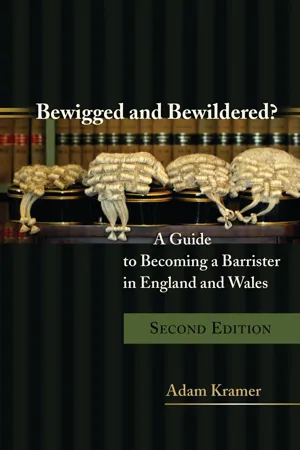
Misunderstandings and jargon prevent many from seriously considering a career as a barrister in the belief that such a career is not for them or that they are not for it. Others know that they might want to become barristers but not how to go about it, or just want to know more about this somewhat mysterious profession. This book (by a barrister who was formerly a university law lecturer) clearly but informally explains the traditions, terminology and institutions of the Bar, and what it is actually like to be a barrister. With this aim, several barristers practising in different fields describe in detail a typical week in their life. Advice is then given on how to be accepted into, fund and survive the various academic and other stages that precede qualification as a barrister, including work experience, Bar School, and pupillage (the barrister's apprenticeship). Space is also given to how to transfer to the Bar after another legal or non-legal career. This second edition is fully updated to take account of the changes to the Bar, training for it and the process of recruitment to it. Adam Kramer regularly provides updates to this book, which can be seen at:
www.hartpub.co.uk/updates/bewigged-updates
eBook - ePub
Bewigged and Bewildered?
A Guide to Becoming a Barrister in England and Wales
- 240 pages
- English
- ePUB (mobile friendly)
- Available on iOS & Android
eBook - ePub
About this book
Information
1
Introduction to the English Bar
BARRISTERS AND SOLICITORS
Unlike in America, but not dissimilar to practice in Europe, the English legal profession is what is referred to as a ‘split profession’. This means that there are two types of English lawyer: solicitors and barristers.2 Solicitors are overwhelmingly the primary legal professionals in that there are more of them, cases come to them first, and they are the more important in the vast majority of cases. There are about 100,000 solicitors in England and Wales as compared with about 15,000 barristers. Of these barristers, 3,000 are at the Employed Bar (see later) and the rest are self-employed, which mode of operation was, until recently, referred to as being ‘at the independent Bar’. We’ll talk more about why being self-employed is important to what a barrister does and the working environment he or she does it in. While we’re dealing with terminology, you should know that while lawyers in the US are called attorneys, that term has not been used in the UK since the nineteenth century. Two terms you do need to know are counsel, which is another word for barrister or barristers (counsel is both the singular and the plural), and the Bar, which is the collective term for all barristers.
Lawyers in England and Wales
100,000 solicitors
(of whom 3,300 are solicitor-advocates)
15,000 barristers
(of whom 12,000 are self-employed and 3,000 are at the Employed Bar)
(of whom 10,000 are in London and 5,000 are outside London)
22,000 legal executives
The key to understanding the interaction between barristers and solicitors is knowing that, normally speaking, clients (ordinary people who are not lawyers) cannot go directly to barristers for help but must go to solicitors. Solicitors can then get a barrister involved if appropriate. The Bar is a ‘referral profession’; as one author puts it, solicitors are ‘the GPs of the legal profession’, leaving barristers as the specialists (Charlotte Buckhaven, Barrister by and Large (London, Pan Books, 1985), p 11). However, it should be remembered that this split professional aspect of the law is important only to litigation (meaning legal disputes, as opposed to other general situations in which people may want advice on how to act within the law): in most transactional work (buying a house, merging companies, drafting contracts, managing company employment policies, advising on tax) solicitors do everything and barristers have little or no involvement, at least until the legal dispute arises. Much lower court litigation and non-court litigation (such as arbitration) is also handled by solicitors. However, within the relevant fields of litigation in which barristers primarily operate, barristers can be said to be specialists in three broad areas:
The first thing barristers are specialists in is the law. This may seem strange as solicitors are also lawyers and have studied the law for the same number of years and at the same universities as barristers. However, solicitors, particularly young solicitors, spend a large amount of their time collecting evidence and generally administering and managing a transaction, inquiry, trial, or project. Barristers get to spend more time working on legal points, and their expertise builds up accordingly, and so solicitors often come to barristers for advice on points of law (although there are many solicitors whose knowledge of the law is at least the equal of that of most barristers and who handle most or all legal points themselves).
The second thing barristers are specialists in is court practice and procedure. Again, because solicitors are often tied up with collecting evidence and general management of the case, barristers are often more familiar with the tactics, procedures, and rules of evidence of litigation and trials and other court hearings. This means that they have a better feel for what would happen if a case were to go to court, and are better able to make strategic decisions concerning the litigation (what applications to make to the court, what witnesses to rely on, what questions to ask, how much to offer in settlement). As with any generalisation, this does not always apply: many solicitors’ firms have specialist litigation departments and the solicitors in those departments may be as expert at litigation or law as barristers, or more so, and further, as is explained below, a large portion of lower court litigation is handled without the use of barristers. To make matters more confusing, some types of barrister do little or no litigation (such as tax barristers and a certain type of Chancery barrister: this terminology will be explained later).
The third thing barristers are specialists in is advocacy: arguing and presenting cases in court. Partly because of the other demands on solicitors’ time that have already been mentioned, in general barristers are more expert in advocacy than solicitors and so are often instructed by solicitors to conduct in court the litigation that the solicitors’ clients are involved in (in other words, making applications and speeches and asking questions of witnesses). Although many barristers spend more time out of court than in court, advocacy skills, taught at Bar school and by the Inns of Court and Specialist Bar Associations (see below), remain the distinguishing skills of the Bar.3 All barristers, no matter how junior, automatically (ie from their first day in practice and without further examinations) have the right to speak in all courts of the land. Solicitors automatically have the right to speak in the lower courts (magistrates’ courts and county courts) and, given the number of solicitors, it is therefore not surprising that most advocacy in those courts is conducted by solicitors and not by barristers. Furthermore, for the last 10 years solicitors have been able to earn higher rights of audience (the rights to appear not only in the lower courts but also in the Crown Courts, High Court, Court of Appeal, and House of Lords) by passing further examinations and qualifying as what are known as solicitor-advocates. However, so far only about 3,300 solicitors have qualified as solicitor-advocates (see further below), and the upshot is that most hearings in the higher courts, as well as some in the lower courts, are conducted by barristers.
The solicitor—being the primary legal practitioner—is generally in charge of the case and of liaising with the client, and brings in barristers as sub-contractors for the specialist work described above (just as a builder might have a contract to construct a building and will subcontract part of the work to an electrician or roof specialist). The consequence of this is that the barrister’s clients are in fact solicitors, who are his or her paymasters (unless the government is paying under the legal aid schemes) and the ones to whom the barrister is providing the service, although the barrister also has duties to the client who is employing the solicitor, that is, the non-lawyer for whom all this is happening (who is distinguished from the solicitors by the label ‘lay client’: ‘lay’ simply means non-professional).
Bizarrely, however, barristers have traditionally not entered into contracts with solicitors for their services and fees and have instead worked on an honour system (although on standard terms set by the Bar Council and Law Society), meaning that solicitors cannot be sued if they don’t pay up, and that interest does not accrue even if solicitors are late paying their invoices. This contributes to cash-flow problems, discussed elsewhere, since, although solicitors almost always pay up, they often take a long time to do so. Since 1991 barristers have been allowed to enter into contracts with solicitors (rather than using this honour system), but this remains the exception, although negotiations between the Bar Council and Law Society to make a contract the default position are fairly advanced and are likely to lead to a change in the near future.
Although solicitors can usually do nicely without engaging a barrister, most cases cannot proceed without a solicitor. Indeed, the barristers’ Code of Conduct (more about this later) forbids barristers from holding money on behalf of lay clients, conducting correspondence or interviewing witnesses, and settling witness statements. Only solicitors, or the lay client in person, may conduct these tasks (although, as with any rule, it is not as black and white as this suggests).
When a solicitor gives a barrister a case, the solicitor is said to give the barrister a brief, or to instruct the barrister: a brief takes the form of a set of instructions to the barrister to answer a particular question, draft a particular document, or to represent the lay client at a particular hearing. Traditionally, the brief is tied up with a ribbon (often pink).
SETS OF CHAMBERS
Solicitors work in law firms. These will be legal partnerships of one form or another, but basically firms are like companies, sometimes very big companies.
In contrast, the majority of barristers are self-employed (the minority who are not are discussed below) but usually gather together into an association (ie not a company) and rent offices from which they work, and share the costs of secretaries (although they have far fewer than solicitors), receptionists, stationery, marketing, clerks (see below), and perhaps a library and conference rooms.
The association (and the offices the barrister works in) is called a ‘chambers’ (treated as a singular: ‘where is your chambers?’, ‘I’m on my way back to chambers’), also known as a ‘set’ or ‘set of chambers’ (as in ‘which set are you in?’). The name of a set will usually be its street address (‘3 Verulam Buildings’, ‘7 Bedford Row’, ‘9 Old Square’), although nowadays more modern names are becoming common (‘Matrix Chambers’, ‘Landmark Chambers’).4 In some chambers all barristers have their own room, whereas in others, particularly in areas of the law which involve a lot of court-work (and so less time spent in chambers), barristers share rooms with one or two other barristers. Generally each individual barrister rents a room (or a share in it) from chambers, which, in turn, rents or owns the chambers’ building. In London the chambers usually rents its building from the Inn it is situated in.
Chambers generally have one or two heads of chambers, who will be selected from the most senior barristers in the chambers. A small chambers would have 10 to 20 barristers in it, a large chambers 50 to 60, with the majority of sets falling somewhere in between. Even a large chambers, however, is dwarfed by a big law firm, which can be an international organisation with thousands of lawyers spread throughout the world.
Because a barrister is associated with the other barristers in his chambers, all the members benefit if a set has a good reputation, which is one reason why barristers spend time and money on attracting good pupils. Many sets find it useful if all their barristers specialise in particular areas of work so that their reputation is also specialised, and solicitors may get into the habit of going to a particular set with a particular type of case, even if the individual barristers they know are unavailable or too senior. While many sets still do the full range of work, specialisation is increasing and, in particular, a large number of sets do either criminal law or civil law (which means everything except criminal law) but not both. I am in a commercial law chambers and will, therefore, never handle a criminal case.
The common chambers specialisms are the following:
(i) Chancery law: specialising in property, trusts, taxation, and wills.
(ii) common law: a mixture of civil law work and often crime, that is, pretty much everything, often with an emphasis on personal injury work.
(iii) commercial law: specialising in the law of commerce, that is, business and trade (especially contracts, insurance, banking, shipping, etc) and company matters.
(iv) commercial Chancery law: specialising in Chancery matters but with a commercial flavour (above all, company and insolvency law).
(v) criminal law: specialising in crime.
(vi) family law: specialising in family law.
(vii) intellectual property law: the law of patents, copyrights, and trademarks.
(viii) public law: specialising in administrative law, human rights, and planning law.
A good idea of the types of things barristers specialise in can be gleaned from a list of the Specialist Bar Associations for the private Bar (clubs that hold conferences, lectures, and training events and represent the interests of their members): ALBA (the Constitutional and Administrative Law Bar Association); the Chancery Bar Association; COMBAR (the Commercial Bar Association); the Criminal Bar Association; the Employment Law Bar Association; FLBA (the Family Law Bar Association); IPBA (the Intellectual Property Bar Association); the Parliamentary Bar Mess; PIBA (the Personal Injuries Bar Association); PEBA (the Planning and Environment Bar Association); the Professional Negligence Bar Association; the Property Bar Association; the Revenue Bar Association; and TECBAR (the Technology and Construction Bar Association). You certainly do not need to know these acronyms.
IT’S NOT JUST ABOUT LAW
Having explained chambers specialisms, this is a convenient point at which to explain something that is fundamental to the practice of the law, namely that law is only half of the picture. The law is a regulatory system that applies to all fields of human endeavour. Like many other service industries (accountancy, marketing, etc), but to a greater degree, the law gets deeply into all areas of society. As a result, there are two ways of looking at law and barristers, and accordingly two ways of coming at the question of whether you want to be a barrister. You may start at the law end, deciding that the law itself interests you, that you have the skills that a barrister needs, and that you are interested in doing the sorts of things that lawyers do (advocacy in court, drafting documents, solving difficult intellectual or practical problems).
Alternatively, however, you may come at law from the other end of the microscope. You may be somebody who is interested by a particular field of society, such as science, medicine, crime and investigation, commerce, the environment and planning, immigration and asylum, employment, family relationships, or tax and finances. However, you may not want to go into those fields by the ordinary route, (respectively) as a scientific researcher, doctor, police officer, business employee, lobbyist or charity or council worker, trade union or human resources worker, counsellor, or accountant. You may instead prefer to go in from a different angle, as a barrister, doing (respectively) intellectual property, medical negligence and personal injury law, criminal or prison law, commercial and Chancery law, environmental and planning law, immigration and human rights law, employment law, family law, or tax law. All barristers practise in one or more of these areas, or areas like them, which means that barristers become acquainted with the workings of these areas of society and are actually involved participants in those areas. A ...
Table of contents
- Cover Page
- Title Page
- Copyright
- Dedication
- Contents
- Foreword
- Introduction to This Book
- 1 Introduction to the English Bar
- 2 The Future of the Bar
- 3 A Week in the Life of a Junior Barrister
- 4 Deciding Whether to Become a Barrister
- 5 An Overview of Qualification
- 6 Work Experience: Mini Pupillages and Other Legal Experience
- 7 Joining an Inn
- 8 The Bvc
- 9 Dining, Qualifying Sessions, and Call
- 10 Getting Pupillage
- 11 Life as a Pupil
- 12 Work as a Pupil
- 13 Alternative Careers
- 14 Transferring to the Bar After Practising Abroad or as a Solicitor
- Further Information
- Glossary
- Timetables for Routes to the Bar
- Index
Trusted by 375,005 students
Access to over 1.5 million titles for a fair monthly price.
Study more efficiently using our study tools.
Frequently asked questions
Yes, you can cancel anytime from the Subscription tab in your account settings on the Perlego website. Your subscription will stay active until the end of your current billing period. Learn how to cancel your subscription
No, books cannot be downloaded as external files, such as PDFs, for use outside of Perlego. However, you can download books within the Perlego app for offline reading on mobile or tablet. Learn how to download books offline
Perlego offers two plans: Essential and Complete
- Essential is ideal for learners and professionals who enjoy exploring a wide range of subjects. Access the Essential Library with 800,000+ trusted titles and best-sellers across business, personal growth, and the humanities. Includes unlimited reading time and Standard Read Aloud voice.
- Complete: Perfect for advanced learners and researchers needing full, unrestricted access. Unlock 1.5M+ books across hundreds of subjects, including academic and specialized titles. The Complete Plan also includes advanced features like Premium Read Aloud and Research Assistant.
We are an online textbook subscription service, where you can get access to an entire online library for less than the price of a single book per month. With over 1.5 million books across 990+ topics, we’ve got you covered! Learn about our mission
Look out for the read-aloud symbol on your next book to see if you can listen to it. The read-aloud tool reads text aloud for you, highlighting the text as it is being read. You can pause it, speed it up and slow it down. Learn more about Read Aloud
Yes! You can use the Perlego app on both iOS and Android devices to read anytime, anywhere — even offline. Perfect for commutes or when you’re on the go.
Please note we cannot support devices running on iOS 13 and Android 7 or earlier. Learn more about using the app
Please note we cannot support devices running on iOS 13 and Android 7 or earlier. Learn more about using the app
Yes, you can access Bewigged and Bewildered? by Adam Kramer KC in PDF and/or ePUB format, as well as other popular books in Law & Legal Education. We have over 1.5 million books available in our catalogue for you to explore.