This is the fifth edition of the leading textbook on criminal law by Professors Simester, Spencer, Sullivan and Virgo. Simester and Sullivan is an outstanding account of modern English criminal law, combining detailed exposition and analysis of the law with a careful exploration of its theoretical underpinnings. Primarily, it is written for undergraduate students of criminal law and it has become the set text in many leading universities. Additionally, the book is used as an important point of reference in academic writing and postgraduate research in England and abroad. Simester and Sullivan has been cited by appellate courts throughout the world.
There have been a large number of important appellate decisions since the last edition of this work. This new case law, among other things, provides helpful guidance for the interpretation of offences under the Serious Crime Act 2007 and of the defence of loss of control provided by the Coroners and Justice Act 2009. There have been significant developments in the laws relating to rape, self-defence and defence of property, and duress. Special mention should be made of the continuing stream of appellate cases regarding the nature and scope of secondary liability in the crimes of others.
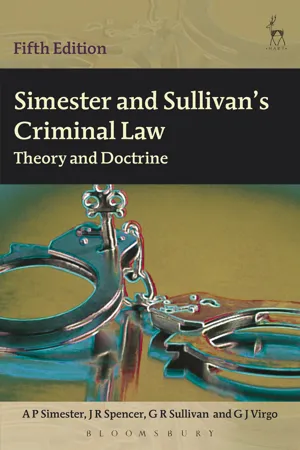
eBook - ePub
Simester and Sullivan's Criminal Law
Theory and Doctrine
- 980 pages
- English
- ePUB (mobile friendly)
- Available on iOS & Android
eBook - ePub
Simester and Sullivan's Criminal Law
Theory and Doctrine
About this book
Information
1
CRIMINAL LAW: DEFINITION AND AMBIT
The aim of this chapter is to introduce some of the theory that surrounds the criminal law: to explain why the criminal law matters, and to highlight the issues it raises. The chapter begins by considering the defining features of the criminal law, those which distinguish it from other varieties of law. Secondly, the ambit of criminal law is investigated—when is it apt to declare someone a criminal? The discussion in this chapter will lead on, in Chapter 2, to a discussion of the constitutional and Rule of Law principles that constrain the enactment and interpretation of criminal law; and later, in Chapter 16, to consideration of what sorts of actions properly attract criminal prohibitions.
§ 1.1 A search for definition
Like other types of law, the criminal law is a means by which the state participates in the ordering of its citizens’ lives. Yet throughout the world, every society with a formal legal system distinguishes between criminal and civil law.1 This raises a question about the scope of criminal law: what marks a law out as criminal rather than civil? One way of approaching that question is to look for a definition of the criminal law. Broadly speaking, a crime is an event that is prohibited by law, one which can be followed by a prosecution in criminal proceedings and, thereafter, by punishment on conviction:2
“A crime must be defined by reference to the legal consequences of the act. We must distinguish, primarily, not between crimes and civil wrongs but between criminal and civil proceedings. A crime then becomes an act that is capable of being followed by criminal proceedings, having one of the types of outcome (punishment etc.) known to follow these proceedings.”
Criminal law, in turn, is the variety of law that prohibits such crimes.
But to define criminal law only in these procedural terms fails to shed any light on a more fundamental problem: why does the distinction between criminal and other law matter? It is true that criminal prosecutions follow a different legal procedure from their civil counterparts. But if that is the sole difference, and there is no underlying reason for separating the two, drawing the distinction would be pointless.3 We need to identify the distinguishing features that also justify treating crimes as a separate body of law.
(i) The harmful nature of the prohibited event
One suggestion might be that the harm proscribed by criminal law is greater in degree than that in the civil law, or is somehow public rather than private in nature. For example, across most if not all cultures, the criminal law contains provisions proscribing serious forms of violence and dishonesty. However, while it is true that prevention of harm is central to the criminal law, the distinctiveness of criminal wrongs cannot be captured by reference simply to the moral gravity of the wrongdoing and the importance of the interest being violated. For one thing, most harms are both public and private. The major oil spillage in Sydney harbour that gave rise to the Wagon Mound tort cases affected more than one person,4 while by contrast an ordinary assault typically involves a single victim. Similarly, consider the situation where D plc has placed a large contract for the supply of raw materials with V Ltd. D is aware that without the contract, V would be forced to close with the loss of hundreds of jobs. If, despite this, D breaks the contract in order to obtain supplies from a cheaper overseas source, it commits no offence. Compare this case with the situation where a company fails to send its annual return to the Registrar of Companies within the time limits prescribed by the Companies Act 2006. It seems, therefore, that the events prohibited by criminal laws are not inherently distinguishable from those regulated by other sorts of law. Indeed, the same act can sometimes lead to both criminal and civil liability. If D takes V’s car without V’s consent, for example, he may be prosecuted for theft. He can also be sued in tort for conversion.
That said, there is intuitive appeal in the idea that criminal wrongs are typically more serious than their civil counterparts; sufficiently serious that, whether or not they also give rise to civil causes of action, the state feels constrained to step in and regulate them directly. This can be seen in the rule that a victim who forgives his attacker may discontinue his civil suit for damages, but cannot stop the prosecution of that attacker. Criminal offences are not merely a private matter. The public as a whole has an interest in their prevention and prosecution. Thus, according to Allen, behaviour is criminalised “because it consists in wrongdoing which directly and in serious degree threatens the security or well-being of society, and because it is not safe to leave it redressable only by compensation of the party injured”.5 Allen’s remark is a useful pointer to why assaults are crimes while breaches of contract are not. Assault involves an interference with fundamental rights of the victim, rights which the State is perceived to have a duty to protect. By contrast, individuals are normally able to protect themselves against breach of contract, and can satisfactorily undo any damage suffered with the aid of the civil law.
Another possible basis for differentiating civil from criminal law is that criminal acts are those acts which are intrinsically morally wrong. (Such acts are sometimes called mala in se.) To some extent this is true of the more serious, stigmatic offences—assault, murder, and so forth.6 But much of the modern criminal law involves prohibitions which constrain conduct which may be wrong only in the technical sense of breaching the terms of the prohibition (mala prohibita). Prohibitions of that kind are often in the public interest. For example, driving on the roads is safer overall because of speed limits. Yet there is little intrinsic moral difference, for instance, between driving safely at 70 miles per hour on the motorway and driving safely at 75; but the latter is an offence.7 And conversely, lying may be immoral, but it is not per se a criminal act.
More generally, the sheer variety of conduct that has been designated a criminal wrong defies reduction to any “essential” minimum. One finds no unifying thread to the subject matter of the multifarious crimes known to England and Wales.8 The criminal law has been used—indeed, overused—as a regulatory device, and consequently extends to conduct that can lack any inherent moral turpitude whatsoever, such as failing to notify the licensing authority of a change of address for one’s driving licence, or omitting a required statement from a consumer credit contract. In this country, the fact that some particular action is criminal may reflect only a decision on the part of a regulatory body that the public interest requires resort to public means of suppression, and that the matter cannot be left to private redress or bargaining. Amongst the available public means of suppression, the criminal law is the most commonly employed coercive mechanism.
So there are limits to the extent to which we can safely elaborate upon our initial definition by reference to the things that criminal law prohibits. In part, this reflects the fact that criminal law engages with political and societal pressures which find expression in the form and content of the law. In Chapter 16, we shall discuss some of the reasons for the State to criminalise certain harms rather than others. But it should always be borne in mind that, in practice, criminal laws are characteristically deployed to control behaviour and events because there is perceived to be a societal, and political, interest in doing so.
(ii) Punishment
A second element of the preliminary definition given in § 1.1 was punishment. Perhaps the main distinction between criminal and civil law is that the criminal law licenses punishment whereas redress for civil law wrongs is predominantly compensation?
Punishment is an important facet of the criminal process. Indeed, it is an indispensable feature of criminal prohibitions. Parliament does not say, “Do not assault other people, please”. That would not be a law at all. Rather, the law declares, “Do not assault other people, or else . . .”. Of course, civil laws also specify sanctions. As Posner points out, however, the nature of the civil sanction differs from that found in criminal law. A defendant who is convicted of a crime will normally be imprisoned or fined. By contrast, someone who loses a civil action faces perhaps an injunction, an order for specific performance, or a requirement to pay damages.
Posner argues that this difference reflects a crucial distinction between the functions of criminal and civil laws. In his opinion, the criminal law exists to impose punishments such as imprisonment in situations where tortious remedies are an insufficient deterrent.9 But Posner’s explanation is doubtful. Both criminal and tortious remedies can operate as deterrents. Each is likely to be regarded as unwelcome by a defendant, and indeed civil damages awards that compensate to the extent of the harm done often far exceed criminal fines in magnitude.
On the other hand, it is instructive to consider the reasons apart from deterrence which underlie the imposition of sanctions in these cases. In particular, whether or not they have deterrent effects, civil remedies are not normally regarded as punitive. Punishment involves more than simply imposing something unwelcome upon a defendant. A punitive sanction imposes hardship because the recipient deserves it.10 Damages in a contract dispute, for instance, are a sanction; but ordinarily they are imposed without censure. It is not necessary to show that a defendant is at fault when he breaches his contractual obligations.
Punishment, by contrast, is imposed with censure as an integral aspect. It responds to the fact that the defendant has done something wrong.11 Indeed, the level of sentence is one way in which a court signals the wrongfulness of the defendant’s actions.12 Of course, there are also fault-based actions in the law of tort. Nonetheless, damages for tort losses are normally compensatory, not punitive, and are understood as such. That is why one may usually insure against contractual or tortious damages, but not against criminal fines.13
Punishment, then, is one function of the criminal law. But punishment is not what is unique about crime. Indeed, punishment is not even a specifically legal phenomenon, let alone specifically the province of criminal law. We do not require a criminal conviction before punishing children or for a footballing foul,14 and it is sometimes possible to obtain exemplary (or “punitive”) damages in civil cases. One may be fined or even imprisoned for a civil contempt of court.15 Conversely, neither is a conviction always accompanied by punitive sanctions. Sometimes offenders are discharged without receiving any sentence for their wrongdoing. Offenders may also be subject to confiscation orders,16 or indeed to life sentences or extended sentences of imprisonment for purposes of public safety rather than punishment.17 This suggests that while punishment is an important facet of the criminal law, it ...
Table of contents
- Cover
- Title Page
- Contents
- Expanded Table of Contents
- Preface
- Abbreviations
- Table of cases
- Table of legislation
- 1 CRIMINAL LAW: DEFINITION AND AMBIT
- 2 THE RULE OF LAW AND THE EUROPEAN CONVENTION
- 3 INTERPRETATION AND PROOF
- 4 THE ACTUS REUS
- 5 MENS REA
- 6 STRICT AND CONSTRUCTIVE LIABILITY
- 7 SECONDARY PARTICIPATION
- 8 VICARIOUS AND CORPORATE LIABILITY
- 9 THE INCHOATE OFFENCES
- 10 HOMICIDE
- 11 NON-FATAL OFFENCES AGAINST THE PERSON
- 12 THE PRINCIPAL SEXUAL OFFENCES
- 13 THEFT
- 14 RELATED OFFENCES
- 15 FRAUD
- 16 THE MORAL LIMITS OF CRIMINALISATION
- 17 DEFENCES: AN OVERVIEW
- 18 FAILURE OF PROOF: MISTAKE AND INTOXICATION
- 19 MENTAL CONDITION DEFENCES
- 20 DEFENCES OF CIRCUMSTANTIAL PRESSURE
- 21 PERMISSIBLE CONDUCT
- 22 DEFENCES AND BLAME: SOME OBSERVATIONS
- Bibliography
- eCopyright
Trusted by 375,005 students
Access to over 1.5 million titles for a fair monthly price.
Study more efficiently using our study tools.
Frequently asked questions
Yes, you can cancel anytime from the Subscription tab in your account settings on the Perlego website. Your subscription will stay active until the end of your current billing period. Learn how to cancel your subscription
No, books cannot be downloaded as external files, such as PDFs, for use outside of Perlego. However, you can download books within the Perlego app for offline reading on mobile or tablet. Learn how to download books offline
Perlego offers two plans: Essential and Complete
- Essential is ideal for learners and professionals who enjoy exploring a wide range of subjects. Access the Essential Library with 800,000+ trusted titles and best-sellers across business, personal growth, and the humanities. Includes unlimited reading time and Standard Read Aloud voice.
- Complete: Perfect for advanced learners and researchers needing full, unrestricted access. Unlock 1.5M+ books across hundreds of subjects, including academic and specialized titles. The Complete Plan also includes advanced features like Premium Read Aloud and Research Assistant.
We are an online textbook subscription service, where you can get access to an entire online library for less than the price of a single book per month. With over 1.5 million books across 990+ topics, we’ve got you covered! Learn about our mission
Look out for the read-aloud symbol on your next book to see if you can listen to it. The read-aloud tool reads text aloud for you, highlighting the text as it is being read. You can pause it, speed it up and slow it down. Learn more about Read Aloud
Yes! You can use the Perlego app on both iOS and Android devices to read anytime, anywhere — even offline. Perfect for commutes or when you’re on the go.
Please note we cannot support devices running on iOS 13 and Android 7 or earlier. Learn more about using the app
Please note we cannot support devices running on iOS 13 and Android 7 or earlier. Learn more about using the app
Yes, you can access Simester and Sullivan's Criminal Law by A P Simester,J R Spencer,G R Sullivan,G J Virgo in PDF and/or ePUB format, as well as other popular books in Law & Criminal Law. We have over 1.5 million books available in our catalogue for you to explore.