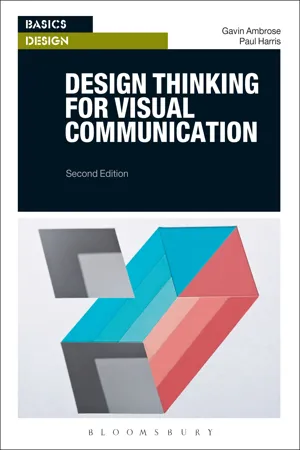
How do you start a design project? How can you generate ideas and concepts in response to a design brief? How do other designers do it? This book will answer all these questions and more. Now in its second edition, the highly popular Design Thinking for Visual Communication identifies methods and thought processes used by designers in order to start the process that eventually leads to a finished piece of work. Step-by-step guidance for each part of the process is highlighted by real-life case studies, enabling the student to see teaching in practice. This focus on ideas and methods eschews an abstract, academic approach in favour of a useable approach to design as a problem-solving activity. The new edition now includes contributions from a broader international range of design practices and adds depth to existing case studies by looking in greater detail at some of the processes used.
- 184 pages
- English
- ePUB (mobile friendly)
- Available on iOS & Android
eBook - ePub
Design Thinking for Visual Communication
About this book
Information

Arts Council England
Pictured is a brand identity created by Studio Output for Arts Council England that features an animation that gives the words a life of their own to create a coherent representation of the organization.
Client: Arts Council England
Design: Studio Output
Design thinking: Animated words that represent the organization
Chapter 4
Refinement
Working up a design idea involves the continued refinement of the artwork and the message it communicates. Refinement involves small yet significant changes made to a design in order to enhance the idea and increase the effectiveness of its ability to communicate.
As a designer works up and refines an idea, a variety of typographic choices and images may be tested. These can be resized, recolored, repositioned, modified and otherwise altered as the designer tries to get the design ‘just right’. Refinement may see many iterations of a piece being undertaken before the design has the required tone or emphasis.
A design contains many different facets that come together in the final job. While these are usually addressed simultaneously during a design job, this chapter is split into the component parts; images, words, shapes, proportion, numbers and color will each be examined in isolation. When combined, they create a final design but you can think about each one separately.
Thinking in images
Images have the ability to convey an idea or a lot of information very quickly, which is why they play such a prominent part in graphic design. As we know, a picture paints a thousand words, so it is worth spending time on careful image selection.
Images can be used to communicate in many different ways as they are versatile and how they are interpreted can be conditioned by other factors at play during their presentation. Images can have different cultural and social interpretations and these can be shaped by the contexts within which they are used.
The cultural groups they are targeted at, the inclusion or exclusion of particular signs and symbols shared by a cultural group, the use or absence of conditioning agents such as wit and humor and the appropriation of historical meaning, are all factors that might influence the meaning drawn from an image. The way an image or design is rendered also has an impact; a black-and-white sketch conveys a different feel from a glossy print, for example.

Receiving and interpreting images
What this means in practice is that one cannot just show a picture of a house. The designer must think about other design aspects that will condition how the viewer receives or interprets the image of the house. Does the house represent an Englishman’s castle, a home, an architectural work, a source of joy or sorrow?

Trafalgar Hotel
Pictured are print pieces created by Ever After Brand for a rebrand of the Trafalgar Hotel in London. The designs feature patterns made up of icons that represent different aspects of the hotel’s service. For example, a glass pattern is used for the drinks menu and a balloon whisk for the food menu. Within the context of a retail environment, the use of patterns softens the dining experience and creates a point of interest.
Client: Trafalgar Hotel
Design: Ever After Brand
Design thinking: Images representing aspects of hotel services are used as icons to create patterns
Thinking in signs
A sign is a powerful communication device: it can be easily recognized and can convey complex concepts in a simple fashion. Images can contain different signs. Signs convey meaning through processes of semiotics, denotation and cognition.
Semiotics
Semiotics offers an explanation about how people extract meaning from words, sounds and pictures. Semiotics proposes that three ‘classifiers’ exist: the sign, the system and the context. A sign offers information by way of its content (such as a stop sign), the system is the scheme within which the sign operates (such as a road-signage scheme), and the context is the scheme within which the sign is placed (such as a road or highway). Many designs include symbolic references or signs that communicate multiple layers of information.
Denotation
This refers to the literal and primary meaning of an image or graphic. Denotation means that something is exactly what it appears to be.
Cognition
Understanding, knowing or interpreting based on what has been perceived, learned or reasoned. The cognitive interpretation of an image depends upon how it is presented. Our denotative interpretation of an image changes as the presentation of the image alters. Such changes can be made by context, coloration, juxtaposition or in other ways.

Thames & Hudson
Volume is a book about Australian architecture firm John Wardle Architects. The pages showcase the work of the architectural practice and are styled like a sketchbook, featuring sketches, photos, plans and annotations, giving a sense of creativity in progress. This approach is also a reflection of the firm’s collaborative studio environment.
Client: Thames & Hudson
Design: 3 Deep
Design thinking: Presentation of material in the style of a sketchbook gives a sense of creativity in progress
Signs are commonly used to communicate short, important messages in a simple way. As he investigated how people make sense of the world around us, American ...
Table of contents
- Cover
- Title Page
- Contents
- Introduction
- Stages of thinking
- Research
- Idea generation
- Refinement
- Prototyping
- Implementation
- Exercises
- Glossary
- Index
- Credits
- eCopyright
Trusted by 375,005 students
Access to over 1.5 million titles for a fair monthly price.
Study more efficiently using our study tools.
Frequently asked questions
Yes, you can cancel anytime from the Subscription tab in your account settings on the Perlego website. Your subscription will stay active until the end of your current billing period. Learn how to cancel your subscription
No, books cannot be downloaded as external files, such as PDFs, for use outside of Perlego. However, you can download books within the Perlego app for offline reading on mobile or tablet. Learn how to download books offline
Perlego offers two plans: Essential and Complete
- Essential is ideal for learners and professionals who enjoy exploring a wide range of subjects. Access the Essential Library with 800,000+ trusted titles and best-sellers across business, personal growth, and the humanities. Includes unlimited reading time and Standard Read Aloud voice.
- Complete: Perfect for advanced learners and researchers needing full, unrestricted access. Unlock 1.5M+ books across hundreds of subjects, including academic and specialized titles. The Complete Plan also includes advanced features like Premium Read Aloud and Research Assistant.
We are an online textbook subscription service, where you can get access to an entire online library for less than the price of a single book per month. With over 1.5 million books across 990+ topics, we’ve got you covered! Learn about our mission
Look out for the read-aloud symbol on your next book to see if you can listen to it. The read-aloud tool reads text aloud for you, highlighting the text as it is being read. You can pause it, speed it up and slow it down. Learn more about Read Aloud
Yes! You can use the Perlego app on both iOS and Android devices to read anytime, anywhere — even offline. Perfect for commutes or when you’re on the go.
Please note we cannot support devices running on iOS 13 and Android 7 or earlier. Learn more about using the app
Please note we cannot support devices running on iOS 13 and Android 7 or earlier. Learn more about using the app
Yes, you can access Design Thinking for Visual Communication by Gavin Ambrose in PDF and/or ePUB format, as well as other popular books in Design & Design General. We have over 1.5 million books available in our catalogue for you to explore.