- 480 pages
- English
- ePUB (mobile friendly)
- Available on iOS & Android
eBook - ePub
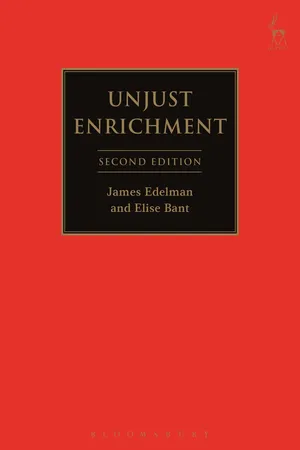
Unjust Enrichment
About this book
Unjust enrichment is one of the least understood of the major branches of private law. This book builds on the 2006 work by the same authors, which examined the developing law of unjust enrichment in Australia. The refinement of the authors' thinking, responding to novel issues and circumstances that have arisen in the maturing case law, has required many chapters of the book to be completely rewritten. The scope of the book is also much broader. It concerns the principles of the law of unjust enrichment in Australia, New Zealand, England and Canada. Major decisions of the highest courts of these jurisdictions in the last decade provide a fertile basis for examining the underlying principles and foundations of this subject. The book uses the leading cases, particularly in England and Australia, to distil and explain the fundamental principles of this branch of private law. The cases discussed are current as of 1 May 2016 although the most recent could only be included in footnotes.
Information
Part I
The Action For Unjust Enrichment
1
Introduction
In Jones v Randall1 Lord Mansfield said that ‘the law of England would be a strange science indeed if it were decided upon precedents only. Precedents serve to illustrate principles, and to give them a fixed certainty.’ The raison d’être of this book is to explain the principles underlying the law of unjust enrichment, by exegesis from the precedents.
Although this book is the second edition of Unjust Enrichment in Australia, the book now focuses heavily on English law as well as Australian law. At relevant points it also contains discussion of the law in the United States, Canada, and New Zealand. There is a reason for our expanded focus. In 2006 when we published Unjust Enrichment in Australia our focus was on the underdeveloped law of unjust enrichment in Australia. We wrote Unjust Enrichment in Australia as a blueprint for the future development of the subject in Australia, drawing from precedent and principle. Since that edition, Australian law has developed substantially. In some respects, including the recognition of the concept of a right to retain, it provides a model for the development of English law. In other respects, such as explanation of the elements of the reductionist enquiry into the components of an unjust enrichment claim, English law has developed more rapidly. The ability for these two jurisdictions to learn and borrow from each other is a strong reason for the expanded scope and comparative focus of this new edition. The question marks which still hang over the existence of the subject in Australia provides a further basis for critical examination of central propositions which are taken for granted in English law, and approached, in some cases, differently in Canada.
At the boundaries of any subject there is scope for different jurisdictions to take different approaches. But we consider that developments in England and Australia emphasise that the core of unjust enrichment is truly common law based on shared underlying principles. To write a book today which is concerned only with the Australian common law of unjust enrichment would be parochial and insular. This new edition of the book, many chapters of which have been completely rewritten, is conceived as a true consideration of the common principles of the law of unjust enrichment. The differences between English and Australian law of unjust enrichment, including the different constitutional contexts, generally fade into the background when compared with the vast number of truly common issues raised within the subject, including those which the courts of neither country have yet considered. As Lord Neuberger said in FHR European Ventures LLP and others v Cedar Capital Partners LLC,2 it is ‘highly desirable for all those jurisdictions to learn from each other, and at least to lean in favour of harmonising the development of the common law round the world.’ Although there are differences between unjust enrichment in English law and in Australian law, as Professor Häcker has explained this minor degree of variance between common law systems3
is not merely tolerable, but positively desirable, provided that certain minimum conditions securing overall compliance are met. To avoid a break-up such as befell the ius commune from the late 18th century onwards, plunging continental legal systems into national isolation (which they are now trying to overcome), it is essential that common lawyers maintain and nurture a climate where one jurisdiction takes cognisance of the developments in another and where intellectual exchange can thrive.
Despite the exponential growth of learning in this subject in recent decades, there are many details of the law of unjust enrichment which have yet to be worked out by Australian and English courts. One reason for this is that in the life of the law, the law of unjust enrichment is still an infant. Our common law of contract and torts only began to emerge in a coherent form in England and the United States in the second half of the nineteenth century. There was a heavy civilian influence. The law of trusts had emerged a little earlier. But, as Frederick Pollock explained, the ‘scientific’ treatment of principles of English law began in ‘that classical period of our jurisprudence’ between 1852 and 1875.4 In contrast, unjust enrichment did not emerge as a recognised branch of the law of obligations until the later twentieth century: 1954 in Canada,5 1987 in Australia6 and 1991 in England.7 Some of the brilliant writers, such as James Barr Ames, who were part of the formative processes for the law of contract and the law of torts had also written on the law of unjust enrichment. But they were the exceptions. Academic writing on unjust enrichment was sparse until the mid-twentieth century. The subject was hidden in the interstices of the law of contract, in forms of actions in indebitatus assumpsit, and in particular bills in equity.
In the development of the law of contract and the law of torts in the late nineteenth century, judges were heavily influenced by academic writing. From the mid-twentieth century, there was an era of prolific scholarship in unjust enrichment. The explicit judicial recognition of the law of unjust enrichment was also based on academic writing. And academic writing devoted to exposing the principles of the law of unjust enrichment kept moving ahead of the cases. But there is now a vast corpus of case law and, as emphasised recently by the Court of Appeal in Investment Trust Companies (In Liquidation) v Revenue and Customs Commissioners,8 it is that case law which forms the primary source material for development of the law. For that reason, this book focuses first and foremost on the cases, although we draw from academic writing in areas where case law is deficient, or where academic writing has provided additional clarity concerning the underlying principle, or where underlying principles cannot be drawn from the cases.
Although this book focuses heavily on the principles as extracted from the cases, we reiterate the vast influence that academic scholarship has had on the development of this area of law, from the most fundamental issues in this branch of private law to the most mundane. Like the leading cases, our scholarship in this book, and the exegetical exercise in which we are engaged, owes a vast debt to the leading, and pioneering, academic works of three scholars of the twentieth century. They are Robert Goff (later Lord Goff), Gareth Jones, and Peter Birks. It was the books by these authors in 1966 and 1985 which became the bedrock upon which the modern law of unjust enrichment developed in England and Australia.9 Other commentators have shone further light on the tributaries of the river mapped by Goff and Jones and Birks. In England those writers include Professors Burrows, Virgo, Mitchell, Mitchell and Watterson. In Australia the writers include Professors Mason, Carter, and Tolhurst. In Canada they include Professors Maddaugh, McCamus, and McInnes. Although we differ from these writers in some respects, and occasionally in major respects, this book owes much to these writers and their explanations of the law of unjust enrichment.
Although this book’s primary focus is the cases, it is not a compendium of cases. With the proliferation, and increasing sophistication, of search engines, blogs, and online indices of cases, there is little place for such books today. Nor is this book merely an exercise in what is sometimes pejoratively described as ‘top-down reasoning’. Although this label can be misleading because almost all analogical reasoning in law involves a top-down aspect, we are not engaged in an exercise of supposing what the law should be and then identifying cases with results which might fit that picture. Instead, the function of this book for an English and Australian audience is to set out the principles of the law of unjust enrichment which emerge from the norms as reflected in the broad pattern of cases, including both the reasoning and results. However, in many of the older cases there is no judicial reasoning to explain why a defendant was unjustly enriched. We use those cases, as well as modern, sometimes conflicting, decisions to explicate the principles by which the law of unjust enrichment has developed and by which it should develop. Throughout, our focus is on the matrix of private law. It is on coherence within the law of unjust enrichment and also between unjust enrichment and the broader private law of obligations. For these reasons, although our examination is heavily rooted in the case law, there are occasions where we explain that even some judicial decisions in the highest courts in Australia or England cannot be justified.
Apart from the increased focus on English law, there are other major changes that have led to much of the first edition of this book being completely rewritten. For instance, a significant departure from the previous edition is that we explain that when asking whether an enrichment was unjust, it is necessary to ask both whether there was an ‘unjust factor’ and whether there is any juristic reason ...
Table of contents
- Cover
- Title Page
- Contents
- Table of Cases
- Table of Legislation
- Part I: The Action For Unjust Enrichment
- Part II: Elements of Unjust Enrichment
- Part III: The Unjust Factors
- Part IV: Defences
- Index
- Copyright Page
Trusted by 375,005 students
Access to over 1.5 million titles for a fair monthly price.
Study more efficiently using our study tools.
Frequently asked questions
Yes, you can cancel anytime from the Subscription tab in your account settings on the Perlego website. Your subscription will stay active until the end of your current billing period. Learn how to cancel your subscription
No, books cannot be downloaded as external files, such as PDFs, for use outside of Perlego. However, you can download books within the Perlego app for offline reading on mobile or tablet. Learn how to download books offline
Perlego offers two plans: Essential and Complete
- Essential is ideal for learners and professionals who enjoy exploring a wide range of subjects. Access the Essential Library with 800,000+ trusted titles and best-sellers across business, personal growth, and the humanities. Includes unlimited reading time and Standard Read Aloud voice.
- Complete: Perfect for advanced learners and researchers needing full, unrestricted access. Unlock 1.5M+ books across hundreds of subjects, including academic and specialized titles. The Complete Plan also includes advanced features like Premium Read Aloud and Research Assistant.
We are an online textbook subscription service, where you can get access to an entire online library for less than the price of a single book per month. With over 1.5 million books across 990+ topics, we’ve got you covered! Learn about our mission
Look out for the read-aloud symbol on your next book to see if you can listen to it. The read-aloud tool reads text aloud for you, highlighting the text as it is being read. You can pause it, speed it up and slow it down. Learn more about Read Aloud
Yes! You can use the Perlego app on both iOS and Android devices to read anytime, anywhere — even offline. Perfect for commutes or when you’re on the go.
Please note we cannot support devices running on iOS 13 and Android 7 or earlier. Learn more about using the app
Please note we cannot support devices running on iOS 13 and Android 7 or earlier. Learn more about using the app
Yes, you can access Unjust Enrichment by James Edelman,Elise Bant in PDF and/or ePUB format, as well as other popular books in Law & Contract Law. We have over 1.5 million books available in our catalogue for you to explore.