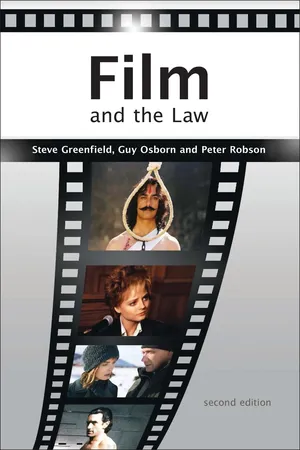
Described by Richard Sherwin of New York Law School as the law and film movement's 'founding text', this text is a second, heavily revised and improved edition of the original Film and the Law (Cavendish Publishing, 2001). The book is distinctive in a number of ways: it is unique as a sustained book-length exposition on law and film by law scholars; it is distinctive within law and film scholarship in its attempt to plot the parameters of a distinctive genre of law films; its examination of law in film as place and space offers a new way out of the law film genre problem, and also offers an examination of representations of an aspect of legal practice, and legal institutions, that have not been addressed by other scholars. It is original in its contribution to work within the wider parameters of law and popular culture and offers a sustained challenge to traditional legal scholarship, amply demonstrating the practical and the pedagogic, as well as the moral and political significance of popular cultural representations of law.
The book is a valuable teaching and learning resource, and is the first in the field to serve as a basic guidebook for students of law and film.
- 358 pages
- English
- ePUB (mobile friendly)
- Available on iOS & Android
eBook - ePub
About this book
Information
1
Film and the Law: an Orientation
Film and the law appears to be thriving. As the text illustrates, significant developments have occurred in many aspects within the field. Significantly we have had a shift further towards both the theoretical and the empirical. At the same time the numbers of scholars teaching and researching in the area has increased. This chapter seeks to provide an initial orientation of these developments, many of which will be interrogated in greater depth in later chapters. As part of this we seek to set down some markers as to the purpose and prospects for work in this area, and to chart how work in the area has been impacted upon by both the theoretical, and the empirical.
Law and Film Scholarship
The scholarship on law and film is both extensive and diverse. Since many of the films examined recur in different books and essays, and in differing contexts, we must be careful not to assume that the specificities of their discussion do not vary accordingly. Given especially that much of the initial work in the field emanated from the United States, it is important to note that much of the individual work that has been undertaken reflects the distinct legal framework in which it takes place, as well as local educational structures. This might seem an obvious point, but very few writers presage their remarks by emphasising the particularity of their situation. Almost no writers indicate the nature of their approach or the limited applicability of their remarks. Writers it seems to us imply by their silence that their comments are capable of being universally applied. They may, perhaps, hope that this is the case. It may be that since film is a global phenomenon, any comments are assumed to have the same properties. This we consider limits the effectiveness of scholarship. Failing to acknowledge the specific cultural situation means the context is not revealed. What may pertain in one jurisdiction in terms of the politics of the judiciary, or the reputation of practising lawyers, may be entirely different in another jurisdiction. Just because we tend to watch the same cultural products does not mean they have the same resonance to every audience.
Thus when we come across work on some feature of law, such as the jury, any remarks need to be limited to those systems where there are very similar institutions. Failure to limit the scope of comments has not in the past been helpful. Recognising the specifics of different legal cultures and popular cultures was not a feature of the early work on law and film, largely because of the hegemony of Hollywood and the Anglo-American adversarial jury-centred system. Given that a significant proportion of the scholarship on law and film takes place outwith the United States the distinct nature of other legal cultures needs to be noted. Otherwise any scholarship speaks only to the American and ignores all the other states with legal systems.
There are very basic differences in focus between those working in American law schools and their colleagues in other jurisdictions, especially as far as becoming lawyers is concerned. The role of education in this process, and where law and film sits as a discipline, needs to be explained. In the United States most of the students are studying law as a graduate course with a view to practice rather than, say, the British model where law is taken as a possible route into practice. After graduation in this model, law students are required to undertake a postgraduate year of professionally orientated study. In Europe there is a very different set of arrangements, with students opting between private practice, the prosecution service and the judicial profession. There has also been considerable interest from those with no direct contact with law teaching or the legal profession, and their interests are rather different from those engaged in teaching and research within legal academia.
Scholarship has flowed from various different questions addressed in relation to film. The interests of scholars have been quite distinct and it is crucial to understand the parameters of these rather different goals. This should address the problem that has emerged in various critical commentaries on earlier works. Whilst our work has sometimes been highly praised, it has also been subject to critique—this has largely focused upon an alleged failure to fully address the concerns of film theory, or for not including television in a study of law and film.[1] It is unhelpful, we submit, for critics to lament the fact that the book or article in question is not the one the critic personally would have written had he or she been writing on, for instance the films of Alfred Hitchcock or Sidney Lumet, the film theory of Jacques Deleuze or the history of the much underrated Carry On … canon.
By seeking to organise the broad literature on the relationship between law and film in the chosen method, we hope that the distinctive contributions of scholars will be recognised, and that participation be encouraged, even where it fails to contribute to, for instance, the development of legal doctrine or film theory. The work, for instance, of Mike Nevins, in drawing attention to the possibilities of B Movie Westerns to provide an alternative location for discussing the nature of justice, should not be dismissed because he does not contribute in this work to debate on whether these films were influential in changing the public mood on the death penalty, or policies in relation to judicial appointments.[2] By the same token, Nevins’ description of the films, made between 1928 and 1934, will provide a valuable resource for anyone taking on the task of a comprehensive history of lawyer films from the birth of cinema, without adding to debates on how music and lighting contributed to the aesthetic pleasures to be derived from law films of this era.[3] In this way work can be considered on its own merits, outside of any particular critic’s own agenda or hobby-horse, although obviously, where relevant, work may be subject to critique.
At this juncture we also believe that law and film studies will benefit from a critical appraisal of what has been achieved, what gaps there are in coverage, and how the area might develop in the future. By its very nature, there is no guiding body in a position to prescribe what might be done, in the way that the Critical Legal Studies Movement, for example, may have proposed a reading of the law of tort or contract.[4] We offer this assessment in the spirit of academic commentators who have worked extensively in the area and who are keen to encourage both a greater volume of work as well as a more engaged kind of scholarship. We are attracted by the idea that the political aspects of this part of practice need to be expressed less obliquely. Long-time radical singer Pete Seeger, in the context of another part of culture, outlined his musician father’s view that ‘The necessary question to ask is not “Is it good music?” but “What is the music good for?”’.[5] We have been concerned for a number of years at the way in which the diversity of approaches in law and film studies threatens to overwhelm its founding principle of engaging students in a liberating intellectual and socially significant process. There is a danger that, in the climate in which scholarship operates in the major areas of activity, it will become impenetrable in its language and arcane in what it seeks to illuminate, and therefore its ideology is rendered opaque.
Law and film is now a relatively mature discipline and has changed markedly since we first produced teaching materials, articles and conference papers. There is a fabulous wealth of material, demonstrating a broad range of aims and methods. Some of these show the way in which the use of film can supplement legal study and involve truly imaginative approaches to areas of scholarship. Others show a use of language that may prove baffling to the beginner and involve an opaque methodology. These comments on the current state of law and film studies outline reasons why some of these developments have taken place, and the problems and differences that have emerged. The relevant areas can be divided into questions of methodology, issues of theoretical engagement and the use of language.
Methodology
Decisions about what the subject matter is, and how enquiry should be carried out, were largely overlooked in the early scholarship. Here was a new (to lawyers) resource—film—highlighting a range of questions in relation to the practice of law. Exactly what one did with this new resource was determined by one’s traditional method of analysing texts for their meaning. Film was no different. It was simply another text that had both clear meaning on its surface as well as other rather more oblique significance and potential meanings. Thus we had The Man Who Shot Liberty Valance (1962) seen as a metaphor for two different concepts of the nature of law.[6] A more modern and innovative example is to use Judge Dredd (1993) to demonstrate how law is divested in figures of authority. We can use films as examples of the source and authority of law; in one version law is shown as emerging organically through the will of the people whilst in the other law is vested in and dispensed from some authoritative source. A slightly different approach is identified by Spelman and Minow through Thelma and Louise (1991).[7] The discussion here is a central theme which crops up in both legal discourse as well as, more broadly, the role of confidence and specifically the ordeal posed by a rape trial.
Much of the early work was relatively modest in its goals; exposing problems with evidence, looking at the accuracy of the legal rules and the realism of portrayal of the personnel presented on screen, for example. A key point in this swathe of work was accuracy and realism, contrasting screen law with ‘real’ law. However, there was little attempt to explore the consequences of any identified gap between film and practice. This is understandable given the enormous and complicated nature of the task involving psychological enquiry and empirical survey. The causal relationship between media portrayals and subsequent beliefs or actions is controversial and highly problematic. Perhaps the location of law as a postgraduate vocational discipline explains the concern of US academics with realism in practice. Undergraduate legal education is less concerned with legal practice so ideas and theories of law may come more to the fore. However, there are UK examples of the realist school. Greenfield and Osborn (1996) adopted a critical approach to two films based on real life events, In the Name of the Father (1993) and Let Him Have It (1991), and their framework was not just to identify flaws and inaccuracies, but to offer some tentative thoughts about the significance of the portrayals. The methodology was to analyse a wide range of non-legal materials that outlined the events. This extended to interviewing the late Iris Bentley (sister to Derek, the central figure in Let Him Have It (1991)) to determine how those close to the ‘story’ felt about the cinematic version of their lives. Iris had mixed views on the film, unhappy with some of the inaccuracies but pleased to keep the case in the public eye. She had nothing but praise for Christopher Ecclestone, who played Derek.[8]
There has, however, been work that has sought to draw rather more elaborate conclusions from the material. A couple of examples illustrate such perspectives. For example, in his examination of the making and re-making of the film Cape Fear (1993), Richard Sherwin draws conclusions about the nature of shifts in American society and the role of lawyers between the late 1950s and the 1990s.[9] His comments appear perceptive and well grounded at the general level, although not necessarily supported by data on levels of respect for lawyers and their changing societal role. The problem, though, is the way in which the cinematic evidence is used as a key to the zeitgeist. How does a trend become significant? How many films should we be looking at? What period of time might we observe? What about the issue of changes in different generations’ perceptions of earlier films?
There are other concerns where we move beyond the imprecise boundaries of zeitgeist. Mark Tushnet examines the film Class Action (1990), not in terms of its s...
Table of contents
- Cover
- Title
- Copyright
- Preface
- Contents
- 1. Film and the Law: an Orientation
- 2. The Penetration of Law and Film
- 3. Theoretical underpinnings and physical boundaries—defining the territory
- 4. Strictly Courtroom? Law Film and Genre
- 5. The British Law Film: From Genre to Iconography
- 6. Military Justice on Screen
- 7. Assessing Cinematic Lawyers (I): Heroes and Villains
- 8. Assessing Cinematic Lawyers (II): Alternative Categorisations
- 9. Missing in Action (I): Judges
- 10. Missing in Action (II): Juries
- 11. Fact, Fiction and the Cinema of Justice (I): Presumed Accurate?
- 12. Fact, Fiction and the Cinema of Justice (II): Specificities
- 13. Love Vigilantes: Private Eyes and Beyond
- 14. Playing with a Different Sex
- 15. Minority Report? Ethnicity in Film
- 16. Future Trajectories and Possibilities
- Bibliography
- Index
Trusted by 375,005 students
Access to over 1.5 million titles for a fair monthly price.
Study more efficiently using our study tools.
Frequently asked questions
Yes, you can cancel anytime from the Subscription tab in your account settings on the Perlego website. Your subscription will stay active until the end of your current billing period. Learn how to cancel your subscription
No, books cannot be downloaded as external files, such as PDFs, for use outside of Perlego. However, you can download books within the Perlego app for offline reading on mobile or tablet. Learn how to download books offline
We are an online textbook subscription service, where you can get access to an entire online library for less than the price of a single book per month. With over 1.5 million books across 990+ topics, we’ve got you covered! Learn about our mission
Look out for the read-aloud symbol on your next book to see if you can listen to it. The read-aloud tool reads text aloud for you, highlighting the text as it is being read. You can pause it, speed it up and slow it down. Learn more about Read Aloud
Yes! You can use the Perlego app on both iOS and Android devices to read anytime, anywhere — even offline. Perfect for commutes or when you’re on the go.
Please note we cannot support devices running on iOS 13 and Android 7 or earlier. Learn more about using the app
Please note we cannot support devices running on iOS 13 and Android 7 or earlier. Learn more about using the app
Yes, you can access Film and the Law by Steve Greenfield,Guy Osborn,Peter Robson in PDF and/or ePUB format, as well as other popular books in Law & Jurisprudence. We have over 1.5 million books available in our catalogue for you to explore.