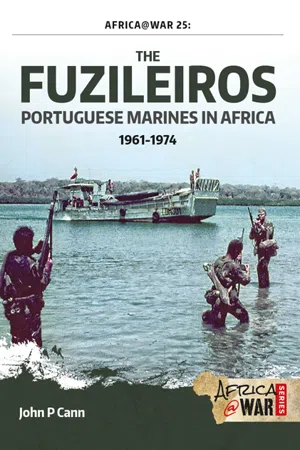
In 1961, Portugal found itself fighting a war to retain its colonial possessions and preserve the remnants of its Empire. It was almost completely unprepared to do so, and this was particularly evident in its ability to project power and to control the vast colonial spaces of Africa. Following the uprisings of March 1961 in the north of Angola, Portugal poured troops into the colony as fast as its creaking logistic system would allow; however, these new arrivals were not competent and did not possess the skills needed to fight a counterinsurgency. While counterinsurgency by its nature requires substantial numbers of light infantry, the force must be trained in the craft of fighting a 'small war' to be effective. The majority of the arriving troops had no such indoctrination and had been readied at an accelerated pace. Even their uniforms were hastily crafted and not ideally suited to fighting in the bush. In reoccupying the north and addressing the enemy threat, Portugal quickly realized that its most effective forces were those with special qualifications and advanced training. Unfortunately there were only very small numbers of such elite forces. The maturing experiences of the Portuguese and their consequent adjustments to fight a counterinsurgency led to the development of specialized, tailored units to close the gaps in skills and knowledge between the insurgents and their forces. This book is about the Fuzileiros or Portuguese marines, a naval force that operated in the riverine littorals of Africa and that was both feared by the enemy and loved by those loyal to Portugal. The Fuzileiros underwent one of the longest and most physically demanding specialist infantry training regimes in the world, lasting some forty-two weeks. Perhaps only 15 to 35 percent of the inductees eventually passed the course and were awarded the traditional and highly coveted navy blue beret. When deployed to Africa, they underwent further acclimation for weeks until they were able to move through the slime and mud of a riverbank with ease, as their lives depended on it. They became experts at riverine warfare and regularly ranged inland on extended patrols, many of which are recounted here. They were comfort able with the uncomfortable fighting environment, and this ability translated into an unpredictability that the enemy feared. This book is the story of how they came to be formed and organized, the initial teething difficulties, and their unqualified successes.
- 72 pages
- English
- ePUB (mobile friendly)
- Available on iOS & Android
eBook - ePub
About this book
Trusted by 375,005 students
Access to over 1.5 million titles for a fair monthly price.
Study more efficiently using our study tools.
Information
Subtopic
African HistoryIndex
HistoryCHAPTER 1
INTO AFRICA
INTO AFRICA
Beginning in 1947 with the independence of India, Great Britain began the dissolution of its Empire. After two unsatisfactory colonial wars (one in Indochina and the other in Algeria), France dismantled its Empire. Portugal was now the remaining colonial power. Its position was very different from Britain and France in that it had been in Africa since the beginning of the 15th century – over four-and-a-half centuries – and longer by far than any other colonial power. It considered its overseas territories, known as the ultramar, an integral part of continental Portugal and refused to consider granting independence to them. Its commitment to their defense had its origins not only in their long-term ownership, but also in their economic promise and the inflexible African policy of Dr António Salazar, the Prime Minister. With the progressive decline of its trading position in the Indian Ocean beginning in 1578, the loss of its colony of Brazil in 1822 and the missed opportunity of a coast-to-coast possession in austral Africa in 1890, the only potential of the Empire lay in the large (but incompletely developed) colonies of Angola and Mozambique. These in Portuguese minds held the promise of a renewed prosperity and greatness. Further, with the heritage of having been Portuguese for so long, their ownership was to be defended at all costs. For this small European nation, the importance of the colonies was captured in an editorial by Dr Marcello Caetano in O Mundo Português (Portuguese World) that appeared in 1935: ‘Africa is for us a moral justification and a raison d’être as a power. Without it we would be a small nation; with it, we are a great country’.1 The growth of revolutionary climate in the ultramar during the 1950s clashed with this philosophy and the country’s refusal to break the colonial bond and to decolonize. The ‘winds of change’ were blowing through Africa, but the Salazar regime refused to consider holding democratic elections or decolonizing.
Political opposition to Salazar and his policies was tolerated neither at home nor in the ultramar. An explosion was inevitable, and when it happened in 1961, the events in Angola and the seizing of Goa by India pushed Salazar to solidify the Portuguese commitment to defend the colonies. So strong was this feeling that it defied any voice of reason and foreclosed any retreat or compromise over African affairs. The Portuguese armed forces and treasure were thus pledged in full to preserve its Empire and the potential of renewed prosperity through an expensive counterinsurgency campaign.
Naval War Planning
The naval component in counterinsurgency often suffers from the primacy of the army and a lack of understanding on the part of national leaders as to how a riverine force can most effectively be used to support a land campaign. This primacy is understandable due to the fact that this form of war requires large numbers of light infantry to police the contested territory. All key infrastructure, villages and their inhabitants must be protected against an enemy who chooses when and where he will attack. Yet he must travel to the vulnerable installations and population centers to publish his message, recruit membership and raise money. To do this he must cross or use rivers, and in Africa, he must cross or use many of them. During the rainy season, these present formidable barriers. If they are policed, they may present very difficult or even impenetrable ones. In Lusophone Africa, where the fuzileiros distinguished themselves during the African campaigns, naval operations were most effective when they complemented the land campaign. In Angola, where there was excellent naval-land coordination, success was clearly achieved and the nationalist movements were completely stalemated. In Guiné and Mozambique, the two theaters where variations of a naval-land disconnect occurred, the enemy pressure proved difficult to contain. The fuzileiros represented the naval-land bridge, and it fell to them to police the riverbanks and their approaches. Their amphibious capability was developed from scratch and reflected the depth and thoughtfulness of Portuguese Navy-thinking in building and deploying a substantial riverine capability in the hostile remoteness of a distant continent. To this day, Portuguese riverine strategy and its execution remain a successful and relevant model.

Portuguese Africa

Angola.

Guiné.
The leader in Portuguese naval thinking at the time was Captain Armando Júlio de Roboredo e Silva, and in February 1959, he initiated a request for an officer and three ratings to undergo Royal Marine training in what would become a first step in the reactivation of the fuzileiros.2 As awareness of the coming conflict in Africa spread, a naval strategy for counterinsurgency there began to emerge. At the beginning of the war, Roboredo was promoted to Deputy Chief of Staff, and then between 1963 and 1970 he served as Chief of Staff. Under his hand, naval policy crystallized into a firm operational plan with the means to execute it.

Mozambique.
Roboredo, in developing his naval strategy, acknowledged that in a subversive war the navy extends its traditional twin tasks of securing the waterways for friendly use and of denying them to the enemy. Travel and traffic by water have always been cheaper and easier than by land, and thus in the rural, less developed areas (particularly in Africa), the contiguous waterways of a territory serve as vital arteries for commerce and war. These water bodies in particular hold great significance for military operations, as they present a natural obstacle to maneuver and provide ideal defensive terrain. They serve as natural boundaries to a battlefield; they are navigation aids and provide orientation; they are avenues of approach for combat and lines of communication for logistic operations. The enemy will likewise recognize their significance and value and seek to control the population, commerce and combat along these waterways. In any insurgency the population is the actual battleground, and the contest is for the loyalty of the people – thus a navy in counterinsurgency must fight for the effect that it can secure ashore where people live. Because of this land orientation, its operations will almost always be a joint enterprise with ground and air elements.
In addressing security in the Portuguese African territories, the navy was quick to recognize the obvious needs and consequently began to review its ‘gunboat policy’ of the previous century that had served it so well in the pacification of the ultramar.3 This outdated policy, however, was hardly adequate in light of the situation developing in Africa – so in January 1957, a new program was proposed: one that would be for Portugal as revolutionary as the shift from wooden to steel ships. It envisioned a small, tailored force that would be established in the ultramar as the basis for future expansion to address the new security situation and that would avoid infringing on the NATO obligations.4 The composition of this force remained under some debate, and eventually it was settled as a force of fuzileiros and attendant inshore ships adapted to the African environment.5 The assembly of this African Navy and its evolution became the most noteworthy naval development during the early years of the war.

Admiral Armando Júlio de Roboredo e Silva, Chief of Staff and founder of the modern fuzileiros, commissioning the first Naval Reserve medical doctor in 1968.
(Source: Estado-Maior da Armada and Revista da Armada)
(Source: Estado-Maior da Armada and Revista da Armada)
The Portuguese requirements in Africa were embodied in three types of vessels: patrol boats (lanchas de fiscalização, or simply, LF) and landing craft (lanchas de desembarque, or simply, LD), both of various class sizes, and rubber boats (botes de borracha). All of these were a blend of the French and British experiences adapted to the conditions in Portuguese Africa. The LFs would be direct successors of the earlier coastal and river gunboats (canhoneiras and lanchas-canhoneiras, respectively) that had ranged from 38 tons to 492 tons displacement. Their mission would be one of patrolling Portuguese territorial waters, inspecting vessels suspected of supporting the insurgent movements and transporting small units of fuzileiros to be inserted ashore in rubber boats. Once ashore, the fuzileiros would gather intelligence, kill insurgents, disrupt food gathering and courier traffic, and make contact with the population. Because of the low-intensity nature of the conflict, it was not anticipated that these boats would face a conventional land force with its relatively heavy crew-served weapons, as the French had experienced in Indochina. Instead they would encounter small bands of insurgents armed with what each could carry. These would include recoilless rifles, machine guns, rocket-propelled grenades (RPGs), mortars and mines – all dangerous enough in their own right, but seemingly not requiring the heavy armor or extensive armament of their forbearers. With these constraints removed, the navy was free to abandon the wood and steel shipbuilding materials of earlier years and explore modern, lightweight fiberglass and plywood hulls for the new LF concept. In this era, most boat-builders subscribed to the idea that ‘fiberglass was for bathtubs and not boats’.6 While a fiberglass boat was not novel at the time, such craft over six meters in length were rare. This did not inhibit the navy, however, from proceeding. The boats were designed for range, ease of maintenance, shallow draft, maneuverability and the capacity to carry small detachments of fuzileiros and their equipment for insertion ashore.

The Canhoneira Limpopo: one of the important vessels in Portuguese ‘gunboat policy’ that protected the littorals of Angola and Mozambique at the turn of the 20th century.
(Source: Estado-Maior da Armada and Revista da Armada)
(Source: Estado-Maior da Armada and Revista da Armada)
The same can be said for armament. It was thought that heavy cannon and automatic weapons were not needed and merely complicated boat design, as they and their ammunition stores raised the center of gravity. Simpler, lighter and highly potent weapons were available and had been proven in Indochina. The new, lighter hulls and selectively installed armor would simplify maintenance, lessen draft and add range, maneuverability and increased speed to the new boats. Fiberglass is easily repaired, and such a hull offered a backhanded sort of protection in that the insurgents’ main ...
Table of contents
- Cover
- Title Page
- Copyright
- Contents
- Glossary
- Introduction
- Chapter One: Into Africa
- Chapter Two: The North of Angola
- Chapter Three: The Rivers of Guiné
- Photo Gallery
- Chapter Four: Niassa and the Indian Ocean
- Chapter Five: East of Angola
- Chapter Six: The Cost
- Bibliography
- Acknowledgments
Frequently asked questions
Yes, you can cancel anytime from the Subscription tab in your account settings on the Perlego website. Your subscription will stay active until the end of your current billing period. Learn how to cancel your subscription
No, books cannot be downloaded as external files, such as PDFs, for use outside of Perlego. However, you can download books within the Perlego app for offline reading on mobile or tablet. Learn how to download books offline
Perlego offers two plans: Essential and Complete
- Essential is ideal for learners and professionals who enjoy exploring a wide range of subjects. Access the Essential Library with 800,000+ trusted titles and best-sellers across business, personal growth, and the humanities. Includes unlimited reading time and Standard Read Aloud voice.
- Complete: Perfect for advanced learners and researchers needing full, unrestricted access. Unlock 1.5M+ books across hundreds of subjects, including academic and specialized titles. The Complete Plan also includes advanced features like Premium Read Aloud and Research Assistant.
We are an online textbook subscription service, where you can get access to an entire online library for less than the price of a single book per month. With over 1.5 million books across 990+ topics, we’ve got you covered! Learn about our mission
Look out for the read-aloud symbol on your next book to see if you can listen to it. The read-aloud tool reads text aloud for you, highlighting the text as it is being read. You can pause it, speed it up and slow it down. Learn more about Read Aloud
Yes! You can use the Perlego app on both iOS and Android devices to read anytime, anywhere — even offline. Perfect for commutes or when you’re on the go.
Please note we cannot support devices running on iOS 13 and Android 7 or earlier. Learn more about using the app
Please note we cannot support devices running on iOS 13 and Android 7 or earlier. Learn more about using the app
Yes, you can access The Fuzileiros by John P. Cann in PDF and/or ePUB format, as well as other popular books in History & African History. We have over 1.5 million books available in our catalogue for you to explore.