Readers are introduced to a range of theoretical and methodological approaches used to understand religion – including sociology, philosophy, psychology, and anthropology – and how they can be used to understand sport as a religious phenomenon. Topics include the formation of powerful communities among fans and the religious experience of the fan, myth, symbols and rituals and the sacrality of sport, and sport and secularization. Case studies are taken from around the world and include the Olympics (ancient and modern), football in the UK, the All Blacks and New Zealand national identity, college football in the American South, and gymnastics.
Ideal for classroom use, Understanding Sport as a Religious Phenomenon illuminates the nature of religion through sports phenomena and is a much-needed contribution to the field of religion and popular culture.
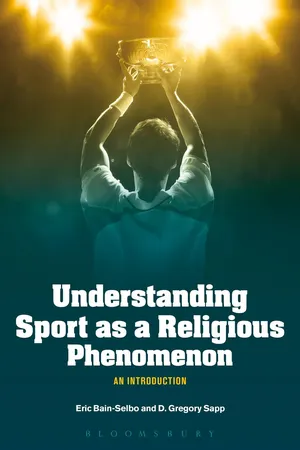
eBook - ePub
Understanding Sport as a Religious Phenomenon
An Introduction
- 184 pages
- English
- ePUB (mobile friendly)
- Available on iOS & Android
eBook - ePub
About this book
Information
1 Introduction
The academic field of religion and sport is fairly new, having originated in the later part of the twentieth century. One of the first important works to address the field was The Joy of Sports: Endzones, Bases, Baskets, Balls, and the Consecration of the American Spirit by Michael Novak.1 He first published this book in 1976 and published revised editions in 1988 and 1994. In 1984, Joseph L. Price first published his piece, “The Super Bowl as Religious Festival,” in The Christian Century2 and has since republished it in From Season to Season: Sports as American Religion.3 Novak and Price (who has written or edited other works in the field) are often cited by those of us who work in this emerging field, and rightly so. They have raised issues and questions that need addressing by a larger audience. Since those early days of religion and sport scholarship, there have been many books and articles written that address some aspect of sport and religion. One need only glance at our bibliography at the end of this book to get a glimpse of the work that has been done in the last forty years or so.4
Some articles and books look at only one sport, or even at one sporting event, as does Price’s article on the Super Bowl. Some focus only on major sports in the United States as does Novak’s The Joy of Sports. Some scholarship focuses on one aspect of religion in the way Tracy Trothen’s article “Better Than Normal?: Constructing Modified Athletes and a Relational Theological Ethic”5 does. Rather than address one aspect of sport as it relates to religion or one aspect of religion as it relates to sport, we wanted to write a book that we hope serves as an introduction to the field and to provide convincing arguments that sport can be religious whether from the perspective of the athletes or the fans. We illustrate our arguments using sports and religions from around the world so that we really deal with religion and sport in general, not with a particular religion or sport that may or may not represent the whole. We are looking at the human condition in general to see similarities between the practice of religion and the practice of sport.
We want to be clear about what it is we think we are doing here. First, we are not arguing that sport in general or any particular sport is a religion in the same way that Hinduism is a religion. We understand that religions tend to have elements of the “supernatural,” for example, and this is not the case with sport (for the most part, a notable exception being the ancient Greek games played in honor of the gods and sometimes with the gods’ help). While fans and athletes may argue which sport is better, questions of ultimate truth are not usually raised. For example, some may argue that a card game of poker is not a sport in the same sense that curling is a sport and thus should not receive television coverage by a cable television show devoted exclusively to sport. However, no one is going to argue that curling is truer than poker as one might argue that the teachings of Hinduism are truer than those of Islam. Religious adherents tend to defend the ultimate truth of their tradition because their eternal destiny is thought to be tied up with the truth of that tradition. We have not run across any fans of a particular team who believe that if they are completely devoted to their team showing true dedication and loyalty throughout their lives they will then be transformed at death into a new existence that far surpasses this one in a world, perhaps, where their team never loses.
We are also not concerned with athletes or fans as followers of a particular religion. When we tell our friends, family, even colleagues that we are working in the field of religion and sport we sometimes get a response like, “Oh yeah, Tim Tebow prays a lot and is very religious.” Or, “I always wondered if it was okay to ask God for your team to win. Doesn’t God love the other team as well?” While the personal religious habits of a particular athlete or fan may be interesting and even inspiring to those who share that athlete’s faith, we see no difference between a player making a gesture toward heaven or bowing her head after a good play as if to thank God and a salesperson kneeling at his desk to offer a prayer of thanks after closing a sale. A player who exhibits religious practice on the field or during a postgame interview is no different than someone praying at the office. In both cases, the individuals are merely bringing their religion into the workplace, wherever that may be. An athlete being a practicing Christian does not make her sport religious any more than a US Congressperson being a Christian makes Congress Christian. There are plenty of books by athletes who share their stories of faith during big games or even of their faith getting them through life’s trials. This is not one of those books. Nor is it a book dealing with the ethics of one team praying to God for a win against the opponent, though that is an interesting theological and philosophical question.
Finally, we are not arguing that sport is religious because some follow it “religiously.” Some would say of devoted fans, “They attend every game religiously.” This is no different than someone who watches a television program “religiously” or someone who brushes his teeth after every meal “religiously.” Used in this sense, “religious” means being devoted to something in a serious and committed manner and regularly performing the activity. It is a rather shallow understanding of what it means to be religious.
What we are arguing is that the human drives and needs that compel some to be a part of a particular religion are the same drives and needs that compel some to be a part of sport in some way. That is, we believe the activities and beliefs associated with religion per se are similar, if not identical, to the activities and beliefs of athletes and fans of sport. We are saying that sport can be religious for some in the same way that participating in the activities of a mosque, temple, or church can be religious. Sport can function like a religion in that it meets the same needs and desires satisfied or promised by formal religions.
We say “can” because not all who attend games or participate in them as athletes are doing so from a religious perspective. Some might attend a game out of curiosity or because they were compelled by others to go. For these people, the game might just be a social gathering of sorts, maybe even a waste of time. Not all athletes play for love of the game. Some are compelled by other interests, be they financial or romantic. Then again, not all who attend church on a regular basis are doing so for religious reasons, either. Some attend out of a sense of guilt or simply to enjoy fellowship with others and a good potluck lunch. Putting up a building with religious images in and on it does not make the building sacred space. It must be invested with religiousness by the believer who believes it to be sacred. For example, a Hindu temple may be sacred to a practicing Hindu who worships his god there, but to a visiting Christian, it is merely another building with little to no religious significance at all. The Christian may respect the temple as being sacred to a Hindu, but the Christian will not see it as sacred himself. The sacrality of space and time depends on the individual experiencing the time and space.
For our purposes, we will focus only on fans or athletes who are participating for the purposes of the games themselves. We are concerned with those who are committed to sport at some level and will compare them not to the Christian visiting the Hindu temple but to the Hindu who finds meaning in her faith.
There are some who doubt that sport can be seen as religious. For them, traditions like Jainism, Daoism, Judaism, and Christianity are religious. These religions profess belief in the supernatural, going to church, synagogue, or temple, committing to and getting initiated into a group of like-minded believers who claim to believe the same things with regard to God, gods, the afterlife, Heaven, Hell, and on and on. They have sacred buildings, priests, or ministers in sacred robes, and they perform religious rituals to appease their god(s). So for some, sport cannot function like a religion simply because it does not look like what they believe traditional religions look like.
Part of the problem some have with calling sport a religion stems from an ancient practice of denying anything that seems new the status of religion. While sport is, apparently, as ancient as human culture, the sports with which we are most familiar such as basketball, football, and baseball were invented just recently at the end of the nineteenth century. Soccer as we know it today took its shape in the 1860s, for example. If something seems new, it cannot be religious because religion deals with eternal truths, not “truths” that began 150 or so years ago. For most, religion cannot change because that would make God or the gods susceptible to change. In large measure, we can thank the ancient Greeks for the notion that an unchangeable God is best. If God changes, then that means either God was imperfect before and became perfect or that God was perfect and became imperfect.6 This means that any religion that was new could not possibly be true for the simple fact that it had not been around for very long. A new religion was, in the minds of the establishment, simply made up and, therefore, false. Even those who claimed to have a different (new) perspective on an existing God were deemed suspicious and often persecuted.
Christian apologists of the second century attempted to use reason to convince the Romans that they were not a new religion but were the next step in ancient Judaism which, by the way, preceded Plato. Justin Martyr is, perhaps, the most well known of the early Christian apologists, and he attempted to argue that Jesus was the prophesied messiah that the Jews failed to recognize. Romans tolerated the Jews as long as they paid their taxes and behaved peacefully, but they saw Christians as upstarts and troublemakers promoting a new movement. Justin tried to convince the Romans that Christianity was, in fact, an ancient religion and should, therefore, receive the same tolerance as any other ancient religion. Unfortunately for Justin, his argument failed and he thus earned the title that we now use for his last name.
A more recent example of religious intolerance and persecution can be found in nineteenth-century North America. Joseph Smith (1805–1844) founded what is commonly known as Mormonism in 1830 in the state of New York. Smith claimed to have received a special revelation from God that resulted in the Book of Mormon. In 1843 he claimed to have received another revelation in which the practice of polygamy was sanctioned. He was killed by a mob for his religious beliefs in 1844. When it comes to religion, new is not usually considered good, and this may be part of the reason some balk at the notion of sport functioning as religion.
Perhaps the most common reason some cannot see sport as religion is because sport does not have as its goal a union with the divine or the idea of God. Robert J. Higgs and Michael C. Braswell take this position in their book An Unholy Alliance: The Sacred and Modern Sports.7 They base much of their understanding of religion on Webster’s Dictionary and quote Webster’s first definition of religion:
The service and adoration of God or a god as expressed in forms of worship, in obedience to divine commands, especially, as found in sacred writings [ital. added] or as declared by recognized teachers and in the pursuit of a way of life regarded as incumbent upon true believers, as ministers of religion.8
Because sport does not ostensibly worship God or a god, Higgs and Braswell declare that it cannot be a religion.
They also rely on Rudolf Otto’s notion of the “holy” to argue that there is no religious experience in sport.9 As we will see in more depth in Chapter 2, Otto’s idea of the holy is that it is “wholly other” and is experienced as the “numinous,” a word he coined to describe what is encountered when one encounters God. Sports, Higgs and Braswell surmise, do not deal with anything like the holy: “What we are saying is that the function of sports as a category of human endeavor is not to connect us to that which is holy or even to remind us of the idea of the holy.”10 For them, for something to qualify as a religion, it has to have a notion of the holy and seek to connect humans with that.
Higgs and Braswell attempt to differentiate between the “sacred” and the “holy.” The sacred is a human endeavor while the holy is beyond human control:
The sacred … is set apart by humans and its significance highlighted by manmade symbols and rites, while the holy is set apart by itself or God and embraces all of creation. The holy is a reality wholly beyond our power. The sacred is always indicated by place, time, object, or word, while the holy is beyond place and time and language ….11
This assertion represents the traditional, theistic view of religion where there is a God no one can see except by special revelation or as mediated by a priestly order to laypersons.
With this understanding of religion, we agree with Higgs and Braswell. As we noted above, sport per se does not promote the idea of God, nor does it encourage fans or athletes to seek God in any way. With this narrow understanding of religion, no one would argue that sports are religions. We, however, do not share Higgs and Braswell’s limited understanding of what constitutes religion. The primary fault in their argument from an academic perspective (which is what we are taking here) is that they assume the existence of God as fact and declare that religion can only be defined as seeking unity with that God. Higgs and Braswell use the Christian Bible as though it were an unbiased source of truth.12 For example, they refer to the Day of Pentecost as found in Acts 2 and (American?) frontier camp meetings for “credible accounts” of people being struck by the holy.13 This is perfectly fine to do in a Christian context, but not in an academic context where religious documents are not invested with divine authority.
A second fault in their argument is that they use terms like “divine” and “God” without explaining what they actually are. They assume an understanding common to a confessional setting. This practice is quite common among those who have not critically examined the tenets of their faith. There is an assumption that everyone knows what the “divine” is or what the “supernatural” is or what “God” is. Higgs and Braswell claim that sport is not religion because it is not divine. They say in their Preface, “We suggest that while sports are good, they are not inherently divine.”14 Yet they never attempt to define what the divine is. As noted above, they use Otto to say that religion is about seeking the holy, but if the holy is, as quoted above, “beyond place and time and language,” then nothing within our grasp is holy.
Higgs and Braswell further demonstrate their overly narrow view of religion when they compare modern sports with ancient religious traditions. They imply that both are brutish. Sport is merely physical competition, not devotional supplication:
We are not denying parallels between ancient myth and modern sports but raising a question as to why the latter can still be called a religion. Such a religion does not really involve praying at midfield on one’s knees, … but going back to the jungle on all fours as we see to one degree or another in football in every play.15
Sport is competitive, an attempt to defeat another person or team. It cannot, therefore, be religious. They regard religion as attempting to ...
Table of contents
- Cover
- Halftitle Page
- Title Page
- Dedication Page
- Contents
- List of Figures
- Acknowledgments
- 1. Introduction
- 2. Sport as a Religious Phenomenon
- 3. The Quest for Perfection: A Theological Approach
- 4. A Psychology of Sport and Religion: Escaping Finitude
- 5. Come Together: A Sociology of Religion and Sport
- 6. Sport and the Moral Life
- 7. Thinking Critically about Religion and Sport
- 8. Religion, Sport, and Secularism
- Epilogue
- Notes
- Bibliography
- Index
- Imprint
Trusted by 375,005 students
Access to over 1.5 million titles for a fair monthly price.
Study more efficiently using our study tools.
Frequently asked questions
Yes, you can cancel anytime from the Subscription tab in your account settings on the Perlego website. Your subscription will stay active until the end of your current billing period. Learn how to cancel your subscription
No, books cannot be downloaded as external files, such as PDFs, for use outside of Perlego. However, you can download books within the Perlego app for offline reading on mobile or tablet. Learn how to download books offline
Perlego offers two plans: Essential and Complete
- Essential is ideal for learners and professionals who enjoy exploring a wide range of subjects. Access the Essential Library with 800,000+ trusted titles and best-sellers across business, personal growth, and the humanities. Includes unlimited reading time and Standard Read Aloud voice.
- Complete: Perfect for advanced learners and researchers needing full, unrestricted access. Unlock 1.5M+ books across hundreds of subjects, including academic and specialized titles. The Complete Plan also includes advanced features like Premium Read Aloud and Research Assistant.
We are an online textbook subscription service, where you can get access to an entire online library for less than the price of a single book per month. With over 1.5 million books across 990+ topics, we’ve got you covered! Learn about our mission
Look out for the read-aloud symbol on your next book to see if you can listen to it. The read-aloud tool reads text aloud for you, highlighting the text as it is being read. You can pause it, speed it up and slow it down. Learn more about Read Aloud
Yes! You can use the Perlego app on both iOS and Android devices to read anytime, anywhere — even offline. Perfect for commutes or when you’re on the go.
Please note we cannot support devices running on iOS 13 and Android 7 or earlier. Learn more about using the app
Please note we cannot support devices running on iOS 13 and Android 7 or earlier. Learn more about using the app
Yes, you can access Understanding Sport as a Religious Phenomenon by Eric Bain-Selbo,D. Gregory Sapp in PDF and/or ePUB format, as well as other popular books in Theology & Religion & Religion. We have over 1.5 million books available in our catalogue for you to explore.