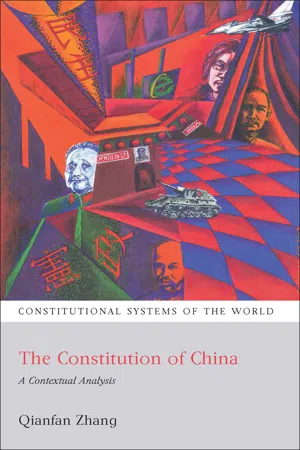
This book on China's constitution and its tradition of constitutionalism is one of the first in the English language, and as such provides a much needed overview of China's constitutional history and present arrangements. The nine chapters are divided into three parts. The first part (Chapters 1 & 2) deals with China's constitutional history, its indigenous and Confucian antecedents, as well as the turbulent century which led up to the 1982 Constitution and the new order which this ushered in. The second chapter deals with the distinctive features of its current constitution. The second part (Chapters 3-6) introduces the institutional structure defined in the current constitution - the relationship between the Centre and the Regions, the role of the party and the role of the People's Congress, the meaning of the socialist rule of law, and the independence of the judiciary. The third part (Chapters 7-9) discusses the major developments in human rights and their deficiencies - the protection offered to life, liberty, property and equality, and at the same time the currently dormant areas of political and religious freedom. The book concludes with a chapter looking forward to the future of the People's Congress and Chinese constitutionalism. In sum, the book offers a readable account of the salient features of Chinese constitutional developments in all major areas.
A Century of Turmoil: An Overview of China’s Constitutional Reform and Revolutions
INTRODUCTION: THE DAWN OF A CONSTITUTIONAL MOMENT – CONSTITUTIONAL ELEMENTS IN THE ANCIENT REGIME AND THEIR LIMITATIONS – Confucian Li as a Social Constitution? – Imperial Constitutional Reforms under Western Influence – Lessons to be Learned: The Dilemma of Constitutional Reform in an Authoritarian State – THE FIRST REPUBLIC: THE NATIONALIST REVOLUTION OF 1911 – The Clash of Regimes within the First Republic – An Interlude for Warlords: The Provincial Autonomy Movement and the Experiment with Federalism – The Northern Expedition, Reunification and the Ascendance of Party Rule – Limitations in the Nationalist One-Party Monopoly – WHY REVOLUTIONS FAIL TO BRING ABOUT CONSTITUTIONALISM
I. INTRODUCTION: THE DAWN OF A CONSTITUTIONAL MOMENT
IT WAS THE last day of April 1895. In a mansion outside the inner Capital city, Kang Youwei (
), who shortly became China’s most influential constitutional entrepreneur, gathered more than a thousand Confucian scholars (
, juren) participating in the annual imperial examination and prepared to petition the Emperor against signing the Treaty of Shimonoseki with Japan. In most Chinese minds, Japan was but a tiny, peripheral, barbarian island (
, zui’erdao); but to their surprise and humiliation, this ‘barbarian’ island had eliminated China’s entire fleet in a decisive battle on a single day in 1894 and forced its giant neighbour to relinquish sovereignty over Taiwan and the Liaodong peninsula. To be sure, the Sino-Japanese War was not the only humiliating defeat from which China suffered in the nineteenth century; as early as 1840, China had lost the first Opium War to Great Britain, to which China ceded Hong Kong, and had since been defeated in a series of battles by the Western powers and signed a number of unequal treaties. But this time the damage was done by a tiny island that had historically relied on China for its language and cultural heritage and, like China, had undergone centuries of seclusion, until the Meiji Reformation of 1868. What had lent this island such magical power as to defeat an empire many times its size? What did China lack that had enabled Japan to attain such great achievements within such a short period? Ever since the very first defeat, Chinese intellectuals had been searching for ways to strengthen their country. First they saw the immediate necessity of building sturdier warships and more powerful cannons; next they realised the need to establish modern industry as the basis for military power.1 For almost half a century, they had been preoccupied with the Westernisation Movement (
, yangwu yundong), which introduced new science, technologies and manufacturing to revitalise the ancient country, but the sad fact that the giant fleet they had studiously built for decades disappeared in a single day before a seemingly tiny rival could not have failed to shock them and raise a far-reaching question: what else had been missing?
The nineteenth-century Chinese were nationalists, proud of their cultural tradition, but they were not blind chauvinists who refuses to learn from their rivals. In fact, Japan had become an object of admiration and imitation for the ordinary Chinese; it had been admired not only for its economic and military achievements but also for its achievements in legal and institutional reforms. During merely two decades following the Meiji Reformation, Japan transplanted the entire body of civil, criminal and administrative law from Western legal systems, before it eventually succeeded in adopting the Meiji Constitution in 1889.2 Constitutional reformers like Kang Youwei and his prominent disciple, Liang Qichao (
), could not fail to seize the chance and make Japan a persuasive case for their own constitutional cause: Japan succeeded because it was a stronger military power, but it was able to build up a strong military and economy only because it had undertaken constitutional and legal reforms as the necessary institutional precondition to its success. It was precisely the lack of a constitution and, together with it, a parliamentary system and rule of law that ultimately accounted for China’s failures. It thus became widely accepted that if China was to part with its disgraceful recent past and join the world as a major power, as Japan had successfully done, the most urgent thing was not to build more warships and set up more factories but to prepare for constitutional reforms that would essentially replace the institutional structure of the ancient Chinese state. And this was precisely what Kang and Liang proposed in their petition to the Emperor: strength through institutional reform (
, bianfa tuqiang).3 While the petition ultimately failed to prevent the Emperor from signing the Treaty (just as the many other official petitions on the matter had), the scholarly gathering that day symbolised the first organised constitutional movement in modern China initiated from below.
The impact of the civic constitutional movement proved to be far-reaching. In the span of several years civic associations sprang up across China, and private newspapers thrived. As early as August 1896, Kang and Liang established in Shanghai an influential newspaper, Current Affairs (
), which soon became the major mouthpiece for constitutional reforms. During the next two years, over 300 associations and news agencies were established across China. Under the persistent influence of this reformist enlightenment, Emperor Guangxu (
) finally issued an edict on 11 June 1898, declaring the inauguration of constitutional reform. The next 100 days saw the introduction of China’s ‘New Deal’ (
, bairi weixin). The Emperor, following the teachings of Kang and Liang, issued over a hundred directives covering a wide range of initiatives from the right to petition to freedom of the press; from educational reforms to streamlining of bureaucratic structures; from centralisation of finance to modernisation of the army; and above all, the repeal of special privileges enjoyed by the small minority ruling class, the Manchu ethnic group (
), which had managed to maintain dominance over the Han (
) population for nearly 300 years. Although the imperial edicts fell short of bringing onto the agenda the more grandiose issues of constitutional monarchy and the establishment of a parliament, these reforms seemed to lay a political and legal foundation for the sustainable modernisation of China, just as they had for Japan.
Unfortunately, the reformist momentum was not sustained for long before it was stalled by the threatened underlying status quo. On 21 September, the Empress Dowager (
, Cixi, Emperor Guangxu’s mother) took over control, put the Emperor under house arrest, repealed all reform measures and executed the ‘six gentlemen’ – high officials in the reform camp. Kang and Liang managed to flee to Japan and continued to try to muster support for constitutional monarchy overseas. Despite this seemingly fatal conservative backlash, the domestic constitutional movement did not simply fail, since the intellectual elites after 1894 had generally agreed that constitutional reform was necessary for China’s modernisation. Shocked by both China’s weakness when faced with Western intruders, who overtook the capital and ransacked the imperial Yuanming Park in 1900, and particularly by the Japanese defeat of the Russian fleet in 1904, even the Dowager realised the inevitability of reform and revived the process of constitutional drafting by sending several high-ranking officials overseas to study the constitutional systems of Western countries.4 An Outline of the Imperial Constitution (
, qinding xianfa dagang) was finally promulgated in 1908. Despite its many defects, even vices, it is commonly regarded as the first written constitution in Chinese history and as a convenient point of departure for China’s modern constitutional movement.
I shall begin the book with a brief introduction to China’s constitutional history, since it not only provides the reader with an important historical perspective and explains why we are where we are now, but also illustrates the basic dilemma that China faces in modernising its constitution and embracing constitutionalism. Some of the historical themes simply recur in a transitional society like China. For example, it is difficult to ascertain why the ruling regime has any interest in fulfilling the promises it made in the Constitution by sharing its powers and making itself accountable to the people, when it has managed to concentrate all powers in its own hands; those within the ruling circle can derive tremendous personal profit from the traditional system, and power-sharing means they will lose at least some of their means for making personal profit. The lessons China learned (or should have learned) from the imperial and Nationalist failures should shed some light on how to transcend China’s constitutional predicaments today.
With that in mind, I divide this chapter into several periods, beginning with a short account of indigenous resources for constitutionalism in China. The Confucian concept of li (
, sometimes translated as ‘rites’ or ‘propriety’) can be fairly characterised as a social constitution that had governed traditional Chinese society for over 2000 years, but when China was confronted by the Western powers as early as the seventeenth century, the incompatibilities of li with modern society became obvious and eventually led to the demise of the traditional institutions. The chapter will then deal with the efforts to modernise these institutions, and it will end with an explanation of the institutional and cultural causes for the repeated failures to establish a stable constitutional state.
II. CONSTITUTIONAL ELEMENTS IN THE ANCIENT REGIME AND THEIR LIMITATIONS
A. Confucian Li as a Social Constitution?
That China’s constitutional movement did not begin until near the end of the nineteenth century does not imply, of course, that pre-modern China had no conception of constitution or fundamental laws. It is true that the word corresponding nowadays to ‘constitution’ (
, xian) meant in ancient times no more than laws or edicts in their ordinary senses5 and was made to designate a constitution only when China imported such meaning from Japan at the turn of the twentieth century. But the Confucian cultural tradition that dominated China for over 2000 was certainly versed in strong normative language and took for granted a few moral precepts as the ‘Way of Heaven’ (
tiandao), the application of which to the human world constituted the ‘Way of Man’ (
rendao). The most fundamental precepts at the core of Confucianism are humanity (
ren) and righteousness (
yi), around which an elaborate body of rules on rites, ceremonies, etiquette and other aspects of human behaviour were developed. This body of rules was specific, complex and all-inclusive, covering matters ranging from local festivals to state ceremonies; from specific procedures of marriage to the minute rituals for mourning the dead; from the manner in which children must treat their parents to the education programme for producing social elites. Taken together, they formed a vas...
Table of contents
Cover
Title
Copyright
Contents
Preface
Glossary of Terms
Table of Acronyms
Table of Cases
Table of Legislation
1 A Century of Turmoil: An Overview of China's Constitutional Reform and Revolutions
2 The New Constitutional Order of the People's Republic
3 Governing the Goliath: China's Central and Local Relations
4 Democracy with Chinese Characteristics? The Role of the People's Congresses
5 Administration of the State According to Law
6 De-politicising the Judiciary
7 The Contemporary Rights Revolution: Life, Liberty, Property and Equality
8 Still Dormant: Political and Religious Rights
9 Conclusion: The Future of China's Constitutionalism
Index
Trusted by 375,005 students
Access to over 1.5 million titles for a fair monthly price.
Study more efficiently using our study tools.
Frequently asked questions
Yes, you can cancel anytime from the Subscription tab in your account settings on the Perlego website. Your subscription will stay active until the end of your current billing period. Learn how to cancel your subscription
No, books cannot be downloaded as external files, such as PDFs, for use outside of Perlego. However, you can download books within the Perlego app for offline reading on mobile or tablet. Learn how to download books offline
Perlego offers two plans: Essential and Complete
Essential is ideal for learners and professionals who enjoy exploring a wide range of subjects. Access the Essential Library with 800,000+ trusted titles and best-sellers across business, personal growth, and the humanities. Includes unlimited reading time and Standard Read Aloud voice.
Complete: Perfect for advanced learners and researchers needing full, unrestricted access. Unlock 1.5M+ books across hundreds of subjects, including academic and specialized titles. The Complete Plan also includes advanced features like Premium Read Aloud and Research Assistant.
Both plans are available with monthly, semester, or annual billing cycles.
We are an online textbook subscription service, where you can get access to an entire online library for less than the price of a single book per month. With over 1.5 million books across 990+ topics, we’ve got you covered! Learn about our mission
Look out for the read-aloud symbol on your next book to see if you can listen to it. The read-aloud tool reads text aloud for you, highlighting the text as it is being read. You can pause it, speed it up and slow it down. Learn more about Read Aloud
Yes! You can use the Perlego app on both iOS and Android devices to read anytime, anywhere — even offline. Perfect for commutes or when you’re on the go. Please note we cannot support devices running on iOS 13 and Android 7 or earlier. Learn more about using the app
Yes, you can access The Constitution of China by Qianfan Zhang in PDF and/or ePUB format, as well as other popular books in Law & Administrative Law. We have over 1.5 million books available in our catalogue for you to explore.