"At last a book has been written that forensically examines how the British Armed Forces fought its way through Normandy . . . utterly absorbing." —James Holland, bestselling author of
Brothers in Arms
Stout Hearts is a book which offers an entirely new perspective on the British Army in Normandy. This fresh study explores the anatomy of war through the Army's operations in the summer of 1944, informing and entertaining the general nonfiction reader as well as students of military history. There have been so many books written on Normandy that the publication of another one might appear superfluous. However most books have focused on narrating the conduct of the battle, describing the factors that influenced its outcome, or debating the relative merits of the armies and their generals. What was missing from the existing body of work on Normandy specifically and the Second World War generally is a book that explains how an army actually operates in war and what it was like for those involved;
Stout Hearts fills this gap.
Stout Hearts is essential reading for those who wish to understand the "mechanics" of battle. How does an Army care for its wounded? How do combat engineers cross obstacles? How do tanks fight? How do Air and Naval Forces support the Army? But to understand what makes an Army "tick" you must also understand its people. Therefore explanations of tactics and techniques are not only well illustrated with excellent photographs and high quality maps but also effectively combined with relevant accounts from the combatants themselves. These dramatic stories of ordinary people doing extraordinary things are the strength of the book, bringing the campaign to life and entertaining the reader.
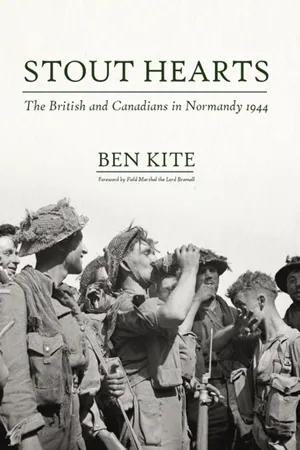
- 488 pages
- English
- ePUB (mobile friendly)
- Available on iOS & Android
eBook - ePub
About this book
Information
1
Introduction and Campaign
Overview
Overview
My experience on numerous battlefield tours is that people, whether soldiers or civilians, are always interested in how an Army actually ‘works’ on operations, how its various arms and services interact on the battlefield to produce an overall operational success. There are many detailed explanations on the various instruments within this orchestra of war which will help the reader understand how a battle is waged. The reader will also note that these explanations are interspersed with many personal accounts from the actual combatants. These veterans’ anecdotes are vital. They bring the book to life and illustrate the important point that whatever the particular procedures, tactics and equipment, warfare remains a collective human endeavour. You cannot comprehend how an Army works without understanding the men within it who have to serve in conditions of extreme danger, confusion and fatigue. This is important because although aspects of warfare change, human behaviour essentially does not. General Patton captured it superbly in a letter he wrote to his son on D-Day itself:
To be a successful soldier you must know history…What you must know is how man reacts. Weapons change but man who uses them changes not at all. To win battles you do not beat weapons–you beat the soul of man of the enemy man. To do that you have to destroy his weapons, but that is only incidental. You must read biography and especially autobiography. If you will do it you will find that war is simple.1
Including veterans’ accounts also fulfils the secondary aim of this book, to capture the serviceman’s experience in one of the most complex and daring military operations in the history of warfare.2
In explaining how an Army works I have concentrated on the British and Canadian3 21st Army Group, resisting the temptation to broaden the scope and include the US Army in Normandy; to have done so would have made the book too rambling. Moreover by focussing on the ‘particular’ the ‘general’ point is often easier to understand. For example, studying a British Casualty Clearing Station in Normandy will facilitate better comprehension of the general principles of surgical and medical support in any modern battle. Similarly, in some chapters I have selected a particular equipment to focus on and paid less attention to other similar types. In the chapter on artillery, for instance, I describe the gun drill of the 25-pounder and how a Field Regiment operates, but do not give the same attention to the 5.5-in gun or Medium Regiments. If you have a good understanding on how a 25-pounder unit operates, you will have a general understanding of how any other artillery unit functions.
Why select Normandy in particular? Principally because 21st Army Group was the largest and most complex organisation the British have placed into the field in living memory. It was also the most decisive, intense battle the British fought in the Second World War, where the best elements of the German Army were engaged and defeated and where casualty rates began to approach the level of the First World War. In addition the success of 21st Army Group was dependent upon both naval and air support and these are also covered. Finally, as the Normandy campaign occurred towards the later stages of the War the British organisation and equipment had begun to reach a mature level. It therefore has the most relevance for modern readers.
This book will enable you not only to understand the battle of Normandy rather better, but also the Second World War more generally. Understanding equipment, tactics and procedures and how tired, frightened serviceman used them, will allow the reader to better appreciate the complexity of land operations and reveal the difficulties and challenges all armies and all soldiers must overcome in order to emerge victorious. The challenges of military operations are all too frequently glossed over in many military histories that fail to understand that ‘easy’ things are often incredibly hard to achieve in war, that however sound a plan may be, it will rarely survive contact with the enemy and finally that all armies usually have to innovate and adapt tactics and equipment as they fight.
As we mark the 70th anniversary of the Normandy campaign it is worth reminding ourselves that the victory in Normandy was by no means a foregone conclusion and the success of the Allies stems from both many individual sacrifices, the organisational efficiency of 21st Army Group and the overall defence effort. My final point is to ask you to keep in mind one vital factor, the importance of morale, how it dominates almost every chapter and how the army is utterly reliant on the quality of its soldiers and their commitment and courage. This book does not focus on the debates over the quality of generalship, or which side was ‘best’. It focuses on an institution that inflicted the greatest defeat Hitler’s armies ever suffered in the West, together with the servicemen who collectively made it work. I hope I have done their efforts justice.
CAMPAIGN OVERVIEW
If anybody had told me then that in four years I should return with Winston and Smuts to lunch with Monty commanding a new invasion force, I should have found it hard to believe.4
The Diary of Field Marshal Lord Alanbrooke, 12 June 1944
21st Army Group in Normandy was led by General Sir Bernard Montgomery and comprised two armies; Second British Army under Lieutenant-General Sir Miles Dempsey and First Canadian Army under Lieutenant-General Sir Harry Crerar. Each Army was composed of several corps, three being the norm but these would be altered as required throughout the campaign. In Normandy there were initially four corps; I Corps, VIII Corps, XII Corps and XXX Corps. Initially all were placed under Second British Army, however once II Canadian Corps had landed First Canadian Army was properly constituted and the order of battle was altered once more. General Montgomery left the activation of HQ First Canadian Army until quite late in the campaign, some have suggested that this was possibly because he did not have much faith in its Canadian commander, Lieutenant-General Crerar.
The corps were usually composed of three divisions. Some of these formations had so far never seen any action in the Second World War (e.g. 15th Scottish Division) and others had not been deployed since Dunkirk (3rd British Division). A few had served in the North African and Italian campaigns and were brought back at Montgomery’s insistence to give his new Army Group some experienced formations (51st Highland, 7th Armoured and 50th Northumbrian Divisions for example). In addition to the various divisions there were a number of ‘independent’ brigades. These included the commando brigades as well as armoured brigades equipped with Sherman cruiser tanks (e.g. 4 Armoured Brigade) and tank brigades equipped with Churchill infantry support tanks (e.g. 31 Tank Brigade). These brigades would be loaned to corps or divisions when required. At Army and Army Group level there were also concentrations of engineers, artillery, medical and logistic units who could be used to support whichever corps was the main effort for a particular operation.
As well as bringing veteran formations back to England, Montgomery was also careful to transfer a number of former Eighth Army staff into HQ 21st Army Group, this importantly included his Chief of Staff, Major General Francis De Guingand, as well as his head of intelligence, Brigadier ‘Bill’ Williams. These key staff all arrived about the same time as General Montgomery took up his appointment in January 1944. Prior to Montgomery’s arrival, the planning for the invasion had been conducted by a team led by the Chief of Staff to the Supreme Allied Commander (COSSAC), Lieutenant-General Sir Frederick Morgan. This staff had selected Normandy as the invasion area based upon a number of key factors. Firstly Normandy possessed several wide, open beaches that were sheltered from the prevailing westerly winds by the Cherbourg peninsula. Secondly it was within range of fighters based in southern England, which would make securing air superiority over the bridgehead easier. Finally it was further away and therefore a less obvious assault area than the Pas de Calais, this fact would be exploited by a highly effective Allied deception plan.
The initial COSSAC-originated OVERLORD plan called for an assault by three divisions, on three beaches, with two brigades dropped by air and follow on divisions disembarking over the same beaches. The Allied military and political leaders approved this plan at the Quebec Conference in 1943.
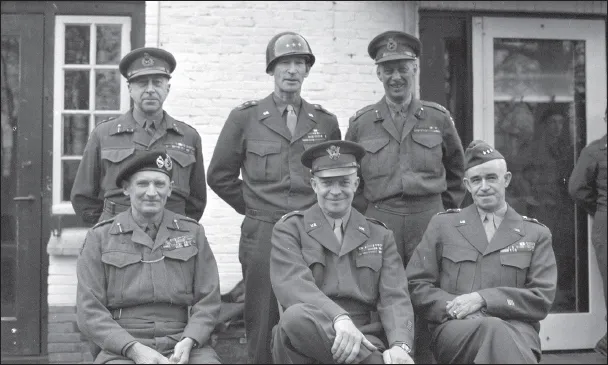
Figure 1.1 The Allied command team, front row left to right: General Montgomery, General Eisenhower and General Bradley. Back row: General Crerar, General Simpson (Ninth US Army) and General Dempsey. (Barney J. Gloster, Library and Archives Canada, PA-136327)
General Montgomery reviewed the plans, once he had been appointed as Commander-in-Chief, 21st Army Group. He dismissed them as too small in scale and with the support of the newly appointed Supreme Allied Commander, General Eisenhower, pressed for an expansion of the initial D -Day assault. General Montgomery proposed a landing of five divisions each on separate beaches, with three airborne divisions dropped to guard the flanks. By expanding the scale of the initial landings Montgomery believed he could deliver a less congested bridgehead, better able to withstand German counter-attacks. These proposed changes to the original plan necessitated a delay till a point when extra landing craft would be available and a new D-Day of early June 1944 was agreed upon.
Following the assault itself the Allies would land a total of thirty-nine follow on divisions in Normandy. These would include twelve British, three Canadian and one Polish division under 21st Army Group as well as twenty-two American and one Free French division under the American General Omar Bradley. Despite the increase in scale of the assault there was still considerable concern over the inevitable strong German counter-attacks against the bridgehead (see Map 2), the Allied plan would mitigate this German response in two ways. Firstly through Operation FORTITUDE; a deception plan aimed at convincing the Germans that the main Allied inva-sion would come through the Pas De Calais and not Normandy. This deception was based on a fictitious US Army Group, supposedly in East Anglia and southern England, under General Patton. Secondly by massive air attacks on German lines of communication in France and the low countries; known as the ‘Transport Plan’. The air assets available included the Strategic Air Forces heavy bombers which were used to destroy rail yards and key bridges over the Seine and Loire. This would disrupt German efforts to deploy their reserves towards Normandy and effectively isolate the battlefield.
This latter activity was controlled by General Eisenhower’s Supreme Headquarters Allied Expeditionary Force (SHAEF). Eisenhower had Air Marshal Tedder as his deputy and three subordinate Commanders in Chief (CinC) to manage the Air, Sea and Land Battles. Air Marshal Sir Trafford Leigh-Mallory was appointed the Air CinC with command of both the British 2nd Tactical Air Force and the American 9th US Air Force. The British Admiral Sir Bertram Ramsay was the Naval CinC and he had two subordinate fleets under his command; the Western Naval Task Force which would support the American forces and the Eastern Naval Task Force which would support 21st Army Group (see Maps 3 and 4). Finally the CinC of the land battle for Normandy was General Montgomery who as well as commanding 21st Army Group’s British and Canadian Armies would also exercise authority over General Bradley’s First US Army. This would be until General Patton’s Third US Army was properly constituted in France, at this point Montgomery would hand over his responsibilities for overall control of the land battle to General Eisenhower who would assume the dual role of both the Supreme Allied Commander and the Land Commander. Though Patton’s Army was firmly established by 1 August, Eisenhower did not take control of the land battle until 1 September.
The British part of the D-Day plan was to assault on three separate beaches (see Map 5). 50th Northumbrian Division would land on the western GOLD beach, 3rd Canadian Infantry Division on the central JUNO beach and the 3rd British Division on the eastern SWORD beach. The British 6th Airborne Division would also land by parachute and glider on D-Day to the east of the beaches. Their task was to protect the British flank by occupying a bridgehead over the River Orne and capturing key bridges for future use (including the famous Pegasus Bridge – see Map 6).
To the west of the British the American First Army would come ashore on OMAHA and UTAH beaches with two airborne divisions, the 82nd and 101st Airborne divisions, dropped to protect their flanks and safeguard the routes from the beaches. General Montgomery had stressed in his pre-invasion planning the importance of securing the town of Caen (12 miles inland) on D-Day. This town was the centre of a number of road junctions and its early capture together with the open ground to the south-east would offer the Allies a strong advantage. The assault on D-Day was undoubtedly a success though opposition was fierce on some beaches. Disappointingly for the Allies 3rd British Division were not able to take Caen on D-Day itself, indeed the town would not finally fall to the British until mid-July. Although 3rd British Division was initially criticised after the war for this failure, most now accept that the poor D-Day weather hampered their efforts and that the objective was unrealistic. Only one Allied division (50th Northumbrian) actually managed to obtain its inland D-Day objective (see Map 5).
From D-Day onwards the British advance encountered German panzer divisions which were being rushed into the area on a daily basis. Within the first week of the landings the British were facing a tough defence bolstered by 21st Panzer Division in the east, 12th SS Hitlerjugend Panzer Division in the centre and, to its west, the Panzer Lehr Division. But the Allies were also landing their follow on forces including some of the veteran divisions from the Desert war (see Map 7). An opportunity seemed to present itself to the British on 12 June when a gap in the German defences to the East of Caumont became apparent.
7th Armoured Division were tasked to exploit this gap during Operation PERCH and succeeded in reaching the town of Villers Bocage. However this penetration was curtailed dramatically when a complacent 7th Armoured Division was ambushed by Tiger tanks led by German ‘panzer ace’ – Michael Wittmann. The experience so shocked the veteran armoured division that it humbly retreated, and it was quickly becoming apparent that the British tanks were no match for the better armed and protected German Tiger and Panther tanks. Additionally this disappointing performance by 7th Armoured Division was coupled with a reportedly poor showing by 51st Highland Division east of the River Orne, leading some observers to raise doubts about the ability and performance of some of the Desert divisions. Some accused the veteran soldiers of being a little too wary and ‘canny’.
The failure of Operation PERCH led Montgomery to seek another method of capturing Caen and pressuring the German eastern flank to tie down the Panzer divisions. This led to Operation EPSOM, an attempt by the newly arrived divisions of VIII Corps to cross the River Odon, capture the important feature of Hill 112 and outflank Caen to the west (see Map 8). This operation would involve the use of 43rd Wessex Division, 15th Scottish Division and the 11th Armoured Division. Operation EPSOM would also be preceded by a divisional attack from 49th Division onto the Rauray spur (Operation MARTLET) which dominated the EPSOM battlefield. Operation EPSOM was scheduled to take place in mid-June but a Channel storm between 19-21 June slowed the arrival of VIII Corps’ divisions in Normandy and caused a few days delay. Operation EPSOM lasted from 26 June to 3 July, it did not achieve its overall objectives but did create a thin bridgehead over the River Odon (known as the ‘Scottish Corridor’). It also succeeded in not only tying down the panzer divisions in place but also committing the newly arrived 1st SS Panzer Corps (9th and 10th SS Panzer divisions) into a counter-attack against the EPSOM salient. Forewarned by ULTRA intelligence the German counter-attack against the salient was beaten off by the British formations supported by strong artillery and air support.
During the June period the American First Army had succeeded in cutti...
Table of contents
- Cover
- Title Page
- Copyright
- Dedication
- Contents
- List of Photographs
- List of Diagrams
- List of Maps
- Foreword
- Acknowledgements
- 1 Introduction and Campaign Overview
- 2 ‘Closing With The Enemy’ – The Infantry
- 3 ‘Neptune’s Trident’ – Naval Support
- 4 ‘First in, Last Out’ – Engineers
- 5 ‘Queen of the Battlefield’ – Artillery
- 6 ‘By Air to Battle‘ – Air Power and Air Support
- Photo Gallery
- 7 ‘Knowledge Gives Strength to Arm’ – Intelligence and Reconnaissance
- 8 ‘Penetrating the Fog’ – Command and Control
- 9 ‘Faithful in Adversity’ – Medical Services
- 10 ‘Grim Summer’ – Life in Normandy 1944
- 11 ‘From Mud, Through Blood To The Green Fields Beyond’ – Armour
- 12 ‘Our Greatest Generation’
- Appendices
- Bibliography
Trusted by 375,005 students
Access to over 1.5 million titles for a fair monthly price.
Study more efficiently using our study tools.
Frequently asked questions
Yes, you can cancel anytime from the Subscription tab in your account settings on the Perlego website. Your subscription will stay active until the end of your current billing period. Learn how to cancel your subscription
No, books cannot be downloaded as external files, such as PDFs, for use outside of Perlego. However, you can download books within the Perlego app for offline reading on mobile or tablet. Learn how to download books offline
Perlego offers two plans: Essential and Complete
- Essential is ideal for learners and professionals who enjoy exploring a wide range of subjects. Access the Essential Library with 800,000+ trusted titles and best-sellers across business, personal growth, and the humanities. Includes unlimited reading time and Standard Read Aloud voice.
- Complete: Perfect for advanced learners and researchers needing full, unrestricted access. Unlock 1.5M+ books across hundreds of subjects, including academic and specialized titles. The Complete Plan also includes advanced features like Premium Read Aloud and Research Assistant.
We are an online textbook subscription service, where you can get access to an entire online library for less than the price of a single book per month. With over 1.5 million books across 990+ topics, we’ve got you covered! Learn about our mission
Look out for the read-aloud symbol on your next book to see if you can listen to it. The read-aloud tool reads text aloud for you, highlighting the text as it is being read. You can pause it, speed it up and slow it down. Learn more about Read Aloud
Yes! You can use the Perlego app on both iOS and Android devices to read anytime, anywhere — even offline. Perfect for commutes or when you’re on the go.
Please note we cannot support devices running on iOS 13 and Android 7 or earlier. Learn more about using the app
Please note we cannot support devices running on iOS 13 and Android 7 or earlier. Learn more about using the app
Yes, you can access Stout Hearts by Ben Kite in PDF and/or ePUB format, as well as other popular books in History & Modern British History. We have over 1.5 million books available in our catalogue for you to explore.