Ordained Anglican ministry is changing rapidly. Soon the majority of clergy are likely to be volunteers and, especially in rural areas, female. All mainstream Churches recognise that new contexts need new forms of ministry. Ordained Local Ministers (OLMs) are priests specifically called out by their local congregation and ordained to minister in that locality.
Half the dioceses in England and elsewhere in the Anglican Communion including Australasia, Scotland and North America have established formal schemes to enable this type of ministry. Some dioceses believe the process has helped to revitalise parishes and raise the spiritual temperature of congregations. Others have called a halt, believing their schemes have somehow gone wrong or have not 'delivered'.
The time has come for a calm assessment of available evidence about an experiment into which the Church has poured considerable time, effort and money over the last twenty years. Does it have ongoing value, or is it just one more bright idea that has flourished for a season and has now had its day?
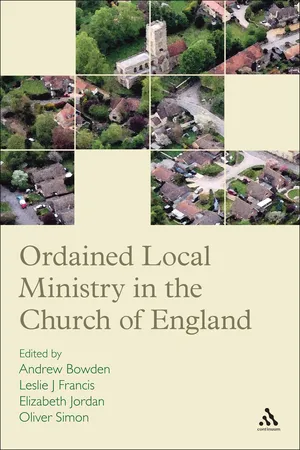
eBook - ePub
Ordained Local Ministry in the Church of England
- 192 pages
- English
- ePUB (mobile friendly)
- Available on iOS & Android
eBook - ePub
Ordained Local Ministry in the Church of England
About this book
Information
1
The ecclesiological
foundations of OLM
foundations of OLM
Oliver Simon
Introduction
Even when it is claimed that Anglican ecclesiology should be ‘special to itself’ (Sykes 1995: xii), there is nothing exclusive about it. The discussion that follows reflects the breadth of the influences which contribute to an understanding of Anglican ecclesiology, sources which privilege its sense of continuity but which recognize a continuous engagement with contemporary cultural realities. Fredrica Thompsett comments,
starting with an understanding of the Church as a people called into relationship with God and each other, Anglican ecclesiology presents a Church that is grounded in society, provisional, inclusive and responsive. (Thompsett 1988: 253)
This chapter investigates three significant features of such a grounded Anglican ecclesiology which inform an explication of Ordained Local Ministry: first, its sense that the church is, above all, relational; second, that it is local; third, that ministry is no longer a clerical prerogative – that a ‘seismic’ shift (Collins 2006) has taken place in the perception of ministry in the past half century.
The biblical metaphors which have frequently been co-opted in Anglican writing to model this ecclesiology are, ‘The Body of Christ’ and ‘The People of God’. The former expresses mutuality and collaboration; the latter, with roots in the Old Testament, speaks of journeying together. Neither prescribes organization or addresses in executive terms the relationship between the church’s contingent and ontological natures. But they help to fashion a theoretical account of ecclesial reality which, in England, has become more relaxed and more participative. So a former Bishop of Durham, Michael Turnbull, writes,
We are a people called to reflect God’s nature in the world. And his nature is not hierarchical and distant but relational and inclusive. That becomes a model of being the Church. (Turnbull 2001: 214)
Relational ecclesiology
While Vatican II came to relational ecclesiology in the 1960s through consideration of the nature of the church as communion (Doyle 2000), Anglicans have tended to appropriate it mystically. A recovered sensibility of the work of the Holy Spirit, liturgically, through the charismatic movement and in theological writing, has clearly been a significant driver. According to one Anglican statement, the ministries of the people of God have a mutuality which
animate[s] [my emphasis] each other, each focusing the activity of God – the work of the Holy Spirit – in each other; each therefore ‘brings the other to be’ in the way in which God’s mission in the world requires. (cited in Heywood 2011: 185)
St Paul anticipated such an ecclesiology: ‘my friends, you have died to the law through the body of Christ, so that you may belong1 to another, to him that has been raised from the dead in order that we may bear fruit for God’ (Rom. 7.4). ‘For as often as you eat this bread and drink this cup you proclaim the Lord’s death until he comes’ (1 Cor. 11.26). Fellowship (koinonia) is linked to proclamation, God’s mission (missio dei), and are inseparable.
An understanding of church premised on the experience of divine spirit-mediated love, on the reality of relationships and on formative liturgical acts privileges an anticipatory experience of the fullness of God, the realization in the present of what is anticipated eschatologically. This is the basis of Robin Greenwood’s argument (Greenwood 1994) that Anglican ecclesiology is trinitarian, that the community of the mutual indwelling of the persons of the Trinity is, in Colin Gunton’s phrase, ‘echoed’ in the life of the church (Gunton 1997).
The Church called into existence by the triune God, however faintly, may be said to have the potential in Christ and through the Spirit, to model or be a sign of that communion which is the being of Godself and the shape of his desire for the ultimate ordering of the entire Creation. (Greenwood 1994: 87)
This is most potent when the people of God assemble as The Body of Christ in worship to remember and to be ‘re-membered’.
Re-membering
Re-membering in the Pauline sense of proclamation is a way of speaking of the formative, regenerative character of relational ecclesial life. Re-membering is a process of reconstruction which has its fundamental basis in the liturgy, in what the people of God do together. The church exists both to remember and be re-membered through the death and resurrection of Jesus who enjoined his disciples: ‘do this in remembrance of me’ (Lk. 22.19, cf. 1 Cor. 11.24–5). The Eucharist therefore plays a paradigmatic if not exclusive role in the development of Anglican relational ecclesiology.
William Cavanaugh, a Roman Catholic, writes that the Eucharist is ‘the imagination of the church’. In the Eucharist, we are united sacrificially ‘to God in holy fellowship by reference to our eternal end’ (Cavanaugh 1998: 229). Echoing St Augustine, ‘One of the peculiarities of the Eucharist feast is that we become the body of Christ by consuming it’2 and in consequence, Cavanaugh goes on, ‘we then become food for the world, to be broken, given away, and consumed’ (Cavanaugh 1998: 231, 232). Accordingly, the church finds its identity within the re-membering; its raison d’être being to be present, as Christ, to the world, ‘ransomed, healed, restored, forgiven’, in the words of a well-known nineteenth-century Anglican hymn.3 For this reason, if for no other, the Anglican Church is irreducibly realized in the coming together for worship of the people of God in any one place at any one time.
The hyphen in re-membering is significant in drawing attention to the dynamic character of this ecclesiology. An-amnesis, the technical liturgical term for re-membering, might be translated as ‘recovering consciousness and a sense of vocation’. John Paul Lederach writes:
Social amnesia may be useful for political pragmatism, but it is a recipe for weak communities incapable of true identity and correspondingly genuine relationships. The land of forgetfulness creates communities without vocation. The challenge of linking memory and vision lies primarily with the vocation of the moral imagination which can only be exercised in the place that lies between the local and the public, between personal biography and the shaping of responsive social structures. (Lederach 2005: 62)
The notion of the liturgy as an event which links both memory and vision, an ‘event . . . moving you from one condition to another. . . . of its essence a transition’ (Williams R. 2009), is a powerful engine for ecclesiogenesis. The ordering of the liturgy and its ministry is thus a significant theme in the development of Anglican ecclesiology. First we need to stay with the notion of church as realized wherever bread is broken and wine is shared. Locality, in an ecclesial sense, is the place of epiphany, where humanity meets divinity and where moral imagination is nourished.
Locality
Locality, in its substantive form as territory or ‘turf’, is far from straightforward. Timothy Jenkins says:
There are local ways of doing things and of thinking, ways of organising continuity and coping with misfortune which, while they are not unique to any particular locality, are tied in the actors’ perceptions to the experience of that locality. In this way ‘local particularity’ is irreducible, because these ways of life create a sense of identity which relates to a particular place: certain aspects of life are mapped out on the ground and cannot be separated from it. (Jenkins 1999: 77)
Social mobility and immediate global communication have diminished the status of locality. But limits on economic growth and issues of sustainability are factors in the re-evaluation of local as a significant sociological category, a process which has been translated in political discourse in the United Kingdom as ‘localism’.
Locality in Anglican ecclesiology
‘Local’ is a key word in the history of Anglican ecclesiology. Even before the Church of England was established in the sixteenth century, ecclesia Anglicana – the church in England – bore witness to christianity embedded within a geographically framed cultural and historical milieu. The Church of England’s website declares that the church has ‘a Christian presence in every community’. ‘Its network of parishes cover the country, bringing a vital Christian dimension to the nation.’4 Notwithstanding evident strains on the parish system, it has been consistently reaffirmed. At the heart of this way of configuring Christian presence, and indeed partly responsible for the particular configuration of parish boundaries historically, has been the presence of a ‘parson’, a representative figure who embodies both the immanent and the divine. The conjunction of parson (with the wherewithal to support him and his household) and parish has been a feature of Anglican ecclesiology since the early middle ages and is culturally deeply resilient.5
Notwithstanding such cultural resilience, there has for some time been concern about the viability of the parish system. According to Michael Turnbull, it is collapsing because of low morale, ageing, declining congregations and the alienation of young people; and because such congregations are not financially viable. Turnbull called for an emphasis on ‘the value of locality but recognize[d] that for most people this is not the parish as we have known it’; and that we should ‘look to establishing locality ministries’, by which he meant clergy and lay teams. Turnbull carefully did not wish to abandon the geographical features of ecclesial organization but rather to change ‘present perceptions of what a parish is’ (Turnbull 2001: 213).
Others have set the parish system, and hence Anglican ecclesiology, more explicitly within a broader cultural canvas of late modernity or postmodernism. Mission has become the key ecclesial strategy (Heywood 2011). The shift in institutional thinking from a pastoral conception of the church in which territory had a central role to a missionary understanding in which locality is regarded more ambivalently has been bench marked by the report Mission-Shaped Church (M-SC), published in 2004, which has greatly influenced the Anglican ecclesial debate. M-SC called for ‘a new inculturation of the gospel within our society’ (AC 2004: xii). It argued for ‘fresh expressions of church’ that are culturally sensitive.
M-SC serves to illustrate the persistence of locality within Anglican ecclesiology albeit in a less prescriptive way. It does not undermine whatever is understood by ‘parish’ but rather speaks of a ‘mixed economy’. Indeed, it has become clear that the parish ‘is still able to connect with a large proportion of the population’ (Croft 2006: 76). This would also be the position taken by some of those who have offered critiques of M-SC (Davison and Milbank (2010), for example). Left to itself, the Church of England might well be compelled for material reasons to withdraw from its commitment to being ‘a Christian presence in every community’ were it not for the significance of a wider resilient ‘tribal’ constituency6 which is supportive of a Christian (Anglican) presence in buildings and worship. So we can still say that locality in the sense of a visible presence is a key principle of Anglican ecclesiology, maintained by a coalition of interests.
Representational ministry
Ordained ministerial agency is an integral part of Anglican ecclesiology. However, in this section, we address the shift in understanding about the nature of the church’s ministry, which has taken place since the middle of the twentieth century, the ‘revolution in traditional thinking’ as John Tiller termed it (Tiller 1983: 65).
The ministry of the people of God
The ecumenical 4th World Conference on Faith and Order in 1963 noticed the change since its last discussion in 1937. The new consensus was summed up in the assertion that, ‘All baptized Christians are called to respond to, and participate in the ministry of Christ directed towards the world’ (WCC 1964: 67). This formulation owed much to the work of Ernst Käsemann who had argued in an essay, ‘Ministry and Community in the New Testament’ in 1948, that the gifts of the Spirit, of which St Paul writes in 1 Corinthians 12–14, were appropriated in the early second century by the emergence of office holders, episkopoi, presbyteroi and diakonoi. Such leadership offered stability by assuming authority but emasculated ministerial potential for the church as a whole. Käsemann pointed however to the subversive influence of those who, added to the church through baptism, brought new and varied spiritual gifts, charismata. This lead him to propose that ‘all the baptized are “officebearers” ’ (Käsemann 1964: 78, 80).
Vatican II took a more restrained position, devoting a chapter of Lumen Gentium to the lay apostolate, which, without using the word ‘ministry’, it ...
Table of contents
- Cover
- Half-Title
- Introduction
- 1 The ecclesiological foundations of OLM
- 2 Laity and clergy – a theological odyssey
- 3 OLM in context – a genealogy
- 4 The relevance of the Northern Michigan experience of Local Ministry to the English context
- 5 Local Ministry in Scotland
- 6 The empirical evaluation of OLM
- 7 The psychological profile of OLMs
- 8 OLM: ministry in relationship
- 9 What is the future of Ordained Local Ministry?
- 10 The Gloucester story
- 11 Ordained Local Ministry: a personal reflection
- 12 Strangers and partners – reimagining ministry
- Bibliography
- Index
- eCopyright
Trusted by 375,005 students
Access to over 1.5 million titles for a fair monthly price.
Study more efficiently using our study tools.
Frequently asked questions
Yes, you can cancel anytime from the Subscription tab in your account settings on the Perlego website. Your subscription will stay active until the end of your current billing period. Learn how to cancel your subscription
No, books cannot be downloaded as external files, such as PDFs, for use outside of Perlego. However, you can download books within the Perlego app for offline reading on mobile or tablet. Learn how to download books offline
We are an online textbook subscription service, where you can get access to an entire online library for less than the price of a single book per month. With over 1.5 million books across 990+ topics, we’ve got you covered! Learn about our mission
Look out for the read-aloud symbol on your next book to see if you can listen to it. The read-aloud tool reads text aloud for you, highlighting the text as it is being read. You can pause it, speed it up and slow it down. Learn more about Read Aloud
Yes! You can use the Perlego app on both iOS and Android devices to read anytime, anywhere — even offline. Perfect for commutes or when you’re on the go.
Please note we cannot support devices running on iOS 13 and Android 7 or earlier. Learn more about using the app
Please note we cannot support devices running on iOS 13 and Android 7 or earlier. Learn more about using the app
Yes, you can access Ordained Local Ministry in the Church of England by Andrew Bowden,Leslie J. Francis,Elizabeth Jordan,Oliver Simon, Andrew Bowden, Leslie J. Francis, Elizabeth Jordan, Oliver Simon in PDF and/or ePUB format, as well as other popular books in Teología y religión & Ministerio cristiano. We have over 1.5 million books available in our catalogue for you to explore.