Packed with examples from classic and contemporary films, The Fundamentals of Animation presents each stage of the animation production process in an engaging visual style, whilst providing an historical and critical context for four core disciplines: drawn/cel; 2D/3D stop-motion; computer generated; and experimental animation. With insightful commentary from leading animators, Wells and Moore also introduce you to the many different career paths open to aspiring animators, from storyboard artist or character designer to VFX artist or writer and director. They also provide you with key tips on producing engaging portfolios and show reels. - Illustrated with over 300 images, including preliminary sketches, frame-by-frame analyses and shots of animators at work. - Now explores the animated documentary genre and the role of visual effects and gaming in contemporary animation. - Features more than 20 interviews with a range of international practitioners including Pete Docter, Director, Monsters, Inc. (2001), Up (2009) and Inside Out (2015). Featured Artists
Sarah Cox, ArthurCox
Lluis Danti, Media Molecule
Pete Docter, Pixar
Paul Driessen
Eric Fogel
Cathal Gaffney, Brown Bag Films
Adam Goddard
Philip Hunt, STUDIO AKA
The Brothers McLeod
Bill Plympton
Ellen Poon, Industrial Light and Magic
Barry Purves
Joanna Quinn
Chris Randall, Second Home Studios
Maureen Selwood
Koji Yamamura
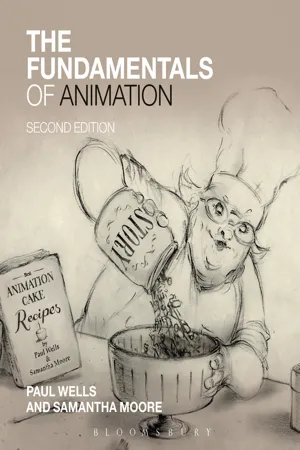
- 216 pages
- English
- ePUB (mobile friendly)
- Available on iOS & Android
eBook - ePub
The Fundamentals of Animation
About this book
Information

08
Drawn and Cel Animation
The history of animation is normally written as the history of the animated cartoon, and the history of the animated cartoon is normally written as the creation of an animation ‘industry’ by the Walt Disney Studio. While this rightly privileges the place of the Disney organisation in the development of animation as an art and a distinctive production process, it also neglects the animation of the pioneers in the United States, and overstates the ‘ownership’ of animation as a singularly American phenomenon. Indeed, it may still be the case that all animation both within the United States and elsewhere in the world remains a response to ‘Disney’ – aesthetically, ideologically and technically. This is both a tribute – many individuals and studios across the world have aspired to the Disney style – and a model of resistance, challenging and implicitly critiquing the process, design and meaning of the Disney output, at the same time preserving indigenous traditions and other approaches to the art form.
The animated cartoon essentially emerged out of the experiments towards the production of the cinematic moving image. As early as 1798 Etienne Robertson created the Phantasmagoria, a sophisticated ‘magic lantern’ to project images, and this was followed by Plateau’s Phenakistiscope in 1833, Horner’s Zoetrope in 1834, von Uchatius’ Kinetoscope in 1854, Heyl’s Phasmatrope in 1870 and Reynaud’s Praxinoscope in 1877 as devices that in some way projected drawn moving images. With the development of the cinematic apparatus came the first intimations of ‘animation’. At first, they were accidents or trick effects in the work of figures like Georges Méliès and the emergence of ‘lightning cartooning’ – the accelerated movement of drawings by manipulating camera speeds – particularly in the British context where Tom Merry, Max Martin, Harry Furniss and Lancelot Speed defined an indigenous model of expression related to British pictorial traditions in caricature and portraiture. It was also Britons Albert E. Smith and J. Stuart Blackton, working in the USA, who saw the potential of a specific kind of animation film-making in The Enchanted Drawing (1900) and Humorous Phases of Funny Faces (1906), though these were essentially little more than developments in lightning cartooning.
While stop-motion 3D animation progressed in a number of nations, it was only with the creation of Émile Cohl’s Fantasmagorie (1908) – a line-drawn animation based on the surrealist principles of the ‘incoherent’ movement of artists in France – that the 2D animated film was seen to be a distinctive art form.
Cohl was later to work in the USA animating George McManus’s comic strip The Newlyweds (1913), one of a number of popular comic strips that characterised early American cartoon animation, including Krazy Kat, The Katzenjammer Kids and Mutt and Jeff. Winsor McCay, an illustrator and graphic artist, made Little Nemo in Slumberland (1911), based on his own New York Times comic strip, and made one of the first self-consciously reflexive cartoons in the aptly titled Winsor McCay Makes His Cartoons Move (1911). McCay’s influence on the history of animation cannot be understated as he created one of the first instances of the horror genre in The Story of the Mosquito (1912); ‘personality’ animation in the figure of Gertie the Dinosaur (1914), who featured in an interactive routine with McCay in his vaudeville show; and ‘documentary’ in an imitative newsreel-style depiction of The Sinking of the Lusitania (1918). McCay had previously suggested that he only wanted to use animation to show things that couldn’t be seen in everyday life – dragons, dinosaurs and dreams – but he realised that animation could also recreate things that had not been documented in another way, hence the realistic detail in his Lusitania film. McCay championed the art of animation, but feared, too, that it would become an industry driven by other motives.

8.1
Still from Humorous Phases of Funny Faces – J. Stuart Blackton
Blackton’s film was essentially a development of the ‘lightning sketch’ – the speeded-up creation of a hand drawing – but its effects suggested that ‘animation’ would soon become a distinctive art form.

8.2
Still from Gertie the Dinosaur – Winsor McCay
Gertie, who featured in Winsor McCay’s vaudeville routine, was arguably the first example of the kind of ‘personality’ animation much admired and developed by Disney. The dinosaur clearly had an identity and point of view of its own, and was very appealing and amusing to audiences.
A Brief History
As early as 1913, John R. Bray and Raoul Barré were developing systematic, ‘industrial’ processes for the production of animated cartoons using variations of what was to become the ‘cel’ animation process, where individual drawings, later cels, were created with various stages of a character’s forward movement, and these were aligned with backgrounds that remained the same, using a peg-bar system: by replacing each stage of the movement and photographing it frame by frame, the illusion of continuous movement occurred. More importantly, a production system was emerging that echoed the economies and hierarchical organisation of Taylorist production processes that characterised the industrial progress of modern America, most notably, in the production of Model T Fords at the Henry Ford car plants. Though the Fleischer Brothers, Paul Terry and Pat Sullivan with Otto Messmer, all emerged as viable producers of cartoons, it was Walt Disney who effectively took the Ford model and created an animation ‘industry’.
With Steamboat Willie (1928), Disney, in the face of increased competition from the technically adept Fleischer Studio, created the first fully synchronised sound cartoon, simultaneously introducing animation’s first cartoon superstar, Mickey Mouse. Within ten years, Disney had made Snow White and the Seven Dwarfs (1937), the first full-length, sound-synchronised, Technicolor animated film, along the way making the seminal Silly Symphonies, including Flowers and Trees (1932), the first cartoon made in three-strip Technicolor; Three Little Pigs (1933); The Band Concert (1935); The Country Cousin (1936); and The Old Mill (1937), all of which made aesthetic, technical and narrative strides in the field. Disney effectively defined animation and created a legacy that all other producers learn from, respond to and seek to imitate or challenge. As Disney made Pinocchio (1940) and Fantasia (1941), the Warner Bros. studio continued its emergence, and following the Disney strike of 1941 (which arguably ended ‘the Golden Era’ of animation), provided a context in which Chuck Jones, Frank Tashlin, Tex Avery, Bob Clampett and Friz Freleng became the new heirs to the animated short. Altogether more urban and adult, the Warner Bros. cartoons were highly inventive, redefining the situational ‘gags’ in Disney films through a higher degree of surreal, self-reflexive and taboo-breaking humour. While the Fleischers had Betty Boop, and a strong embrace of Black culture and underground social mores, and Hanna-Barbera had the enduring Tom and Jerry, Warner Bros. had the zany Daffy Duck, the laconic ‘wise ass’ Bugs Bunny and gullible dupes Porky Pig and Elmer Fudd, who became popular and morale-raising figures during the war-torn 1940s and its aftermath.
Jones and Avery, in particular, altered the aesthetics of the cartoon, changing its pace and subject matter, relying less on the ‘full animation’ of Disney, and more on different design strategies and self-conscious thematic concerns, for example, sex and sexuality; injustice; status and social position. In many senses, the innovation in cartoons as varied as The Dover Boys (1942), Red Hot Riding Hood (1943) and Coal Black and de Sebben Dwarfs (1943) anticipates the more formal experimentation of the UPA (United Productions of America) studio, a breakaway group of Disney animators, including Steve Bosustow, Dave Hilberman and Zachary Schwartz, wishing to work more in the style of modernist art (actually pioneered at the Halas & Batchelor and Larkins Studios in England), less in the comic vein, and on more auteurist terms and conditions. Works like Gerald McBoing Boing (1951) and The Tell-Tale Heart (1953) used minimalist backgrounds and limited animation, and were clearly embracing a European modernist sensibility that itself was developing in the ‘reduced animation’ of the Zagreb Studios, and its leading artist Dusan Vukotic.
As the Disney studio arguably entered a period of decline, Chuck Jones created three masterpieces – Duck Amuck (1953), One Froggy Evening (1956) and What’s Opera, Doc? (1957) – all exhibiting Jones’s ability to deconstruct the cartoon, work with literate and complex themes, and create cartoon ‘art’ in its own right.

8.3
Fritz the Cat – Ralph Bakshi
Bakshi’s counter-culture cartoon for adults was taboo breaking and subversive in its representation of a sexualised, drug-taking, politically aware America in the shape of cartoon animals, previously the epitome of innocence and child-friendly humour.

8.4
Akira –Katsuhiro Ôtomo
Ôtomo’s breakthrough animé is distinguished by its dystopian feel and its spectacular animation sequences, which revolutionised animated feature animation and brought a new audience to the form.
In retrospect, it is clear that these were the last gre...
Table of contents
- Cover
- Title Page
- Contents
- Introduction
- 01 Principles and Processes
- 02 Applications and Outcomes
- 03 Contexts
- Bibliography and Webography
- Acknowledgements and Credits
- eCopyright
Trusted by 375,005 students
Access to over 1.5 million titles for a fair monthly price.
Study more efficiently using our study tools.
Frequently asked questions
Yes, you can cancel anytime from the Subscription tab in your account settings on the Perlego website. Your subscription will stay active until the end of your current billing period. Learn how to cancel your subscription
No, books cannot be downloaded as external files, such as PDFs, for use outside of Perlego. However, you can download books within the Perlego app for offline reading on mobile or tablet. Learn how to download books offline
Perlego offers two plans: Essential and Complete
- Essential is ideal for learners and professionals who enjoy exploring a wide range of subjects. Access the Essential Library with 800,000+ trusted titles and best-sellers across business, personal growth, and the humanities. Includes unlimited reading time and Standard Read Aloud voice.
- Complete: Perfect for advanced learners and researchers needing full, unrestricted access. Unlock 1.5M+ books across hundreds of subjects, including academic and specialized titles. The Complete Plan also includes advanced features like Premium Read Aloud and Research Assistant.
We are an online textbook subscription service, where you can get access to an entire online library for less than the price of a single book per month. With over 1.5 million books across 990+ topics, we’ve got you covered! Learn about our mission
Look out for the read-aloud symbol on your next book to see if you can listen to it. The read-aloud tool reads text aloud for you, highlighting the text as it is being read. You can pause it, speed it up and slow it down. Learn more about Read Aloud
Yes! You can use the Perlego app on both iOS and Android devices to read anytime, anywhere — even offline. Perfect for commutes or when you’re on the go.
Please note we cannot support devices running on iOS 13 and Android 7 or earlier. Learn more about using the app
Please note we cannot support devices running on iOS 13 and Android 7 or earlier. Learn more about using the app
Yes, you can access The Fundamentals of Animation by Paul Wells,Samantha Moore in PDF and/or ePUB format, as well as other popular books in Computer Science & Digital Media. We have over 1.5 million books available in our catalogue for you to explore.