The Complete Guide to Postural Training is the first book to take a systematic approach to improving posture, from initial postural assessment to a programme of corrective exercise.
Poor posture results in pain and ill health for a considerable part of the population. Only recently have people, and personal trainers, realised that improved posture can lead to enormous health and well-being benefits. Not to mention physical benefits: the average person can add half an inch to their height, 1 inch to their shoulder width and reduce their waistline by two-thirds of an inch purely by improving posture.
This book is ideal for anyone who wishes to improve their posture, particularly those who wish to see health and fitness benefits or improved sporting performance. It will also prove invaluable to gym instructors and personal trainers who are dealing with increasing numbers of clients looking to improve posture and, at present, have no source of reference to work from.
- 1 pages
- English
- ePUB (mobile friendly)
- Available on iOS & Android
eBook - ePub
The Complete Guide to Postural Training
About this book
Information

INTRODUCTION | 1 |
This chapter will introduce you to some of the key concepts surrounding the subject of posture in terms of assessment and re-education. It aims to provide practitioners of manual therapy, exercise and movement specialists, patients, exercisers, and anyone interested in human movement, with a number of useful and effective tools that will improve postural control, both structurally and functionally. Hopefully, this book will not overcomplicate the process of assessment and re-education – not all the information here will be necessary for your needs. It has, however, been put together in such a way that you can develop your own re-education programmes based on a firm foundation of classical and contemporary schools of thought.
Defining posture

It is difficult to define posture as it is interpreted differently by different people. The military officer, the teenager, the model, the dancer, the personal trainer, the actor, the anthropologist, the martial artist, the sculptor – these people and many more will all have their own ideas about what posture means to them. With this in mind, it is difficult to create a postural ‘norm’, a set of standards against which posture can be measured. Were such a norm to exist, all the above people would have a common point of reference. However, over a period of time, these postures become each person’s own norm, and begin to feel so right and balanced that movement towards any other posture may feel unnatural. In this way, temporary attitudes become long-term habits as the body moulds itself into fixed patterns that can influence current and future performance and functioning.
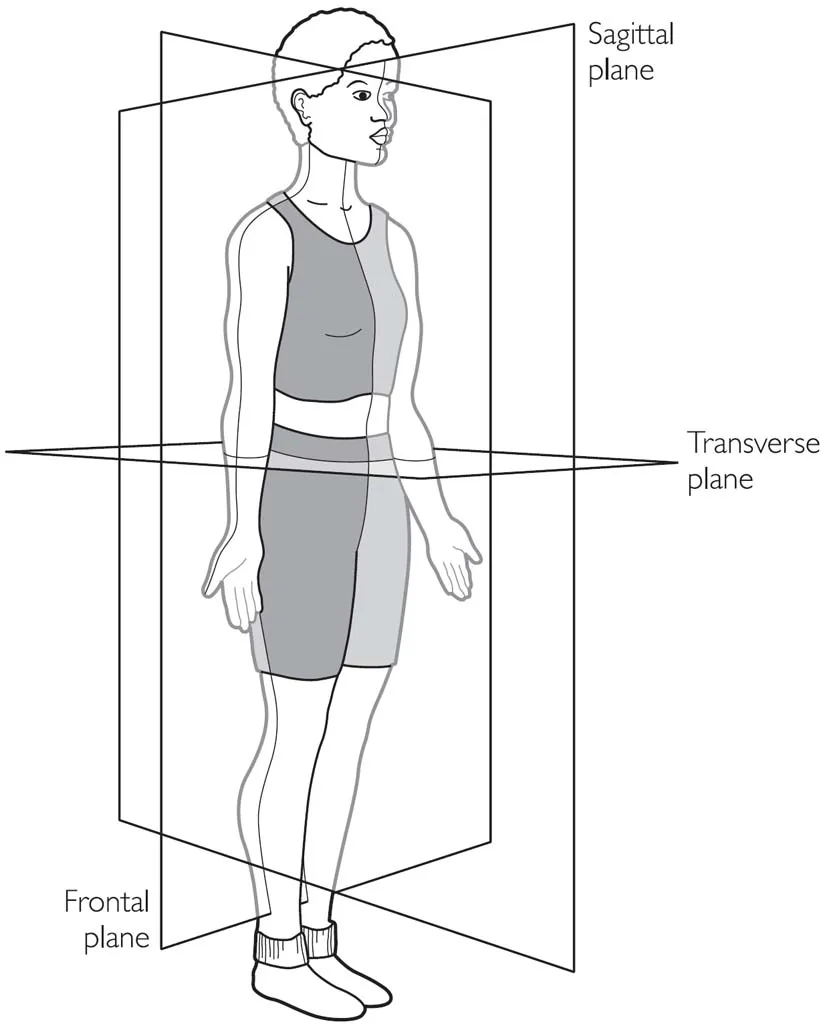
Posture is often thought of in geometrical or Cartesian terms, where an ideal posture consists simply of the stacking of one joint on top of the other in relation to three planes of motion and axes of rotation – a configuration reinforced by good muscle balance around the joints (see fig 1.1). While this is true to some extent, it fails to recognise the way in which we achieve this configuration and how we are able to maintain it during movement. To look at these points, we must delve deeper and consider posture from another point of view – efficiency of use.
Figure 1.1 The body’s planes of motion
Although there are an infinite number of possibilities in the configuration of limbs and their mechanical use for any given task, inherent in every task is a way of organising and using the body with the least wear and tear and the most efficient functioning. For example, sitting down on a chair can be performed in many ways; however, only a few of these will require the least use of energy and effort. Much of the time, we become accustomed to using excessive amounts of energy when moving; indeed, many of us exhibit unnecessary amounts of muscular tension even when sitting or standing. This raises the question not of what’s right or wrong, but rather what works? What positions or movements allow for optimal efficiency? The answers to these questions presuppose that posture is not necessarily defined by static positioning alone, but more importantly by the way we organise our bodies as we move. When such an attitude is adopted by practitioners, this type of questioning can effectively move patients towards a postural re-education programme that is motivated by a process of self-exploration and body awareness: a situation that is almost childlike in nature, and one that allows the body to re-learn and self-regulate its own posture.
The development of posture
The human body is a homeostatic organism. It is constantly adjusting, modifying and learning in response to internal and external stimuli: a process of self-regulation by continual feedback. These stimuli imprint themselves physically and mentally on the body in the way of learning – some desirable, some not so desirable. In fact, much of this learning begins before we are even born. Our ability to move begins in utero, we perform slow controlled movements, as well as rapid ones, almost as if we are stretching and strengthening in some way – a process known as pandiculation. These innate movement patterns appear to be directed by the precisely controlled and progressive expression (and inhibition) of important reflex pathways. When we are born, these patterns continue to help our learning as we lift and turn our heads, as we learn how to crawl, roll and sit, and eventually as we learn how to stand and walk. The systematic emergence of these movement patterns are important developmental milestones that can provide us with knowledge of how postural control evolved from birth. Much can be learnt from infantile movement patterns and the realisation that all children learn how to control posture in a very short space of time. This process implies a rapid learning curve, one that can be applied to adult re-education.
Further understanding of posture may require explorations into our ancestral heritage, and investigations into how and why human bipedalism has evolved and adapted over millions of years. Considering the extent of musculoskeletal dysfunction and movement impairment in today’s society, the role of posture in this process, and an appreciation of how we used to move may provide clues to the restoration of optimal posture and function.
Lastly, postural re-education strategies should, perhaps, incorporate and integrate concepts of animal behaviour, in particular, those of other primates such as the great apes. It is often forgotten that humans are primates and as such we share much of our framework and potential motor behaviour with other apes. The overall aim is subjectively to model the origin of human movement from a diverse range of study options, and use this information to design effective postural re-education programmes in adults. A number of these principles are reflected in the postural lesson plans in chapters 7–10.
Control of posture
As adults, we often take our ability to sit, stand and move for granted – that is until we lose the ability to do so effortlessly. Unless this education is continued in the same way as it started, we can easily lose the ability to organise our limbs effectively and move efficiently. We may also lose the ability to notice the very stimuli that helped us to organise ourselves in the first instance. This inherent ability is known as feedback and feed-forward, and is largely governed by our proprioceptive and exteroceptive systems, which provide postural adjustments accordingly. The proprioceptive system senses changes in body position, posture and movement via specialist receptors that feed back information to the central nervous system. The exteroceptive system senses changes in our immediate environment through the senses of vision, hearing, touch, smell and taste. The basic principles of proprioception and how these intricate mechanisms help us to control stability and balance by compensatory and anticipatory postural adjustments are discussed in chapter 2. Using this knowledge, these same mechanisms of postural control can be enhanced further through appropriate exercise and movement. In this way, the nervous system can once again learn to interact continually with the environment, so that we can organise our bodies quickly and efficiently.
Evaluating posture
Optimal posture is more efficient than any other type of posture: the proprioceptive mechanisms are beautifully integrated to bring the body into a configuration where all weight-bearing articulations are subjected to minimal compression and stress. As we attempt to ‘measure’ posture, we may initially observe such a configuration statically, through observations of joint alignment. We may also look at how these characteristics affect our ability to function dynamically, by assessing movement potential, balance and coordination.
The assessment of static posture is usually conducted against a gravity line, which provides a point of reference for observation of joint alignment. These observations can then be correlated with those of seated or lying assessments, and later confirmed with specific muscle function testing. This provides an overall picture of the way the body organises itself statically in relation to gravity, and is also known as structural efficiency. Variations away from the gravity line can be interpreted within the context of existing pain and impairment, or can be used as indicators of potential dysfunction. Some common postural variations are discussed in chapter 4.
The assessment of dynamic posture usually involves the performance of key movement patterns that challenge a number of important postural mechanisms, such as coordination, balance, economy of effort, and reversibility. This provides an overall picture of how the body organises itself in preparation for and during movement, and is also known as functional efficiency. A number of important movement assessments are explored in chapter 4, with discussions of why they are vital to postural health.
Putting this altogether, we now have a different model for posture: one that focuses on body efficiency or how the body is used for any given task. From an evaluation perspective, this doesn’t stop at observation of joint alignment. In fact, a more suitable term might be body configuration, where configuration relates to how parts of the body are arranged and interconnected, so that the body functions correctly.
A model for re-education
Many of the techniques presented in this book are synergistic in the sense that they are more effective when they are performed as a sequence, rather than when they are performed in isolation. Each movement sequence aims to meet a specific postural objective, and movements are organised in such a way to maximise learning and change. To help this learning process, a number of therapeutic practices are used in a specific way that allows accumulative change, in that each method effectively builds on the previous method in the sequence. Many of these practices are discussed in chapter 6, and include positional release and contract-relax techniques, which can then be effectively programmed alongside integration techniques, to build postural lesson plans.
The objective of each lesson plan is not to correct a particular postural dysfunction, but to allow you to focus on how you are using a particular body part in relation to other body parts. The result is two-fold:
1. Effective resolution of pain and dysfunction, as the nervous system recalibrates itself to detect postural disturbances at a finer level.
2. Increased efficiency of movement and economy of effort, as the body learns to organise itself differently in relation to itself and the environment.
Such a change in self-perception, whether the objective is to eradicate pain, or to prevent pain and maintain good health, is an important result of postural re-education. In the majority of cases, this process involves improving body awareness, an approach that is heavily reliant on effective ‘re-wiring’ of the body’s sensation of position and movement. As previously mentioned, a number of techniques can be used to achieve this, which can be self-administered or practitioner-assisted.
These techniques have been organised into 20 lesson plans, thematically organised around the achievement of common postural objec...
Table of contents
- Cover
- Title page
- Dedication
- Table of Contents
- Preface and acknowledgements
- PART ONE: The Principles of Postural Training
- 1 Introduction
- 2 Control of posture
- 3 Assessment of structure
- 4 Assessment of function
- 5 A model of re-education
- PART TWO: Exercises for Postural Training
- 6 Strategies for postural re-education
- 7 Lesson plans for the lower body
- 8 Lesson plans for the trunk and spine
- 9 Lesson plans for the neck and shoulders
- 10 Lesson plans for balance and alignment
- References
- Suggested reading
- Glossary
- Also Available
- eCopyright
Trusted by 375,005 students
Access to over 1.5 million titles for a fair monthly price.
Study more efficiently using our study tools.
Frequently asked questions
Yes, you can cancel anytime from the Subscription tab in your account settings on the Perlego website. Your subscription will stay active until the end of your current billing period. Learn how to cancel your subscription
No, books cannot be downloaded as external files, such as PDFs, for use outside of Perlego. However, you can download books within the Perlego app for offline reading on mobile or tablet. Learn how to download books offline
Perlego offers two plans: Essential and Complete
- Essential is ideal for learners and professionals who enjoy exploring a wide range of subjects. Access the Essential Library with 800,000+ trusted titles and best-sellers across business, personal growth, and the humanities. Includes unlimited reading time and Standard Read Aloud voice.
- Complete: Perfect for advanced learners and researchers needing full, unrestricted access. Unlock 1.5M+ books across hundreds of subjects, including academic and specialized titles. The Complete Plan also includes advanced features like Premium Read Aloud and Research Assistant.
We are an online textbook subscription service, where you can get access to an entire online library for less than the price of a single book per month. With over 1.5 million books across 990+ topics, we’ve got you covered! Learn about our mission
Look out for the read-aloud symbol on your next book to see if you can listen to it. The read-aloud tool reads text aloud for you, highlighting the text as it is being read. You can pause it, speed it up and slow it down. Learn more about Read Aloud
Yes! You can use the Perlego app on both iOS and Android devices to read anytime, anywhere — even offline. Perfect for commutes or when you’re on the go.
Please note we cannot support devices running on iOS 13 and Android 7 or earlier. Learn more about using the app
Please note we cannot support devices running on iOS 13 and Android 7 or earlier. Learn more about using the app
Yes, you can access The Complete Guide to Postural Training by Kesh Patel in PDF and/or ePUB format. We have over 1.5 million books available in our catalogue for you to explore.