The Complete Guide to Studio Cycling has been written for people who want to know how to train effectively on indoor stationary bikes, from instructors, personal trainers and coaches, to sportspeople and anyone who just wants to get fit.
Studio cycling, or 'spinning' should be fun and motivating, and this book promotes focus and concentration techniques, including an individual training programme that can be adapted as your fitness levels improve.
The Complete Guide to Studio Cycling answers key questions about studio cycling, from what it is and what it aims to achieve, to how to set your bike up to suit your needs. It highlights dos and don'ts, confronts the myths and presents the facts, and allows everyone to benefit from one of the most effective exercise classes available.
- 1 pages
- English
- ePUB (mobile friendly)
- Available on iOS & Android
eBook - ePub
The Complete Guide to Studio Cycling
About this book
Information
HEALTH AND FITNESS | 1 |
The definition of fitness is to be in good health or condition, and therefore this is not a performance rating. How many times have you heard people say, ‘I’d love to join a studio cycling class but I’m not fit enough’? The answer to that is that no one is ‘not fit enough’ to spin; the instructor does not force you to put the resistance onto the flywheel — it is something that you do yourself. Fitness comes later when you allow yourself to be challenged in a class. This chapter on health and fitness will aid you on the way to a healthy mind and fitter body.
If you are going to separate the performance rating of individuals then you must also create different classes for experience and capability, which is why it is necessary to have varied types of class for people to choose from. This choice must be made by the class member in the first instance; however, ultimately the instructor should place the person in a suitable class.
Nutrition
Have you ever heard the phrase, ‘We are what we eat’? It is a true statement: a healthy diet will result in improvements in energy levels, muscle strength, hair, skin, nails and all-round well-being. In order to follow a healthy diet it is important to have a certain element of knowledge about the food you eat; this chapter aims to help you, not by telling you what you are to eat but by explaining why and how your diet can help you adapt to exercise.
The balance of a daily diet should be approximately: 50–60% carbohydrates; 25–30% fat; 15–20% protein. Men should consume 2500 kcal per day, and women 2000 kcal per day (the more exercise the higher the consumption).
Eating before and during exercise
Many people are nervous about what to eat before exercise or a race. However, fuelling your body is vital to performance especially prior to a long ride or race. Ideally you should eat at least 1–2 hours before exercise; your food intake should consist primarily of complex carbohydrate such as porridge, pasta or rice with some protein. It is important not to eat food that is high in fat and sugar as your body will be unable to digest it.
Why eat carbohydrate before exercise?
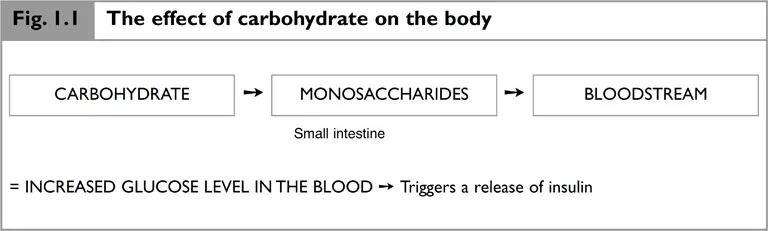
Carbohydrates can take on many different forms. Monosaccharide units can pair up to form diasaccharides, or join up in longer chains to form oligosaccharides or polysaccharides.
Insulin ‘removes’ the glucose from the blood. The glucose is transported into the muscles and into the fatty tissue. When our glycogen stores are well fuelled by a diet rich in carbohydrate, we can exert ourselves for a longer period of time.
If we have a diet rich in carbohydrate our glycogen stores will be replenished and we will be ready to train within 12–24 hours. However if we have a diet rich in protein and fat the process will take 2–3 days.
| Table 1.1 | Types of carbohydrate | |
| Monosaccharides (monoses)  | Examples Glucose Fructose Galactose | Found in Honey Fruit Milk |
| Diasaccharides (dioses)  | Saccharose Maltose Lactose | Sugar Malt Drink Milk |
| Ogliosaccharides  up to 10 monosaccharide units | Maltotroise Dextrin | Toast, crisp bread etc |
| Polysaccharide (complex carbs.) more than ten up to several 100,000s of monosaccharide units | Vegetable starch Animal glycogen | Cereals Breads Rice |
Are any fats acceptable in our diet?
Yes, fats are just as important as carbohydrate and protein. Just as it is important that your training should be balanced, so should your diet. There are many different types of fats. The fatty acids are differentiated according to their length (short-chain, medium-chain, long-chain) and according to whether they are saturated or unsaturated.
Fat plays an important role in the body; it lubricates joints, protects internal organs and is a concentrated source of energy.
| BAD FATS = Saturated fats | • Increased cholesterol level • Contained in animal fats such as meat, milk products, cheese and butter |
| ‘IN MODERATION’ FATS = Monosaturated fats | • Liquid consistency • Positive effects on cholesterol levels • Contained in vegetable oils, such as olive oil and peanut oil |
| GOOD FATS = Polyunsaturated fats | • Liquid consistency • Positive effect on cholesterol • Vegetable oils • Fish — herring, mackerel, and salmon |
What about protein?
When you think of a diet high in protein it might bring to mind pictures of bodybuilders drinking protein shakes and devouring huge steaks. As a result you might think it is better to cut back on your intake of protein rather than increase it. Actually this is not true: you could be denying your body vital nutrients since body proteins break down when you exercise or participate in any other heavy muscular activity. Twenty per cent of the body consists of protein. Emphasis is often placed on carbohydrates when it comes to health and fitness, but protein also plays a vital role in building and repairing muscles, and maintaining all types of tissue; it helps to keep brain cells functioning and the blood flowing. Even more high-quality protein is needed if you are exercising. Some of the symptoms of lack of protein are chronic fatigue, constant colds or general...
Table of contents
- Cover
- Title page
- Table of Contents
- Foreword
- Preface
- Introduction What is Studio Cycling?
- 1 Health and Fitness
- 2 Getting Started
- 3 Visualisation, Focus and Concentration
- 4 Heart Zone Training for Studio Cycling
- 5 General Training Zones within a Class Structure
- 6 Further Assistance for Instructors
- 7 Different Forms of Studio Cycling
- 8 Studio Cycling at Home
- 9 Athletes ‘Spin to Win’
- 10 Overtraining
- 11 Special Populations
- Glossary
- References
- Dedication
- Acknowledgments
- eCopyright
Trusted by 375,005 students
Access to over 1.5 million titles for a fair monthly price.
Study more efficiently using our study tools.
Frequently asked questions
Yes, you can cancel anytime from the Subscription tab in your account settings on the Perlego website. Your subscription will stay active until the end of your current billing period. Learn how to cancel your subscription
No, books cannot be downloaded as external files, such as PDFs, for use outside of Perlego. However, you can download books within the Perlego app for offline reading on mobile or tablet. Learn how to download books offline
Perlego offers two plans: Essential and Complete
- Essential is ideal for learners and professionals who enjoy exploring a wide range of subjects. Access the Essential Library with 800,000+ trusted titles and best-sellers across business, personal growth, and the humanities. Includes unlimited reading time and Standard Read Aloud voice.
- Complete: Perfect for advanced learners and researchers needing full, unrestricted access. Unlock 1.5M+ books across hundreds of subjects, including academic and specialized titles. The Complete Plan also includes advanced features like Premium Read Aloud and Research Assistant.
We are an online textbook subscription service, where you can get access to an entire online library for less than the price of a single book per month. With over 1.5 million books across 990+ topics, we’ve got you covered! Learn about our mission
Look out for the read-aloud symbol on your next book to see if you can listen to it. The read-aloud tool reads text aloud for you, highlighting the text as it is being read. You can pause it, speed it up and slow it down. Learn more about Read Aloud
Yes! You can use the Perlego app on both iOS and Android devices to read anytime, anywhere — even offline. Perfect for commutes or when you’re on the go.
Please note we cannot support devices running on iOS 13 and Android 7 or earlier. Learn more about using the app
Please note we cannot support devices running on iOS 13 and Android 7 or earlier. Learn more about using the app
Yes, you can access The Complete Guide to Studio Cycling by Rick Kiddle in PDF and/or ePUB format, as well as other popular books in Biological Sciences & Sport & Exercise Science. We have over 1.5 million books available in our catalogue for you to explore.