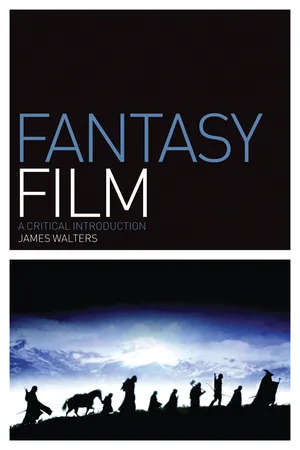
Fantasy Film proposes an innovative approach to the study of this most popular cinematic genre. Engaging with the diversity of tones, forms and styles that fantasy can take in the cinema, the book examines the value and significance of fantasy across a wide range of key films. This volume extends critical understanding beyond the often narrowly defined boundaries of what is seen as "fantasy".
Fantasy Film uses key concepts in film studies - such as authorship, representation, history,genre, coherence and point of view - to interrogate the fantasy genre and establish its parameters. A wide range of films are held up to close scrutiny to illustrate the discussion.
Moving from Alfred Hitchcock's dark thrillers to Vincente Minnelli's vibrant musicals, from George Méliès' 1904 Voyage à travers l'impossible to the X-Men series, the creative dexterity and excitement of film fantasy is evoked and explored. The book will be invaluable to students and fans of the fantasy genre.
- 160 pages
- English
- ePUB (mobile friendly)
- Available on iOS & Android
eBook - ePub
About this book
Information
1
Approaching Fantasy Film
Fantasy and the Moment
A series of critics and theorists1 have remarked that the conclusion to Fritz Lang’s You Only Live Once (1937) constitutes a significant and unexpected shift in the tone, mood and dramatic structure of the film. In taking this relatively brief final scene as a starting point for discussion, it is my contention that the nature of this shift and the style in which these closing moments unfold is of particular relevance to our preliminary concerns regarding the interactions between fantasy and film. That Lang’s film should make an intervention into debates of this kind is perhaps as unanticipated as the events taking place in its conclusion, given that You Only Live Once would not be a natural inclusion in any canon of fantasy cinema, were we inclined to construct such a thing. Indeed, it is more usually described as a crime thriller or ‘social consciousness’ film.2 Whilst not wishing to disrupt or challenge classifications of this kind, which in any case describe accurately the overall character of You Only Live Once, I am drawn to the ways in which the film’s forceful departure from such generic parameters at its conclusion foregrounds issues closely fused with concepts of fantasy cinema, thus having potent implications for the themes taken up within this book.
In order to account for the tonal and structural rupture at the end of Lang’s film, it is worth providing some context to events. The final action of You Only Live Once involves its two central characters, Eddie (Henry Fonda) and Joan Taylor (Sylvia Sydney) as they make one last desperate break for freedom after having been on the run from the authorities for several weeks. Having both sustained wounds when their car was shot at by an armed patrolman and run off the road, the couple stagger from their vehicle and make their way into the nearby woods. As they flee the car, first Eddie falls against the wheel arch of the car in pain before carrying on, only for Joan’s injuries to overcome her, causing her to slump against the trunk of a tree. Eddie reacts by scooping her up into his arms and, stumbling back slightly as he takes her weight against his own wounded frame, he continues their progress slowly and painfully through the overgrowth. The sounds of car engines and the squeal of tyres in the background make it clear that a full pursuit is taking place, emphasizing the urgency of the pair’s predicament and also bringing into intense focus the hopelessness of Eddie’s efforts as he struggles to flee the scene with his wife. A cut away from Joan and Eddie reveals a pack of officers passing by the couple’s wrecked car and swarming into the woods after them. Each man possesses a rifle.
In one sense, the pursuit of Eddie and Joan by the police officers here can be taken as a direct reference to the way in which Eddie (and, when she joins him on the run, Joan) has been hounded by the authorities throughout the film. Certainly, we are led to understand that this is the view of his fate taken by Eddie himself as, on learning that he has shot and killed a close acquaintance, Father Dolan (William Gargan), whilst breaking out of jail when ironically he was already free due to a late pardon, he responds by shifting culpability for his actions, declaring: ‘They made me a murderer.’ Whilst Eddie’s reading of his predicament is at least precarious in that it lifts all responsibility for his actions from his own shoulders, we can also appreciate that a number of characters fail to give him a sincere opportunity for improvement following his initial release from prison at the beginning of the film. In one particular case Lang seems to draw a set of parallels between the dismissive attitudes of Eddie’s employer on leaving prison, Mr Williams (William Pawley), and the guard who watches over him later in his cell as he awaits execution, Rogers (Guin Williams). Eddie is sacked from his job as a driver by Mr Williams when he fails to return his truck, choosing instead to delay for an hour-and-a-half while he looks around a potential new home with Joan. When Eddie returns to his office to plead for his employment to be reinstated Williams displays an almost complete lack of regard for him, turning away from Eddie to make social arrangements with his own wife on the telephone and only breaking off from that exchange to offer sharp dismissals of Eddie’s entreaties. Lang makes a point of contrasting Williams’ harsh treatment of Eddie with the oversweet mode of address he adopts when talking to his wife, emphasizing the tonal disparity as Williams switches between these two different styles of speech.
Rogers, the guard, replicates this dismissive attitude towards Eddie when he is charged with the duty of watching over him in his cell. Eddie has been sentenced to death after being convicted of the murder of six people as the result of a gas bomb attack and robbery of the State bank. He is found guilty of this crime based on the fact that his initialled hat was found at the scene of the crime, although whether he actually participated in the robbery is never made properly clear to us.3 As the scene in Eddie’s cell opens, Rogers sits smoking a pipe and reading a magazine and, when Eddie asks if he can see his wife, he informs him that ‘It’s too late now: it’s against the rules.’ At this, Eddie asks if Rogers will do him a favour by telling Joan that he’s sorry, that he acted like ‘such a heel’. The request is made with passion and is complemented by a sentimental (if somewhat heavily-asserted) string melody that rises up from the underscore. But when Eddie asks Rogers if he will do the favour, the guard reacts with a non-committal ‘Mmm mmm’, barely looking at the prisoner before returning to his reading and smoking. The implication of this limp response is that Rogers will not be passing on the message: that he deems it unimportant, inconsequential or futile.
Twice, then, Eddie makes impassioned pleas to characters and is turned down flat. In both instances, the effect is to strip him of his humanity, of his ability to appeal to the humanity of others, and effectively represents a dismissal of Eddie’s value as a sentient human being within his world. Taken together, the responses of Williams and Rogers form a picture of a society – or at least significant and powerful aspects of a society – that take Eddie to be entirely without worth. In the final hours, Rogers sees before him a condemned man upon whom it would be pointless to reward with attention and certainly not kindness. In this sense, he interprets his job as a guard as an essentially mechanical and dehumanized procedure, perhaps regarding himself as a second barrier of protection beyond the bars that enclose Eddie in his cell. What is striking, however, is the extent to which Williams appears to view Eddie in a very similar way at a much earlier stage in the narrative, when Eddie is ostensibly a reformed criminal seeking to make a new beginning. We might implicitly take from this pattern of correspondences the suggestion that Eddie is never given a chance, from the moment he is released from prison to the moment he is imprisoned again and condemned to death. Read in this way, his declaration that ‘They made me a murderer’ holds value as it relates potently to an attitude of dismissal and distrust exhibited by certain authority figures in their dealings with him.
Yet it is also the case that both Williams and Rogers are somewhat justified in their mistrust of Eddie and their suspicion of his pleas to be treated as an honest man. In Williams’ case, Eddie has engineered the situation to a certain extent by electing to flout the conditions of his employment in the first place, but his volatile temperament is also revealed dramatically when he responds to his boss’s lack of compassion by hitting him hard in the face. Rogers’ lack of regard for Eddie in fact rebounds when it turns out that his prisoner has received a note about a hidden gun in the isolation ward and proceeds to cut his wrist with the ripped edge of a metal beaker in order to secure his delivery there. Ironically, then, it turns out that Rogers’ lack of attention in fact aids Eddie’s deception, and so the guard is guilty not only of showing an insufficient amount of human compassion but also of neglecting to remain vigilant in watching over an apparently dangerous criminal. In both instances, however, and from a certain perspective, Eddie can be seen to be in possession of an irresponsible, violent or deceptive temperament, and so his status as a victim of an unforgiving society is at least complicated, and perhaps ultimately compromised. It is indicative of the film’s subtlety in dealing with such matters of guilt and responsibility, and its commitment to keeping the lines of crime and innocence ambiguous, that we are not entitled to place the weight of blame for Eddie’s predicament either with the figures of authority he faces or with Eddie himself in either instance. In this way, the film poses the conundrum of who is to blame for the crimes committed, what constitutes a crime in this fictional world, and who is guilty of which crimes – society or the individual.
The image of the fatally injured Eddie carrying Joan through the woods with a pack of armed police officers in pursuit would seem to perfectly encapsulate this moral dilemma: whose hand has brought events to this conclusion? A visual emphasis of this theme occurs in the striking point of view shot from the viewfinder of a patrolman’s rifle as he apparently takes aim at Eddie and Joan. On the one hand, this seems to symbolize the extent to which the pair – and particularly Eddie – have been in the sights of the authorities from the outset, fatally marked out. But on the other hand we are also required to consider what it is the marksman sees through his lens: the back of a murderer and thief retreating into the woods with his fugitive wife. The film’s social dilemma is clear as we are effectively invited to contemplate which perspective is fair: a balance of judgement that can never be properly struck. In this sense, the shot through the viewfinder corresponds with George Wilson’s central contention regarding You Only Live Once that:
The narration explores with elaborate care the ways in which film may enhance and complicate our difficulties of seeing the world accurately by leading perception and conviction astray with methods of its own. The film’s power cannot be fully felt until the viewer recognizes that the dramas of misperception enacted on the screen have been replicated still one more time in his or her theatre seat.4
Here, Wilson elaborates this film’s particular strategy of involving its audience closely in the potential fallibilities of vision and perception and placing at stake the ways in which these can impact upon the moral judgements we form in relation to characters and the society they inhabit, a theme that he explores fully in his landmark reading of the film. Following this lead, we might therefore speculate that the shot through the viewfinder does not simply propose a straightforward vision but instead questions the reliability of vision itself in the film’s depiction of its fictional world, and the implications for interpreting images in any particular way.
Questions of vision and reliability achieve yet further significance as it is at this point that the film radically shifts its storytelling tone and, in doing so, potentially expands its boundaries of possibility. A cut away from the rifleman’s point of view shot reveals Eddie reassuring Joan ‘We’re OK kid, we’re OK’ as he carries her. She touches and strokes his face, before her head falls forward in apparent unconsciousness. Eddie’s calling out ‘Jo’ rouses her momentarily and she tells him, in an intimate close-up, ‘I’d do it again, darling, all over again … glad-’ and then collapses, dead. We cut back to a medium shot as Eddie cries out again – ‘Jo’ – but then a shot rings out and he stumbles forward, eyes closing as the bullet strikes him in the back. A moment of silence and stillness follows, before he opens his eyes once more and a male voice calls out to him ‘Eddie’, accompanied by an unseen choir of seraphic voices. Eddie’s gaze drops down once more to Joan and he kisses her gently on the lips, but the enigmatic voice calls out once more, insistently: ‘Eddie!’ Eddie looks around slowly to a space off-screen, the hint of a smile forming on his face; the choral accompaniment swells and the voice continues ‘You’re free Eddie! The gates are open!’ At these words, there is a cut to what appears to be Eddie’s point of view (an assumption complemented by the invoked convention of the eye-line match between the two shots): a forest scene lit by a shard of bright daylight that falls across the woodland floor, touching the canopy of leaves and branches that enclose the scene. The underscored music and voices reach their emphatic conclusion and the scene fades to black. The film ends.
We are entitled to be unresolved in our understanding of what has occurred in these final moments. Is this a vision of heaven, and thus an endorsement of the central character’s redemption? Or is it the final subjective vision of a man before he succumbs to death? The voice that calls out is recognizably that of Father Dolan, the character whom Eddie killed earlier in the film, but are we to take this to be an apparition calling out from beyond the grave, or the product of Eddie’s residual guilt over his actions finally taking overwhelming hold of his physical senses? Certainly, nothing in the film up to this point can prepare us for its conclusion. On first viewing, at least, the effect of the ending approaches that of a fracture occurring in the narrative, as though a border between conventions and codes had been forcefully breached. (The moment of stillness and silence that follows Eddie’s being shot in the back seems to reinforce this notion, occurring almost as a standstill between two worlds.) Furthermore, the relative brevity of Eddie’s final revelation in the woods serves to heighten the impact of the event, leaving us to question whether it really took place in those few seconds, and whether it has taken place in the manner we have understood it to, or whether ultimately we have understood fundamentally what has taken place at all. The notion that the film’s ending provides something of a question mark rather than a full stop to the narrative is reinforced by the major critical reactions that have been formulated in response to it. Not only do respective scholars identify the ending as odd, or at least out of step with Lang’s vision of a fictional world up to that point, but there is a concerted attempt to rationalize the events taking place – a desire to come to terms with the anomaly and the terms in which it is presented to us. Continuing the themes of his general argument about You Only Live Once, George Wilson relates the ending to its overarching debates surrounding the fallibility of character point of view, and the unreliability of the film’s narrative strategies. He concludes that:
We have strong reason to suppose that Eddie’s dying vision may only be the ultimate misperception that culminates the vast chain of misperceptions which has led him to his death. I have stressed again and again how much of the narrative development depends upon various failures of perception; how characters may appear deceptively to each other and to us. There is a compelling logic to the possibility that we are seeing in the end the past hope, the last pitiful illusion of a dying and defeated man … Like the film as a whole, the vision is strictly ambiguous. It may be genuine or it may be horribly false, but we cannot accept without question a heavenly promise of life after death in a film whose title is, after all, You Only Live Once.5
In conceding the scene’s inherent ambiguity, Wilson proposes a reading of the moment as an ironic encapsulation of the failures of vision expounded within Lang’s film, centring those shortcomings upon the central character of Eddie. Consistent with this interpretation, Wilson offers the example – occurring in the film just before the final scene – of Eddie wrongly identifying a light in the woods as the morning star, when in fact Joan has spotted the reflected light of the police cars that lie in wait for them. For Wilson, Eddie’s confusing an impending symbol of death with a symbol of hope and renewal proves indicative of his skewed perception of events throughout the film.6 We might add to this example Eddie and Joan’s later shared indulgence in a fantasy of their predicament when, both badly wounded by bullets, they each seek to reassure each other that they are not hurt in a blatant – and desperate – denial of the grim reality they both share. Where the incident with the morning star might be read as symbolic of Eddie’s misperception of events, a misperception that he is critically unaware of, the example of the denied bullet wounds suggest both Eddie and Joan’s wilful denial of reality: the extent to which they seek in desperation to resist the terms of a world that has turned against them finally and retreat instead towards a shared illusion. Wilson’s reading of the film’s moment places the weight of emphasis upon Eddie’s vision of his world – his perception of events and his place within them. Whether or not this is a wilful or unintentional skewing of life’s realities, it nevertheless makes Eddie the author of the heavenly vision at the end of the film, marking it out as a product of his imagination rather than as an event to which he bears witness. In Wilson’s terms, this ultimately becomes an ironic statement concerning Eddie’s fallible vision and characteristic misperception, fitting a pattern that brings him to this final predicament.
Tom Gunning also acknowledges the moment’s ambiguity in his reading of the film, but in doing so proposes that the scene opens up a variety of interpretations apart from Wilson’s understanding of it as an ironic statement, ‘the last pitiful illusion of a dying and desperate man.’ Although conceding the limitations of emphasizing solely directorial intention, Gunning asks us to consider again Lang’s key claim, made in conversation with Peter Bogdanovich, that the sentiment of the closing moments was not designed to be ironic.7 Gunning pursues this line of reasoning to consider what it would mean to accept the closing episode as sincere:
Can we follow Lang and see Eddie as receiving a vision of the truth at the end of You Only Live Once? What would that truth be? The most obvious allegorical reading would be that Eddie and Joan are redeemed. The Production Code may demand their death, but heaven will receive them. The gates that open now are the gates of heaven. Therefore this vision would be of the sort of rebirth Father Dolan said death could be, allowing us to remember our glorious birthright. Again this is a possible reading, less fashionable than Wilson’s, but also not inadequate.8
Although, for the purposes of his wider argument, Gunning allows this interpretation to splinter as he proposes further meanings, such as how the vagueness of the view of ‘heaven’ might lead us to consider Canada as a ‘promised land’ across the border for the couple (and one which remains barred from them), he nevertheless constructs an account of the closing moments of You Only Live Once that runs counter to Wilson’s, proposing that the scene can be read as an allegorical expression of freedom a...
Table of contents
- Cover
- Title Page
- Contents
- Dedication
- Introduction
- 1 Approaching Fantasy Film
- 2 Fantasy, History and Cinema
- 3 Fantasy, Authorship and Genre
- 4 Fantasy, Childhood and Entertainment
- 5 Fantasy, Imagination and Interiority
- 6 Fantasy, Style and Coherence
- Acknowledgements
- Conclusion
- Notes
- Annotated Guide to Further Reading
- Bibliography
- Imprint
Trusted by 375,005 students
Access to over 1.5 million titles for a fair monthly price.
Study more efficiently using our study tools.
Frequently asked questions
Yes, you can cancel anytime from the Subscription tab in your account settings on the Perlego website. Your subscription will stay active until the end of your current billing period. Learn how to cancel your subscription
No, books cannot be downloaded as external files, such as PDFs, for use outside of Perlego. However, you can download books within the Perlego app for offline reading on mobile or tablet. Learn how to download books offline
Perlego offers two plans: Essential and Complete
- Essential is ideal for learners and professionals who enjoy exploring a wide range of subjects. Access the Essential Library with 800,000+ trusted titles and best-sellers across business, personal growth, and the humanities. Includes unlimited reading time and Standard Read Aloud voice.
- Complete: Perfect for advanced learners and researchers needing full, unrestricted access. Unlock 1.5M+ books across hundreds of subjects, including academic and specialized titles. The Complete Plan also includes advanced features like Premium Read Aloud and Research Assistant.
We are an online textbook subscription service, where you can get access to an entire online library for less than the price of a single book per month. With over 1.5 million books across 990+ topics, we’ve got you covered! Learn about our mission
Look out for the read-aloud symbol on your next book to see if you can listen to it. The read-aloud tool reads text aloud for you, highlighting the text as it is being read. You can pause it, speed it up and slow it down. Learn more about Read Aloud
Yes! You can use the Perlego app on both iOS and Android devices to read anytime, anywhere — even offline. Perfect for commutes or when you’re on the go.
Please note we cannot support devices running on iOS 13 and Android 7 or earlier. Learn more about using the app
Please note we cannot support devices running on iOS 13 and Android 7 or earlier. Learn more about using the app
Yes, you can access Fantasy Film by James Walters in PDF and/or ePUB format, as well as other popular books in Medien & darstellende Kunst & Darstellende Kunst. We have over 1.5 million books available in our catalogue for you to explore.