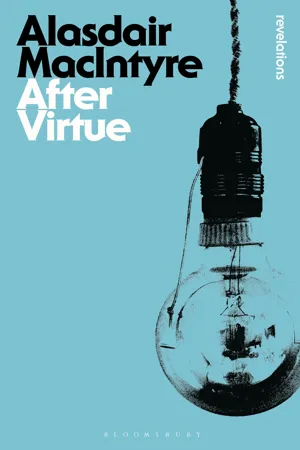
Highly controversial when it was first published in 1981, Alasdair MacIntyre's After Virtue has since established itself as a landmark work in contemporary moral philosophy. In this book, MacIntyre sought to address a crisis in moral language that he traced back to a European Enlightenment that had made the formulation of moral principles increasingly difficult. In the search for a way out of this impasse, MacIntyre returns to an earlier strand of ethical thinking, that of Aristotle, who emphasised the importance of 'virtue' to the ethical life.
More than thirty years after its original publication, After Virtue remains a work that is impossible to ignore for anyone interested in our understanding of ethics and morality today.
eBook - PDF
After Virtue
About this book
Information
Table of contents
- Title Page
- Copyright Page
- Contents
- Prologue to the Third Edition After Virtue After a Quarter of a Century
- Preface
- Chapter 1 A Disquieting Suggestion
- Chapter 2 The Nature of Moral Disagreement Today and the Claims of Emotivism
- Chapter 3 Emotivism: Social Content and Social Context
- Chapter 4 The Predecessor Culture and the Enlightenment Project of Justifying Morality
- Chapter 5 Why the Enlightenment Project of Justifying Morality had to Fail
- Chapter 6 Some Consequences of the Failure of the Enlightenment Project
- Chapter 7 ‘Fact’, Explanation and Expertise
- Chapter 8 The Character of Generalizations in Social Science and their Lack of Predictive Power
- Chapter 9 Nietzsche or Aristotle?
- Chapter 10 The Virtues in Heroic Societies
- Chapter 11 The Virtues at Athens
- Chapter 12 Aristotle’s Account of the Virtues
- Chapter 13 Medieval Aspects and Occasions
- Chapter 14 The Nature of the Virtues
- Chapter 15 The Virtues, the Unity of a Human Life and the Concept of a Tradition
- Chapter 16 From the Virtues to Virtue and After Virtue
- Chapter 17 Justice as a Virtue: Changing Conceptions
- Chapter 18 After Virtue: Nietzsche or Aristotle, Trotsky and St Benedict
- Chapter 19 Postscript to the Second Edition
- Bibliography
Trusted by 375,005 students
Access to over 1.5 million titles for a fair monthly price.
Study more efficiently using our study tools.
Frequently asked questions
Yes, you can cancel anytime from the Subscription tab in your account settings on the Perlego website. Your subscription will stay active until the end of your current billing period. Learn how to cancel your subscription
No, books cannot be downloaded as external files, such as PDFs, for use outside of Perlego. However, you can download books within the Perlego app for offline reading on mobile or tablet. Learn how to download books offline
Perlego offers two plans: Essential and Complete
- Essential is ideal for learners and professionals who enjoy exploring a wide range of subjects. Access the Essential Library with 800,000+ trusted titles and best-sellers across business, personal growth, and the humanities. Includes unlimited reading time and Standard Read Aloud voice.
- Complete: Perfect for advanced learners and researchers needing full, unrestricted access. Unlock 1.5M+ books across hundreds of subjects, including academic and specialized titles. The Complete Plan also includes advanced features like Premium Read Aloud and Research Assistant.
We are an online textbook subscription service, where you can get access to an entire online library for less than the price of a single book per month. With over 1.5 million books across 990+ topics, we’ve got you covered! Learn about our mission
Look out for the read-aloud symbol on your next book to see if you can listen to it. The read-aloud tool reads text aloud for you, highlighting the text as it is being read. You can pause it, speed it up and slow it down. Learn more about Read Aloud
Yes! You can use the Perlego app on both iOS and Android devices to read anytime, anywhere — even offline. Perfect for commutes or when you’re on the go.
Please note we cannot support devices running on iOS 13 and Android 7 or earlier. Learn more about using the app
Please note we cannot support devices running on iOS 13 and Android 7 or earlier. Learn more about using the app
Yes, you can access After Virtue by Alasdair MacIntyre in PDF and/or ePUB format, as well as other popular books in Philosophy & Ethics & Moral Philosophy. We have over 1.5 million books available in our catalogue for you to explore.