Science has made a huge impact on human society over hundred years, but how does it work? How do scientists do the things they do? How do they come up with the theories? How do they test them? How do they use these theories to explain phenomena? How do they draw conclusions from them about how the world might be?
Now updated, this second edition of Philosophy of Science: Key Concepts looks at each of these questions and more. Taking in turn the fundamental theories, processes and views lying at the heart of the philosophy of science, this engaging introduction illuminates the scientific practice and provides a better appreciation of how science actually works. It features:
- Chapters on discovery, evidence, verification and falsification, realism and objectivity
- Accessible overviews of work of key thinkers such as Galileo, Einstein and Mullis
- A new chapter on explanation
- An extended range of easy-to-follow and contemporary examples to help explain more technical ideas
- Study exercises, an annotated bibliography and suggestions of Where to Go Next
Succinct and approachable, Philosophy of Science: Key Concepts outlines some of the most central and important scientific questions, problems and arguments without assuming prior knowledge of philosophy. This enjoyable introduction is the perfect starting point for anyone looking to understand how and why science has shaped and changed our view of the world.
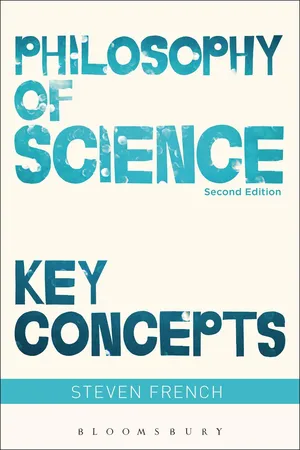
- 234 pages
- English
- PDF
- Available on iOS & Android
eBook - PDF
Philosophy of Science: Key Concepts
About this book
Information
Table of contents
- FC
- Half title
- Also Available from Bloomsbury
- Title
- Copyright
- Contents
- Acknowledgements
- 1 Introduction
- 2 Discovery
- 3 Heuristics
- 4 Explanation
- 5 Justification
- 6 Observation
- 7 Experiment
- 8 Realism
- 9 Anti-realism
- 10 Independence
- 11 Gender bias
- 12 Summary: Where we’ve been and where to go for more
- Suggested readings
- Index
Trusted by 375,005 students
Access to over 1.5 million titles for a fair monthly price.
Study more efficiently using our study tools.
Frequently asked questions
Yes, you can cancel anytime from the Subscription tab in your account settings on the Perlego website. Your subscription will stay active until the end of your current billing period. Learn how to cancel your subscription
No, books cannot be downloaded as external files, such as PDFs, for use outside of Perlego. However, you can download books within the Perlego app for offline reading on mobile or tablet. Learn how to download books offline
Perlego offers two plans: Essential and Complete
- Essential is ideal for learners and professionals who enjoy exploring a wide range of subjects. Access the Essential Library with 800,000+ trusted titles and best-sellers across business, personal growth, and the humanities. Includes unlimited reading time and Standard Read Aloud voice.
- Complete: Perfect for advanced learners and researchers needing full, unrestricted access. Unlock 1.5M+ books across hundreds of subjects, including academic and specialized titles. The Complete Plan also includes advanced features like Premium Read Aloud and Research Assistant.
We are an online textbook subscription service, where you can get access to an entire online library for less than the price of a single book per month. With over 1.5 million books across 990+ topics, we’ve got you covered! Learn about our mission
Look out for the read-aloud symbol on your next book to see if you can listen to it. The read-aloud tool reads text aloud for you, highlighting the text as it is being read. You can pause it, speed it up and slow it down. Learn more about Read Aloud
Yes! You can use the Perlego app on both iOS and Android devices to read anytime, anywhere — even offline. Perfect for commutes or when you’re on the go.
Please note we cannot support devices running on iOS 13 and Android 7 or earlier. Learn more about using the app
Please note we cannot support devices running on iOS 13 and Android 7 or earlier. Learn more about using the app
Yes, you can access Philosophy of Science: Key Concepts by Steven French in PDF and/or ePUB format, as well as other popular books in Philosophy & Analytic Philosophy. We have over 1.5 million books available in our catalogue for you to explore.