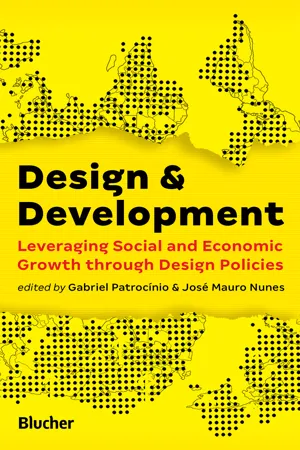
eBook - ePub
Design Development
Leveraging social and economic growth through design policies
- 264 pages
- English
- ePUB (mobile friendly)
- Available on iOS & Android
eBook - ePub
Design Development
Leveraging social and economic growth through design policies
About this book
"The subject of Design Policies is slowly growing to be broadly discussed, although most of the time from within a design practitioners' and design enthusiasts' bubble. Public administration is gradually embracing design from another perspective - using Design Thinking to develop programmes and services. Lawmakers and government executives are still distant, frequently without a real knowledge of design and its potential. Governments (and designers as well) seem to be contented by design promotion actions or programmes, which are frequently wrongly accepted as a design policy. From this prospect, this book intends to be a contribution to the debate of Design Policies nourished by past experiences and reflections, but also from current practices - as in Europe and China, for example.
The book was originally meant in hindsight of a document produced in the seventies by the United Nations Industrial Development Organization, UNIDO, within the context of a partnership with the International Council of Societies of Industrial Design, ICSID. This partnership resulted in a document discussing design as a driver of economic growth, prepared by Gui Bonsiepe in 1973, and then summarized by the UNIDO Secretariat in 1975 as the Basic guidelines for policy of industrial design in developing countries. Both documents were made available for this book by UNIDO, and are reproduced here as appendices. Although originally aimed at developing countries, after these four decades of unsettling growth of wicked problems, this theme deserves to be reviewed and discussed thoroughly. Design might play a very significant role when approaching contemporary problems such as rearranging urban spaces, urban mobility, tourism, immigration, housing, violence, and environment among others. These - not so new - wicked problems prompts to a whole new perspective on design and public design policies that goes beyond the original context here. The perspective of the "Third World" economy (as it was known at the time) might offer insights to understand and perhaps solve problems of any size economy - especially if we consider the aspects of local or regional problems. It is time to exercise empathy towards someone else's problems and to reflect under different scales and measures, and design seem to be the perfect instrument for it.
Mugendi M'Rithaa, former President of ICSID (currently the WDO, World Design Organization) saluted the book as "the most important contribution on this field in the last ten years" (cited in the final remarks of his interview in the chapter Design in Africa: I participate, therefore I am). In Brazil the book was awarded twice - initially at the Objeto:Brasil International Design Award in May 2016, and then later at the same year at the MCB (Museum of the Brazilian Home) Design Awards of 2016. The jury of this later has acclaimed the book as "a theoretical and academic milestone, with potential to change the current practice and understanding of Design." After the successful launch in Portugal with conferences in three design schools in 2016, the book was selected in 2017 to the exhibition Brasil: Hoje at MUDE, Lisbon's Museum of Fashion and Design. The curator, Frederico Duarte, highlighted in the catalogue: "The first and indispensable book on design and development in the Portuguese language." In 2018 the book was selected in Spain to be part of BID, the Ibero-American Design Biennial, in Madrid. In the same year was published an e-book edition in Portuguese to make it more accessible, at the same time that this first English edition started being prepared."
Information
Topic
DesignSubtopic
Design GeneralTable of contents
- Cover
- Contents
- About the book
- Note to the Portuguese Edition
- Note to the First English Edition
- Foreword: UNIDO and industrial design
- Foreword: The role of design in the knowledge era
- Why discuss design policies? - An introduction
- 1. Design for development: mapping the context
- 2. Development patterns of industrial design in the Third World: a conceptual model for newly industrialized countries
- 3. Design and developing countries: the dialectics of design for need vs. design for development
- 4. 40 years later
- 5. From Latin America to Latin America: design as a tool for economic and cultural development
- 6. From Prebisch to the new devopmentalism: theory and practice of industrial policies
- 7. Inside India’s eternal “timelessness” – does design throw up more questions than answers?
- 8. Design in Africa: I participate, therefore I am
- 9. Design for development: a perspective of China
- 10. A paradigm shift in policy: integrating design into the European innovation agenda
- 11. Consumption and development: perspectives, limits and dilemas of collaborative consumption in contemporaneity
- Appendix 1: Development through design
- Appendix 2: Basic guidelines for policy of industrial design in developing countries
- About the authors
- Colophon
Trusted by 375,005 students
Access to over 1.5 million titles for a fair monthly price.
Study more efficiently using our study tools.
Frequently asked questions
Yes, you can cancel anytime from the Subscription tab in your account settings on the Perlego website. Your subscription will stay active until the end of your current billing period. Learn how to cancel your subscription
No, books cannot be downloaded as external files, such as PDFs, for use outside of Perlego. However, you can download books within the Perlego app for offline reading on mobile or tablet. Learn how to download books offline
Perlego offers two plans: Essential and Complete
- Essential is ideal for learners and professionals who enjoy exploring a wide range of subjects. Access the Essential Library with 800,000+ trusted titles and best-sellers across business, personal growth, and the humanities. Includes unlimited reading time and Standard Read Aloud voice.
- Complete: Perfect for advanced learners and researchers needing full, unrestricted access. Unlock 1.5M+ books across hundreds of subjects, including academic and specialized titles. The Complete Plan also includes advanced features like Premium Read Aloud and Research Assistant.
We are an online textbook subscription service, where you can get access to an entire online library for less than the price of a single book per month. With over 1.5 million books across 990+ topics, we’ve got you covered! Learn about our mission
Look out for the read-aloud symbol on your next book to see if you can listen to it. The read-aloud tool reads text aloud for you, highlighting the text as it is being read. You can pause it, speed it up and slow it down. Learn more about Read Aloud
Yes! You can use the Perlego app on both iOS and Android devices to read anytime, anywhere — even offline. Perfect for commutes or when you’re on the go.
Please note we cannot support devices running on iOS 13 and Android 7 or earlier. Learn more about using the app
Please note we cannot support devices running on iOS 13 and Android 7 or earlier. Learn more about using the app
Yes, you can access Design Development by Gabriel Patrocínio,José Mauro Nunes in PDF and/or ePUB format, as well as other popular books in Design & Design General. We have over 1.5 million books available in our catalogue for you to explore.