A 2024 CHOICE OUTSTANDING ACADEMIC TITLE
PROSE AWARDS MEDIA AND CULTURAL STUDIES FINALIST 2024
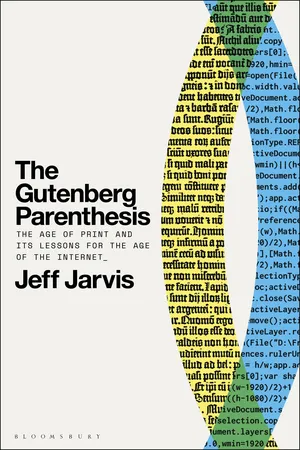
The Gutenberg Parenthesis traces the epoch of print from its fateful beginnings to our digital present – and draws out lessons for the age to come.
The age of print is a grand exception in history. For five centuries it fostered what some call print culture – a worldview shaped by the completeness, permanence, and authority of the printed word. As a technology, print at its birth was as disruptive as the digital migration of today. Now, as the internet ushers us past print culture, journalist Jeff Jarvis offers important lessons from the era we leave behind.
To understand our transition out of the Gutenberg Age, Jarvis first examines the transition into it. Tracking Western industrialized print to its origins, he explores its invention, spread, and evolution, as well as the bureaucracy and censorship that followed. He also reveals how print gave rise to the idea of the mass – mass media, mass market, mass culture, mass politics, and so on – that came to dominate the public sphere.
What can we glean from the captivating, profound, and challenging history of our devotion to print? Could it be that we are returning to a time before mass media, to a society built on conversation, and that we are relearning how to hold that conversation with ourselves? Brimming with broader implications for today's debates over communication, authorship, and ownership, Jarvis' exploration of print on a grand scale is also a complex, compelling history of technology and power.
eBook - ePub
The Gutenberg Parenthesis
The Age of Print and Its Lessons for the Age of the Internet
- 328 pages
- English
- ePUB (mobile friendly)
- Available on iOS & Android
eBook - ePub
About this book
Information
Table of contents
- Cover
- Half-Title Page
- Dedication
- Title Page
- Contents
- Part I The Gutenberg Parenthesis
- 1 The Parenthesis
- 2 Print’s Presumptions
- 3 Trepidation
- Part II Inside the Parenthesis
- 4 What Came Before
- 5 How to Print
- 6 Gutenberg
- 7 After the Bible
- 8 Print Spreads
- 9 The Troubles
- 10 Creation with Print
- 11 The Birth of the Newspaper
- 12 Print Evolves: Until 1800
- 13 Aesthetics of Print
- 14 Steam and the Mechanization of Print
- 15 Electricity and the Industrialization of Media
- 16 The Meaning of It All
- Part III Leaving the Parenthesis
- 17 Conversation vs. Content
- 18 Death to the Mass
- 19 Creativity and Control
- 20 Institutional Revolutions
- Afterword: And What of the Book?
- Acknowledgements
- Notes
- Bibliography
- Index
- Colophon
- Copyright
Trusted by 375,005 students
Access to over 1.5 million titles for a fair monthly price.
Study more efficiently using our study tools.
Frequently asked questions
Yes, you can cancel anytime from the Subscription tab in your account settings on the Perlego website. Your subscription will stay active until the end of your current billing period. Learn how to cancel your subscription
No, books cannot be downloaded as external files, such as PDFs, for use outside of Perlego. However, you can download books within the Perlego app for offline reading on mobile or tablet. Learn how to download books offline
Perlego offers two plans: Essential and Complete
- Essential is ideal for learners and professionals who enjoy exploring a wide range of subjects. Access the Essential Library with 800,000+ trusted titles and best-sellers across business, personal growth, and the humanities. Includes unlimited reading time and Standard Read Aloud voice.
- Complete: Perfect for advanced learners and researchers needing full, unrestricted access. Unlock 1.5M+ books across hundreds of subjects, including academic and specialized titles. The Complete Plan also includes advanced features like Premium Read Aloud and Research Assistant.
We are an online textbook subscription service, where you can get access to an entire online library for less than the price of a single book per month. With over 1.5 million books across 990+ topics, we’ve got you covered! Learn about our mission
Look out for the read-aloud symbol on your next book to see if you can listen to it. The read-aloud tool reads text aloud for you, highlighting the text as it is being read. You can pause it, speed it up and slow it down. Learn more about Read Aloud
Yes! You can use the Perlego app on both iOS and Android devices to read anytime, anywhere — even offline. Perfect for commutes or when you’re on the go.
Please note we cannot support devices running on iOS 13 and Android 7 or earlier. Learn more about using the app
Please note we cannot support devices running on iOS 13 and Android 7 or earlier. Learn more about using the app
Yes, you can access The Gutenberg Parenthesis by Jeff Jarvis in PDF and/or ePUB format, as well as other popular books in Literature & Literary Criticism for Comparative Literature. We have over 1.5 million books available in our catalogue for you to explore.