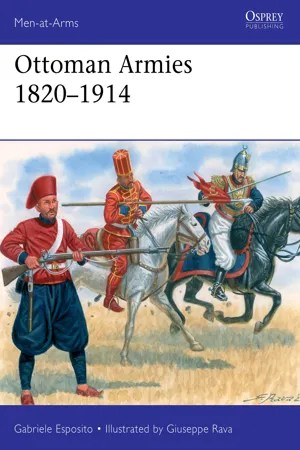
This book describes and illustrates the armies of the embattled Ottoman Turkish Empire involved in 19th-century wars during the Empire's long spiral of decline.
During the so called 'long 19th century', between the end of the Napoleonic Wars in 1815 and the outbreak of World War I in 1914, the difficulties faced by the Ottoman Turkish Empire were a recurrent factor in international geopolitics. Against a background of Russian–Ottoman rivalry, France and Britain supported the Empire during the Crimean War (1854–56), but not in the Russo–Turkish War (1877–78).
Portraying the uniforms, arms and appearance of Ottoman troops during this period, this book traces the history of the Ottoman Empire throughout this period, when no fewer than ten wars of regional insurgency and foreign expansion against the Empire were fought in territories in south-eastern Europe, the Middle East and North Africa.
Using rare photos and illustrations from Turkish, Balkan and other sources, author, Gabriele Esposito details the history of the multi-ethnic Ottoman armies periodic attempts to modernize which enabled them to win some victories at a tactical level. But the Empire – 'the sick man of Europe' – lacked a coherent strategy or sufficient resources, and failed attempts to crush regional uprisings and to defend borders, saw the steady loss of territories. Due to misgovernment and economic failure, unrest finally boiled over in 1908–09, reducing the sultan's court to a largely ceremonial role, and installing a military government by the 'Young Turks' led by the general Enver Pasha.
This book is a vivid description of the organization, operations, uniforms and equipment of one of the most active and varied armies of the 'long 19th century' and paints a detailed picture of the Ottoman Empire's struggle to maintain control of its territories.
- 48 pages
- English
- ePUB (mobile friendly)
- Available on iOS & Android
eBook - ePub
Ottoman Armies 1820–1914
About this book
Information
Table of contents
- Cover
- Title Page
- Table of Contents
- Introduction
- Chronology, 1815–1914
- Reforms under Mahmud II, 1826–39
- The Tanzimat, 1840–53
- The Crimean War, 1853–56
- The Russo–Turkish War, 1877–78
- The Late Ottoman Army
- The ‘Young Turks’ Revolution
- Armies of Vassal States
- Select Bibliography
- Plate Commentaries
- eCopyright
Trusted by 375,005 students
Access to over 1.5 million titles for a fair monthly price.
Study more efficiently using our study tools.
Frequently asked questions
Yes, you can cancel anytime from the Subscription tab in your account settings on the Perlego website. Your subscription will stay active until the end of your current billing period. Learn how to cancel your subscription
No, books cannot be downloaded as external files, such as PDFs, for use outside of Perlego. However, you can download books within the Perlego app for offline reading on mobile or tablet. Learn how to download books offline
Perlego offers two plans: Essential and Complete
- Essential is ideal for learners and professionals who enjoy exploring a wide range of subjects. Access the Essential Library with 800,000+ trusted titles and best-sellers across business, personal growth, and the humanities. Includes unlimited reading time and Standard Read Aloud voice.
- Complete: Perfect for advanced learners and researchers needing full, unrestricted access. Unlock 1.5M+ books across hundreds of subjects, including academic and specialized titles. The Complete Plan also includes advanced features like Premium Read Aloud and Research Assistant.
We are an online textbook subscription service, where you can get access to an entire online library for less than the price of a single book per month. With over 1.5 million books across 990+ topics, we’ve got you covered! Learn about our mission
Look out for the read-aloud symbol on your next book to see if you can listen to it. The read-aloud tool reads text aloud for you, highlighting the text as it is being read. You can pause it, speed it up and slow it down. Learn more about Read Aloud
Yes! You can use the Perlego app on both iOS and Android devices to read anytime, anywhere — even offline. Perfect for commutes or when you’re on the go.
Please note we cannot support devices running on iOS 13 and Android 7 or earlier. Learn more about using the app
Please note we cannot support devices running on iOS 13 and Android 7 or earlier. Learn more about using the app
Yes, you can access Ottoman Armies 1820–1914 by Gabriele Esposito,Giuseppe Rava in PDF and/or ePUB format, as well as other popular books in History & 19th Century History. We have over 1.5 million books available in our catalogue for you to explore.