Shortlisted for the 2008 Young Authors Inner Temple Book Prize
Are parallel importers the key to free trade, breaking down long-established national barriers for the benefit of all? Or do they instead just operate in a dubious 'grey market' for their own profit, free-loading on the investment of innovators and brand owners to the ultimate detriment of everyone? Parallel trade is in turn lionised and demonised, both in legal commentary and in the mainstream press. As one might expect, the truth lies somewhere between these extremes.
Once goods have been manufactured they are put onto the market in one country by the manufacturer. Parallel trade occurs when the goods are subsequently transferred to a second country by another party (the parallel trader, who may be the end consumer). The distinguishing feature of parallel trade is that the manufacturer did not intend those particular goods to end up in the second country. The goods are normally described in that country as 'parallel imports' or 'grey market goods'. The latter term is generally used to suggest that the trade, while not exactly 'black market', is not entirely lawful either.
Understanding how European Community law operates to permit or restrict parallel trade involves exploring a complex matrix of rules from the fields of free movement, intellectual property, competition and regulatory law, including both private and public enforcement regimes. Where goods are parallel imported from outside the Community these rules change and new considerations come into play, such as obligations arising from the European Economic Area, the World Trade Organization and bilateral free trade agreements. The experience of Europe, which has grappled with the issues on a regional basis for more than four decades, provides a fertile source for examination of parallel trade in other jurisdictions.
Christopher Stothers' comprehensive treatment successfully analyses this difficult topic, considering both Community and national decisions.
eBook - PDF
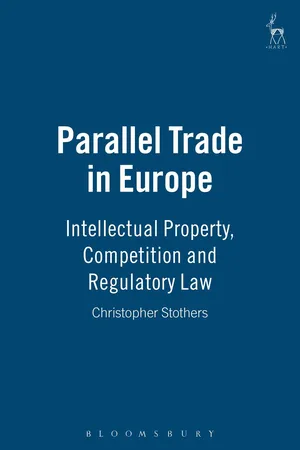
Parallel Trade in Europe
Intellectual Property, Competition and Regulatory Law
- 526 pages
- English
- PDF
- Available on iOS & Android
eBook - PDF
Table of contents
- Half Title Page
- Title Page
- Title verso
- Foreword
- Preface
- Contents
- Table of Cases
- Table of EC Legislation
- Table of National Legislation
- Table of Treaties and Conventions
- Table of Competition Decisions
- 1. Introduction
- 2. Intellectual Property Rights
- 3. Competition Law
- 4. Regulation
- 5. International Aspects
- Bibliography
Trusted by 375,005 students
Access to over 1.5 million titles for a fair monthly price.
Study more efficiently using our study tools.
Frequently asked questions
Yes, you can cancel anytime from the Subscription tab in your account settings on the Perlego website. Your subscription will stay active until the end of your current billing period. Learn how to cancel your subscription
No, books cannot be downloaded as external files, such as PDFs, for use outside of Perlego. However, you can download books within the Perlego app for offline reading on mobile or tablet. Learn how to download books offline
We are an online textbook subscription service, where you can get access to an entire online library for less than the price of a single book per month. With over 1.5 million books across 990+ topics, we’ve got you covered! Learn about our mission
Look out for the read-aloud symbol on your next book to see if you can listen to it. The read-aloud tool reads text aloud for you, highlighting the text as it is being read. You can pause it, speed it up and slow it down. Learn more about Read Aloud
Yes! You can use the Perlego app on both iOS and Android devices to read anytime, anywhere — even offline. Perfect for commutes or when you’re on the go.
Please note we cannot support devices running on iOS 13 and Android 7 or earlier. Learn more about using the app
Please note we cannot support devices running on iOS 13 and Android 7 or earlier. Learn more about using the app
Yes, you can access Parallel Trade in Europe by Christopher Stothers in PDF and/or ePUB format, as well as other popular books in Law & Antitrust. We have over 1.5 million books available in our catalogue for you to explore.