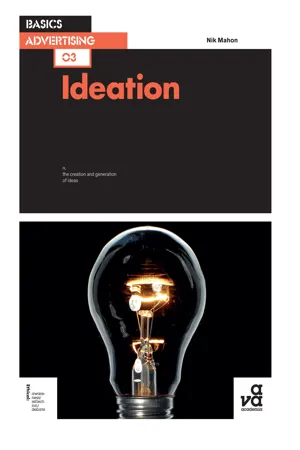
Idea generation is arguably the most vital part of the advertising process - and can be the most demanding. This book provides an essential introduction to the process of generating creative advertising ideas and concepts, and looks at the various obstacles that can stop ideas from forming - before exploring in detail a range of effective ways to break through creative blocks. Ideation examines different ways of visualizing and communicating ideas, explores key approaches used by international and memorable advertising campaigns and details a vast range of methods that you can use for generating your own creative ideas.
Ideation is the process of generating creative ideas. The term ‘ideation’ is a portmanteau word that combines the words ‘idea’ and ‘generation’.
For some, it can be a natural thing that happens without conscious effort or premeditation. For others, it may happen through a concerted effort and necessitate a more systematic approach involving specific techniques. Some of us feel more creative at certain times of the day or while performing certain activities; others may find certain environments or surroundings more conducive to creativity.
One thing about ideation is common to us all: we can never know if or when that ‘eureka moment’ will occur. In some creative fields, it’s okay to simply wait however long it takes for inspiration. In advertising, where there is always a deadline tomorrow, it’s necessary to take proactive measures to gain inspiration and generate creative solutions.
The principles of ideation
While there is no magic formula nor single method or approach for generating ideas and finding creative solutions, there are nevertheless a few general principles of ideation that you can easily pick up. Gaining a good understanding of these principles, together with acquiring some knowledge of how the general process of creative thinking operates, will significantly increase your chances of having great ideas every time that you need to tackle a creative problem or brief.
Divergent and convergent thinking
To help you get started, think of the route that you need to take from a creative problem to a creative solution as a journey. This is an analogy that we’ll revisit on several occasions throughout this book.
The quickest and safest route to a creative solution is the direct, well-trodden pathway that can sometimes lead to the first idea that pops into your head, or at other times to a solution that’s very similar to previous solutions that you may have arrived at. Using the same conventional linear approach each time that you’re faced with a creative advertising brief will undoubtedly guarantee that you’ll reach a solution, but it’s highly unlikely that this solution will break any new creative ground and be noticeably different from past ideas that you’ve had.
Divergent thinking
The best way to find new ideas is to start with fresh ways of approaching the problem that you’re confronted with; this requires the use of divergent thinking. Divergent thinking is a term used to describe the process of looking in different directions for alternative ideas (or to use a well-worn and hackneyed phrase, of ‘thinking outside the box’).
Divergent thinking represents the essence of creativity. It leads us to ideas and sometimes to random thoughts that are often so far from the conventional or logical way that we would normally approach the brief that it can be easy to get carried away with an exciting idea and so lose sight of the creative objectives. For this reason, divergent thinking is always followed by convergent thinking.
Convergent thinking
Convergent thinking refers to when we have to refocus on the creative problem and evaluate the thoughts and ideas that have been generated through divergent thinking in order to see if any of them can be successfully used or adapted to provide adequate solutions that are both highly original and relevant to the brief.
From problem to solution
Divergent thinking is the creative phase of the ideation process that involves exploring alternative lateral ideas; whereas convergent thinking brings us back on track by evaluating those ideas in terms of the objectives outlined in the creative brief and filtering through those ideas that may provide viable creative solutions. In some fields of business, divergent/convergent thinking is sometimes referred to as ‘loose/tight thinking’.
Preparation, incubation, illumination and verification
The creative process broadly involves four sequential phases or stages; preparation, incubation, illumination and verification, which we shall explore in more detail below.
Preparation
The preparation stage includes all the effort that is invested in the initial part of the process. For advertising creatives, this will involve everything from the creative briefing through to subsequent research or fact-finding measures undertaken to discover more about the product, brand or service to be advertised. It will also include any initial brainstorming sessions or first thoughts regarding the brief and may result in the creation of some initial ideas.
Directly sampling or experiencing the product or service by talking to those who make it, sell it, buy it or use it can also enable you to discover interesting things about it and so trigger an original concept for a whole campaign. Surrounding yourself with articles and objects associated with the product while it’s in front of you can also liberate new ideas and keep your brain working on the creative problem, even when you’re not really thinking about it.
Preparation also includes the kind of activities that you might routinely engage in but that may not be specifically related to the problem at hand. The films you watch, the books you read, the music you listen to, the art galleries you visit and the people you meet are just a few of the everyday influences that inform how you perceive the world around you and that will influence how you approach the tasks you are presented with.
Essentially, the preparation stage is about priming yourself for inspiration. It’s important to remember that without any input, there can be no output. Creativity needs to be fed, and absorbing information from an eclectic range of sources is key to finding a solution that’s both unique and unexpected.
Incubation
Once you’ve done the preparation work, it’s time to step back from the brief and simply allow ideas to gestate. This is particularly true if you’ve spent a long time trying hard to have an idea. The best ideas rarely happen whilst you’re staring at a blank page of layout paper and it’s more often the case that the harder you try, the more difficult it becomes to have an idea – so just relax and do something else. Go for a jog, take a bath, read the newspaper, have a coffee, or simply work on another project for a while. In many cases, you’ll find that you’ll have your best ideas for project A whilst you’re working on project B (and vice versa). Crucially, taking a break from the problem gives you some creative space and allows you to return to it with fresh eyes.
The best ideas rarely happen whilst you’re staring at a blank page of layout paper and it’s more often the case that the harder you try, the more difficult it becomes to have an idea – so just relax and do something else
Illumination
The illumination stage is the point at which an idea is realized – more commonly referred to as the moment of inspiration. The Roma...
Table of contents
Cover
Title Page
Table of Contents
Introduction
Chapter 1 What is ideation?
Chapter 2 Breaking through to ideas
Chapter 3 Using creative tools to generate ideas
Chapter 4 Executing creative ideas successfully
Conclusion
Bibliography
Glossary
Index
Acknowledgements
Working with ethics
eCopyright
Trusted by 375,005 students
Access to over 1.5 million titles for a fair monthly price.
Study more efficiently using our study tools.
Frequently asked questions
Yes, you can cancel anytime from the Subscription tab in your account settings on the Perlego website. Your subscription will stay active until the end of your current billing period. Learn how to cancel your subscription
No, books cannot be downloaded as external files, such as PDFs, for use outside of Perlego. However, you can download books within the Perlego app for offline reading on mobile or tablet. Learn how to download books offline
Perlego offers two plans: Essential and Complete
Essential is ideal for learners and professionals who enjoy exploring a wide range of subjects. Access the Essential Library with 800,000+ trusted titles and best-sellers across business, personal growth, and the humanities. Includes unlimited reading time and Standard Read Aloud voice.
Complete: Perfect for advanced learners and researchers needing full, unrestricted access. Unlock 1.5M+ books across hundreds of subjects, including academic and specialized titles. The Complete Plan also includes advanced features like Premium Read Aloud and Research Assistant.
Both plans are available with monthly, semester, or annual billing cycles.
We are an online textbook subscription service, where you can get access to an entire online library for less than the price of a single book per month. With over 1.5 million books across 990+ topics, we’ve got you covered! Learn about our mission
Look out for the read-aloud symbol on your next book to see if you can listen to it. The read-aloud tool reads text aloud for you, highlighting the text as it is being read. You can pause it, speed it up and slow it down. Learn more about Read Aloud
Yes! You can use the Perlego app on both iOS and Android devices to read anytime, anywhere — even offline. Perfect for commutes or when you’re on the go. Please note we cannot support devices running on iOS 13 and Android 7 or earlier. Learn more about using the app
Yes, you can access Basics Advertising 03: Ideation by Nik Mahon in PDF and/or ePUB format, as well as other popular books in Design & Graphic Design. We have over 1.5 million books available in our catalogue for you to explore.