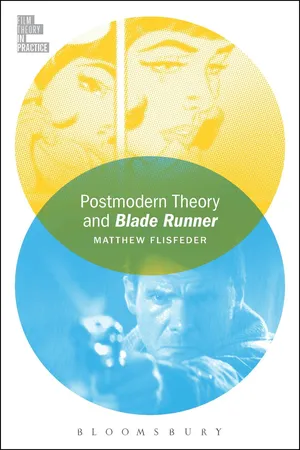
Matthew Flisfeder introduces readers to key concepts in postmodern theory and demonstrates how it can be used for a critical interpretation and analysis of Blade Runner, arguably 'the greatest science fiction film'. By contextualizing the film within the culture of late 20th and early 21st-century capitalism, Flisfeder provides a valuable guide for both students and scholars interested in learning more about one of the most significant, influential, and controversial concepts in film and cultural studies of the past 40 years.
The "Film Theory in Practice" series fills a gaping hole in the world of film theory. By marrying the explanation of film theory with interpretation of a film, the volumes provide discrete examples of how film theory can serve as the basis for textual analysis. Postmodern Theory and Blade Runner offers a concise introduction to Postmodernism in jargon-free language and shows how this theory can be deployed to interpret Ridley Scott's cult film Blade Runner.
- 185 pages
- English
- PDF
- Available on iOS & Android
eBook - PDF
Postmodern Theory and Blade Runner
About this book
Information

CHAPTER ONE
Postmodernism
and
postmodern theory
Toward
a
theory
of
the
postmodern
My
approach
to
postmodernism
involves
first
providing
a
his-
torical
sketch
of
its
emergence,
and
especially
its
relationship
to
modernism.
Since,
in
my
view,
postmodernism
is
on
the
one
hand
the
product
of
transformations
in
the
political
economy
of
capitalism,
and
on
the
other
hand,
initially
a
reaction
to
the
commodification
and
institutionalization
of
modernism,
it
is
necessary
to
first
look
at
some
of
the
key
features
of
modern-
ism
and
modern
culture.
After
providing
an
initial
sketch
for
the
historical
emergence
of
postmodernism,
I go
on
to
explain
its
chief
characteristics
and
themes,
and
some
of
its
methods
of
analysis,
including
categories
such
as
pastiche/parody,
irony,
double-coding,
allegory,
its
conceptions
of
subjectivity
and
identity,
and
the
concept
of
the
hyperreal.
Bearing
all
of
this
in
mind,
though,
my
central
argument
in
what
follows
is
that
postmodernism
has
made
some
significant
gains
in
terms
of
its
critique
of
the
elitism,
Eurocentrism,
and
phallocentrism
of
modern
cultural
criticism;
its
theories
of
media
and
new
media
add
to
our
understanding
of
ideology
and
representation;
however,
by
disavowing
the
historical
materialist
approach
to
culture,
the
radical
and
political
potential
of
postmodern
theory
and
criticism
is
effectively lost.
Table of contents
- Cover
- Half Title
- Series
- Title
- Copyright
- Contents
- Acknowledgments
- Introduction
- CHAPTER ONE Postmodernism and postmodern theory
- CHAPTER TWO Postmodernism and Blade Runner
- Conclusion Postmodern theory after the end of history
- Further Reading
- Index
Trusted by 375,005 students
Access to over 1.5 million titles for a fair monthly price.
Study more efficiently using our study tools.
Frequently asked questions
Yes, you can cancel anytime from the Subscription tab in your account settings on the Perlego website. Your subscription will stay active until the end of your current billing period. Learn how to cancel your subscription
No, books cannot be downloaded as external files, such as PDFs, for use outside of Perlego. However, you can download books within the Perlego app for offline reading on mobile or tablet. Learn how to download books offline
Perlego offers two plans: Essential and Complete
- Essential is ideal for learners and professionals who enjoy exploring a wide range of subjects. Access the Essential Library with 800,000+ trusted titles and best-sellers across business, personal growth, and the humanities. Includes unlimited reading time and Standard Read Aloud voice.
- Complete: Perfect for advanced learners and researchers needing full, unrestricted access. Unlock 1.5M+ books across hundreds of subjects, including academic and specialized titles. The Complete Plan also includes advanced features like Premium Read Aloud and Research Assistant.
We are an online textbook subscription service, where you can get access to an entire online library for less than the price of a single book per month. With over 1.5 million books across 990+ topics, we’ve got you covered! Learn about our mission
Look out for the read-aloud symbol on your next book to see if you can listen to it. The read-aloud tool reads text aloud for you, highlighting the text as it is being read. You can pause it, speed it up and slow it down. Learn more about Read Aloud
Yes! You can use the Perlego app on both iOS and Android devices to read anytime, anywhere — even offline. Perfect for commutes or when you’re on the go.
Please note we cannot support devices running on iOS 13 and Android 7 or earlier. Learn more about using the app
Please note we cannot support devices running on iOS 13 and Android 7 or earlier. Learn more about using the app
Yes, you can access Postmodern Theory and Blade Runner by Matthew Flisfeder in PDF and/or ePUB format, as well as other popular books in Media & Performing Arts & Film History & Criticism. We have over 1.5 million books available in our catalogue for you to explore.