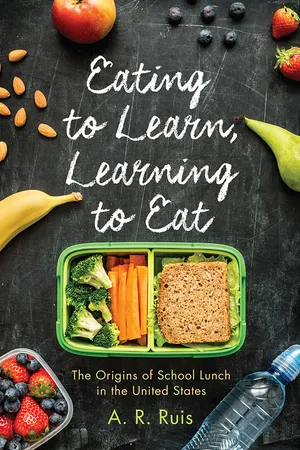
In Eating to Learn, Learning to Eat, historian A. R. Ruis explores the origins of American school meal initiatives to explain why it was (and, to some extent, has continued to be) so difficult to establish meal programs that satisfy the often competing interests of children, parents, schools, health authorities, politicians, and the food industry. Through careful studies of several key contexts and detailed analysis of the policies and politics that governed the creation of school meal programs, Ruis demonstrates how the early history of school meal program development helps us understand contemporary debates over changes to school lunch policies.
- 220 pages
- English
- ePUB (mobile friendly)
- Available on iOS & Android
eBook - ePub
Eating to Learn, Learning to Eat
About this book
Information
Topic
MedicineSubtopic
History of EducationChapter 1
“The Old-Fashioned Lunch Box . . . Seems Likely to Be Extinct”
The Promise of School Meals in the United States
“I grant that our school children have food enough and, in the main, good food,” Horace Makechnie declared at the 1897 meeting of the American Medical Association, “but are they nourished?” Invoking a rhetorical device that would become a cliché in subsequent years—“What! starvation around tables loaded with food?”—Makechnie called attention to one of the many child health concerns that arose in the wake of compulsory schooling. With more and more American children spending long hours away from home, he warned, “we cannot afford to systematically starve our children even by an indirect way, even in a mild degree.”1
Makechnie was not the first to express concern over the effects of schools and schooling on children’s health; from the time of Horace Mann, physicians had written about the potential health consequences of poorly constructed school buildings and insalubrious educational practices. But with the expansion of compulsory education laws, the majority of which were enacted in the late nineteenth and early twentieth centuries, came a new health policy issue: If state-mandated attendance at school caused or exacerbated child health problems, to what extent was the state responsible for addressing those problems?
By removing young children from their homes for the purpose of educating them, the state implicitly assumed responsibility for their well-being. However, the extent to which that responsibility included feeding children was—and has remained to the present day—a socially and politically contentious issue. Few things were so closely associated with private, household affairs as the care and feeding of children. To make children’s diets a public concern, even in part, challenged deep-seated beliefs about the balance between private and public responsibilities, the proper functions of the public school, and the role of the state in children’s health and welfare.2
The health of schoolchildren was also an educational concern, for ill and malnourished children were unable to take full advantage of the free education that more and more states were requiring by law. “From the educational point of view,” noted one home economist, “repeated experiments have conclusively proved that it is the well-nourished children who take high rank in education and that it is the army of the under-fed that hold back the efficiency of our public schools. It is costly to educate a child, and the cost is certainly wasted if the system instructs those who are dull because of improper feeding.”3 Despite the confidence with which health experts drew a direct connection between the belly and the brain, there were no scientific studies in the early twentieth century that demonstrated a correlation between nutritional health and academic performance.4 But teachers and medical inspectors across the country routinely reported that malnourished children were more likely to be absent, tardy, inattentive, apathetic, and generally unable to benefit from educational efforts, and they seemed to succumb more readily to infectious diseases. This experience, even in the absence of definitive studies, contributed to the emergence of a powerful narrative about the relationship between diet, health, behavior, and academic achievement.
In response to concerns about child hunger, malnutrition, and generally poor health, the feeding of schoolchildren became an increasingly central topic in discussions of the role and responsibilities of American public schools. By the first decade of the twentieth century, a reform movement was coalescing around the promotion of public health nutrition and the need for schools to support children’s nutritional health. Educators, physicians, nurses, home economists, nutritionists, and philanthropists in cities across the United States began advocating for meal programs, in part to address the logistical challenges of educating children away from home and in part to address the sociomedical problems of hunger and malnourishment. School breakfasts and lunches, milk programs, and similar endeavors thus emerged alongside other expansions and innovations in school health work, including medical inspection, school nurses, playgrounds and outdoor recreation, instruction in health and hygiene, open-air classrooms, and separate classes for children with disabilities or special needs.5
As with many public health innovations in this era, American cities trailed their European counterparts in establishing school meal programs. In 1882, Paris became the first major city to provide meals to schoolchildren at public expense. By the first decade of the twentieth century, England, France, Holland, Norway, Sweden, and Switzerland had passed national legislation authorizing school authorities to provide meals in schools using public funds, and local initiatives were common in Belgium, Denmark, Germany, and Italy.6
While European measures to feed schoolchildren generally predated American attempts to do the same, there were several important differences between school meal programs as they were conceived and developed on opposite sides of the Atlantic. First, European meal programs generally followed from the assumption that with state-mandated education came state responsibility for the health of schoolchildren. This was a far more contentious position in the United States, where even many proponents of school meals took pains to insist that responsibility for feeding children remained with the home, that children should pay at least a nominal fee to prevent dependency and pauperization, and that schools were not institutions of charity or social work. The school, in that case, served only a facilitating role, with the result that most of the cost of school meals was typically paid directly by students or defrayed by private donations; the use of public monies was usually restricted to the construction and maintenance of facilities and, in some cases, the salaries of personnel.
Second, oversight of American education fell under the purview of the states, not the federal government, which meant that school meal programs were locally established and managed. Because virtually no states explicitly authorized such programs, leaving them in something of a legal gray area, they were often established and managed by private entities such as women’s clubs, parent-teacher associations, or other community organizations. Federal support for school meals in the United States ultimately came only as an emergency response to the deprivations of the Great Depression, and there was no permanent, national legislation authorizing the provision of meals with public funds until 1946—and that legislation was an entitlement, not a mandate. Thus the availability, conduct, cost, and quality of school meals in the United States varied substantially from city to city, and even across schools within the same city. In some cases, this meant that those who needed nutritional assistance most were least likely to get it, as in cities with segregated school systems or stark socioeconomic divides.
Yet the circumstances that led to the development of school meal programs in Europe were largely the same as those pressuring the United States: industrialization, urbanization, growing opposition to child labor, increased state involvement in social welfare and public health, and, perhaps most important, passage of compulsory education laws.7 Massachusetts was the first state to pass a compulsory education law (1852), and all forty-eight states had done so by 1918. By requiring children to attend school, state lawmakers facilitated the expansion of state influence over children, families, and communities. Requiring attendance at school and enforcing it through truancy officers and work permits led to state involvement in matters not only of education but also of health, labor, welfare, and other once-private domains. By the turn of the twentieth century, the school had transformed into a central civic and social institution, a key venue for state interaction with children and their families and public intervention in private affairs. This redefined the boundaries between home and state, and between private rights and public welfare.8
Compulsory education placed school-aged children under the supervision of the state, literally and figuratively, facilitating the establishment and rapid growth of routine and widespread health surveillance. Only one U.S. city had regular school medical inspection in 1890, but more than four hundred did by 1910, bringing millions of children into contact with health authorities for the first time.9 Physicians and nurses working in the schools documented numerous health problems. Although the most common—including poor eyesight, postural disorders, and carious teeth—were relatively minor, many were not so benign, and health problems were identified in a shockingly high number of children; according to one national review, as many as 75 percent of schoolchildren bore at least one physical or mental “defect,” many of which were attributed to malnourishment and other remediable conditions.10 School medical inspection marked the first time that such large numbers of children were examined regularly by nurses and physicians, and the examinations revealed the pervasiveness of both acute and chronic child health problems.
At the same time, exposés by journalists, settlement workers, and social reformers—including Jacob Riis’s How the Other Half Lives (1890), Robert Hunter’s Poverty (1904), Upton Sinclair’s The Jungle (1906), and John Spargo’s Underfed Schoolchildren (1906)—depicted the devastating toll that steady immigration, rapid industrialization, and brutal labor practices were exacting on people living and working in densely populated cities. Against the backdrop of diminishing infant mortality rates, substantial reductions in major epidemic diseases, improved municipal sanitation, and effective treatments for common childhood diseases like diphtheria, the poor health of American children in the early twentieth century was a shock to health experts and the public alike, the more so because Americans were assumed to be taller and heavier on average—and thus healthier and better fed—than their European counterparts.11
The revelations of widespread ill health and poor physical condition among children and young adults in American cities led many to advocate for school-based health services, including school nurses, physical education and outdoor play, dental clinics, special classes for disabled or tubercular children, and school meal programs. “It may be as much the duty of the state to supplement at school the insufficient and wrong feeding in the homes,” argued a teacher from Boston, “as it is to supply the instruction which the parents are unable to give.”12
But the justifications given for the importance of school meal programs were varied, reflecting different ideological and professional perspectives. Arguments from morality defined access to sufficient (or sufficiently nourishing) food as a human right, obliging the state to ensure that children were adequately fed. Arguments from economy stressed that well-fed children were easier and less expensive to educate, and that they grew up to become better workers, soldiers, and mothers. Arguments from prophylaxis suggested that well-nourished children succumbed with less frequency to infectious diseases (thus stemming dissemination) and were less likely to suffer stunted growth, developmental problems, and disability. Feeding children in school would thus lower the incidences of acute and chronic health issues, not only among the malnourished but in the school-aged population as a whole. Of course, these three categories were not mutually exclusive; though separable conceptually, they were often intertwined in actual usage.
The argument for state intervention in schoolchildren’s health based on morality, an evocation of health as a basic human right, coincided with larger social changes in the value of children. With declines in both average family size and infant mortality rates, along with a shift toward urban living—where children were more expensive and less able to contribute to the livelihood of the family13—children became “emotionally priceless” rather than economically valuable. Over the first decades of the twentieth century, as the sociologist Viviana Zelizer has shown, children’s lives became “sacred”; the death of a child was “an intolerable sacrilege, provoking not only parental sorrow but social bereavement as well.”14 In this context, the health of children was as much an ethical issue as a practical one. “It is less a question of parental responsibility than of children’s rights,” wrote Ernest Hoag and Lewis Terman of school health services in 1914. “Least of all need we prematurely be frightened by the specter of socialism. To protect the bodies of children from defective development is not a question of socialism, but of humanity and of common sense.”15 Hoag, then medical director of the Long Beach City Schools in California, and Terman, a child psychologist and professor of education at Stanford University, framed the issue of school health as an issue of ...
Table of contents
- Cover
- Title Page
- Copyright Page
- Dedication
- Contents
- List of Abbreviations
- Chapter 1 “The Old-Fashioned Lunch Box . . . Seems Likely to Be Extinct”: The Promise of School Meals in the United States
- Chapter 2 (Il)Legal Lunches: School Meals in Chicago
- Chapter 3 Menus for the Melting Pot: School Meals in New York City
- Chapter 4 Food for the Farm Belt: School Meals in Rural America
- Chapter 5 “A Nation Ill-Housed, Ill-Clad, Ill-Nourished”: School Meals under Federal Relief Programs
- Chapter 6 From Aid to Entitlement: Creation of the National School Lunch Program
- Epilogue
- Acknowledgments
- Notes
- Index
Trusted by 375,005 students
Access to over 1.5 million titles for a fair monthly price.
Study more efficiently using our study tools.
Frequently asked questions
Yes, you can cancel anytime from the Subscription tab in your account settings on the Perlego website. Your subscription will stay active until the end of your current billing period. Learn how to cancel your subscription
No, books cannot be downloaded as external files, such as PDFs, for use outside of Perlego. However, you can download books within the Perlego app for offline reading on mobile or tablet. Learn how to download books offline
Perlego offers two plans: Essential and Complete
- Essential is ideal for learners and professionals who enjoy exploring a wide range of subjects. Access the Essential Library with 800,000+ trusted titles and best-sellers across business, personal growth, and the humanities. Includes unlimited reading time and Standard Read Aloud voice.
- Complete: Perfect for advanced learners and researchers needing full, unrestricted access. Unlock 1.5M+ books across hundreds of subjects, including academic and specialized titles. The Complete Plan also includes advanced features like Premium Read Aloud and Research Assistant.
We are an online textbook subscription service, where you can get access to an entire online library for less than the price of a single book per month. With over 1.5 million books across 990+ topics, we’ve got you covered! Learn about our mission
Look out for the read-aloud symbol on your next book to see if you can listen to it. The read-aloud tool reads text aloud for you, highlighting the text as it is being read. You can pause it, speed it up and slow it down. Learn more about Read Aloud
Yes! You can use the Perlego app on both iOS and Android devices to read anytime, anywhere — even offline. Perfect for commutes or when you’re on the go.
Please note we cannot support devices running on iOS 13 and Android 7 or earlier. Learn more about using the app
Please note we cannot support devices running on iOS 13 and Android 7 or earlier. Learn more about using the app
Yes, you can access Eating to Learn, Learning to Eat by Andrew R. Ruis in PDF and/or ePUB format, as well as other popular books in Medicine & History of Education. We have over 1.5 million books available in our catalogue for you to explore.