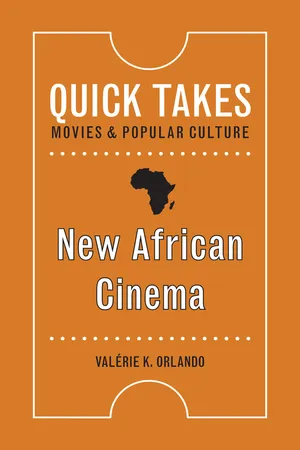
New African Cinema examines the pressing social, cultural, economic, and historical issues explored by African filmmakers from the early post-colonial years into the new millennium. Offering an overview of the development of postcolonial African cinema since the 1960s, Valérie K. Orlando highlights the variations in content and themes that reflect the socio-cultural and political environments of filmmakers and the cultures they depict in their films.
Orlando illuminates the diverse themes evident in the works of filmmakers such as Ousmane Sembène’s Ceddo (Senegal, 1977), Sarah Maldoror’s Sambizanga (Angola, 1972), Assia Djebar’s La Nouba des femmes de Mont Chenoua (The Circle of women of Mount Chenoua, Algeria, 1978), Zézé Gamboa’s The Hero (Angola, 2004) and Abderrahmane Sissako’s Timbuktu (Mauritania, 2014), among others. Orlando also considers the influence of major African film schools and their traditions, as well as European and American influences on the marketing and distribution of African film. For those familiar with the polemics of African film, or new to them, Orlando offers a cogent analytical approach that is engaging.
- 200 pages
- English
- ePUB (mobile friendly)
- Available on iOS & Android
eBook - ePub
New African Cinema
About this book
Information
Subtopic
Art General1
From Revolution to the Coming of Age of African Cinema, 1960s–1990s
Africa’s decolonizing moments all played out in very different ways across the continent. From the late 1950s (Ghana) to the early 1990s (South Africa), postindependence has meant a variety of challenges, while presenting a multitude of issues as diverse as the continent itself. In order to understand African film history and what the cinema of the continent is today, we must first understand the overall dynamics, issues, and contexts that have shaped it. As mentioned in the introduction, African filmmaking is constantly infused by the geographical, linguistic, and cultural parameters that contribute to it. The most effective way to understand the trajectory of African film since the early 1960s is to review chronologically the various trends and influences that have shaped it up to the present. Most specifically, African filmmaking has transited from reflecting Third Cinema ideology, popular during third-world movements in the late 1960s–early 1970s, through social realist frameworks favored by filmmakers working in the 1970s and 1880s, to Afrocentric philosophical agendas promoted in the 1990s, to finally evoking the transnational and global themes of the twenty-first Afropolitan century we see today.
THIRD CINEMA IDEOLOGY
An overarching influence that has dominated most African filmmaking, certainly in the 1960s–1970s, is Third Cinema ideology, which emerged in the early 1970s from evolving transnational third-world movements across the globe. “Third Cinema,” emanating from popular liberation movements in Latin America in the late 1960s–early 1970s, was first coined as a term by the Argentine filmmakers Fernando Solanas and Octavio Getino within their group, Grupo Cine Liberación (Cinema Liberation Group). In 1969, they published the manifesto Hacia un tercer cine (Toward a third cinema), which outlined how revolutionary cinema would work to counter neocolonialism, capitalist (Western) systems, and Hollywood models, which held that cinema was merely for entertainment and to make money (Pines and Willeman). Third Cinema sociopolitical ideology, used to critique films from Latin America, was then adopted by the Ethiopian scholar and long-time professor of film at UCLA Teshome Gabriel to extend to the cinemas of the postcolonial, developing world, primarily in Africa. In his 1982 work Third Cinema in the Third World: The Aesthetics of Liberation, Gabriel underscores that Third Cinema is “a cinema that is committed to a direct and aggressive opposition to oppression. Its purpose will be validated only if it integrates its objectives with the aspirations, values, struggles, and social needs of the oppressed classes” (15). It is a cinema that tells audiences that in order for “the struggle of Third World countries to be successful, it is essential that the people clearly identify the enemy(ies) and see, first, that it is the ruling classes of the imperialist countries who oppress the Third World, rather than all whites or all Europeans and Americans” (15). Thus, for Gabriel, the sociopolitical film of the third world was fighting against not racism per se but rather the inequality that had already become visible between the haves and the have-nots in the postcolonial world.
In a later essay, “Towards a Critical Theory of Third World Films” (1989), Gabriel lays out how the revolutionary, decolonizing ideology promoted by Frantz Fanon (a leading revolutionary thinker for the decolonization of Africa in the late 1950s–early 1960s) could evolve to form a critical theory for emerging cinemas in the postcolonial context. Whereas Getino and Solanas mention Fanon as contributing ideas of national culture, explaining that this culture in the postcolonial era would rely on writers, artists, and filmmakers to structure it, Gabriel worked deeper, looking into Fanonian praxis to explain the paths taken by revolutionary African filmmakers in the first decades of independence. Drawing on Fanon’s prescription for the role of the African writer in the making of postcolonial culture, as outlined in his famous work The Wretched of the Earth (1961), Gabriel, like Fanon, notes that there are three phases of engagement through which the cultural producer travels in order to finally find his or her place as a critical player in the formation of postcolonial culture:
From pre-colonial times to the present, the struggle for freedom from oppression has been waged by the Third World masses, who in their maintenance of a deep cultural identity have made history come alive. Just as they have moved aggressively towards independence, so has the evolution of Third World film culture followed a path from “domination” to “liberation.” This genealogy of Third World film culture moves from the First Phase in which foreign images are impressed in an alienating fashion on the audience, to the Second and Third Phases in which recognition of “consciousness of oneself” serves as the essential antecedent for national and, more significantly, international consciousness. There are, therefore, three phases in this methodological device. (“Towards” 31)
Like Fanon’s prescriptions for sociopolitically committed authors, for Gabriel, the filmmaker develops his or her critical thinking as a social activist through the three phases that Fanon outlines in The Wretched of the Earth. First, the cineaste makes films that mimic the Hollywood tradition; second, he enters a phase in which he “remembers who he is” by working in nation-building paradigms to make cinema an art form for the people. For example, in Algeria in the 1960s, this phase was known as le cinéma moudjahid (cinema of the mujahidin, the rebel freedom fighters during the Algerian revolution);1 in Senegal and Mozambique, films were labeled engagé, or the cinema of the socially committed. These countries’ films promoted themes that glorified “the return . . . to the Third World’s source of strength, i.e. culture and history. The predominance of filmic themes such as the clash between rural and urban life, traditional versus modern value systems, folklore and mythology,” characterized the themes of this phase (Gabriel, “Towards” 32).
The last and most defining phase is the “combative,” in which filmmakers make films for the people, insisting “on viewing film in its ideological ramifications” as “an ideological tool.” In this last stage, film becomes dangerous for nation-states’ governments, as filmmakers become more critical of them. Ousmane Sembène’s famous Ceddo (1977) is one such film (Gabriel, “Towards” 34). Ceddo tells the tale of a ceddo (villager) who goes against a king in an African village who has let Islam infiltrate, usurping traditional cultural practices. In order to combat the Islamic conversion taking place, the ceddo kidnaps the king’s daughter, vowing not to return her until the king stops the wave of Islamicization. The king dies, and the Imam takes charge, thus “launching the conversion drive forcefully and brutally and in the end rescuing the princess, whom he intends to marry. The Imam is eventually slain by the princess” (Ukadike 183). Ukadike notes that Ceddo is “an iconoclastic film” because it is staunchly antireligious, “focusing mainly on the Islamic impact and particularly questioning the subjugation entrenched in its ideology and the acceptance of this ideology by Africans to the extent of rendering traditional cultures impotent” (183).
The Marxist-influenced Sembène remained steadfast in his belief that imported religions from elsewhere in the world would forever hold Africa hostage and deny Africans access to their own belief and value systems. These foreign religions were essentially different modes of colonization that kept Africans from embracing the true sense of their being. Although an allegory, the film’s blatant political messages countered the unifying goals that the Christian president, Léopold S. Senghor, had for his country. He banned the film for eight years, fearing that if released, it would cause divisions across Senegal. Avoiding the religious questions and debates that the film raised, the president “officially” condemned the film “because Mr. Sembène insists on spelling ‘ceddo’ with two d’s while the Senegalese Government insists it be spelled with one” (Canby). Ceddo symbolizes the contentious debates that filmmakers presented to their respective governments from the 1970s forward. As a staunch sociopolitical critic, constantly challenging Senegalese political leadership, as well as the customs and traditions that impeded the people from embracing modernity, Sembène Ousmane led his Marxist-secular charge up to the time of his death in 2007.
REVOLUTIONARY CINEMA AS PROPAGANDA
Like West Africa, the cinema of the Maghreb has, in the years since independence, also closely reflected the changing tides of Tunisia’s, Algeria’s, and Morocco’s political oceans. Although, since the mid-1960s and the outset of independence, all three national cinemas were conceived of in more or less the same terms, they have, nevertheless, been molded in very different ways by the sociocultural and political dynamics, events, and challenges taking place in each nation. As mentioned in the introduction, all three countries founded their national cinemas on the French institutional model (which meant setting up agencies funded by the state, usually overseen by a ministry of culture) that would provide subsidies to filmmakers to make their films. This model was used by all three nations from the mid-1960s forward to hone a “new sense of national identity [by] seeking new forms of expression” through film (Armes, Postcolonial 8). Film was a way to further the ideologies of each nation’s government while also giving to the world for the first time the expression of “a reality as seen from a specifically Algerian, Moroccan [and] Tunisian perspective” (Armes, Postcolonial 8).
What is interesting is how each model, conceptualized similarly at the founding of these postcolonial states, was later challenged at various moments in history by filmmakers operating in very different ways. The French model, prescribing that film perform as an art form in society, continues to influence the national cinemas of Morocco, Algeria, and Tunisia. Despite taking to heart Fanon’s plea to cultural producers (in film, the arts, and literature) to help express the culture of new nations, national film industries still rely on a colonial institutional model. Nevertheless, these institutional models were instrumental in the early 1960s in helping to define the agendas of new nations, which used them to inspire their peoples to think about the future. Postcolonial filmmakers used their cameras to seek to live up to Fanon’s challenge. The formerly colonized “must get away from white culture. He must seek his culture elsewhere,” and the “style” of the filmmaker, as for the writer, “is harsh, . . . full of images, for the image is the drawbridge which allows unconscious energies to be scattered on the surrounding meadows. . . . This style . . . has nothing racial about it. . . . It expresses above all a hand-to-hand struggle and it reveals the need that man has to liberate himself from a part of his being which already contained the seeds of decay” (Fanon 220).
The use of films as a means to document liberation is best exemplified by Algeria in the early 1960s. “Algerian cinema was born out of the war of independence and served that war,” notes Guy Austin in his book Algerian National Cinema (20). Algerian cinema was useful for capturing the horrors of the war of liberation as well as mythologizing the FLN’s (Front de libération nationale / National Liberation Front) struggle to free the country from French colonial rule and ultimately bring to fruition the Algerian nation. From the first years after independence in 1962, the “‘cinéma moudjahid’ or ‘freedom fighter cinema’ of the 1960s and 1970s was central to post-independence cultural policy” (Austin 20). Over the past five decades, we can say that Algerian cinema has always celebrated “the new nation-state but also interrogates the discontents of the new Algeria” (Austin 20). Elsewhere, across the Maghreb, this has been true in varying degrees, depending on the politics of governing authorities after independence. Early films such as Rih al-awras (Wind from the Aurès; Mohamed L. Hamina, Algeria, 1966), Al-fajr (The dawn; Omar Khlifi, Tunisia, 1966), and Inticar al-hayat (Conquer to live; Mohamed Tazi and Ahmed Mesnaoui, Morocco, 1968) all imparted to audiences the winds of change that filmmakers hoped would come with independence in order to build strong and powerful postcolonial states (Armes, Postcolonial 213).
Films also were used as a means for forgetting colonial brutality and for moving forward in the early days of postcolonial nation building. Many filmmakers proposed themes to help work through the trauma of the bloody battles of decolonization, particularly in Algeria: “The function of Algerian films in the liberation struggle [in the 1960s] seems closer to the narrativisation of trauma as a means of remembering to forget, hence a ‘working through,’ an articulation of national identity that seeks to commemorate suffering but thereby to move onwards and to build new power structures (the FLN state), rather than as a traumatized perpetual present” (Austin 35).
Moroccan cinema, though, was conceptualized in a different manner from its Algerian neighbor’s industry. Although ruled since independence in 1956 by a monarchy, the king of Morocco invested heavily in a national film institute that had already been established by the French in 1947. The Centre Cinématographique du Marocain (CCM) took form in 1957. Since this date, the state has subsidized films for over fifty years. King Mohamed V, the first ruler of independent Morocco, regarded film as a means to document social development in the country immediately following independence. For the first few decades, most films made in the country were documentaries. The CCM sent filmmakers abroad to France, Russia, and Italy to learn the trade. At the same time at home, the CCM established a studio, lab, film stock, and trained personnel in Rabat, Casablanca, and Marrakesh. Filmmakers, however, for many years after independence, concentrated only on promoting themes highlighting regional and economic development issues that could be filmed as documentaries (Carter 67). Mohamed V’s death in 1963 and the enthronement of his son, King Hassan II, marked a new chapter in the development of Moroccan cinema. During the Lead Years (Les années de plomb, 1963–1999), which characterized repressive King Hassan II’s rule, Moroccan film was viewed as a form of media particularly dangerous to the monarchy.2 It was monitored heavily, and filmmakers felt hindered by censored scenes, curtailing their ability to probe the sociopolitical topics of the era. Up to the end of the Lead Years (1999, with the death of Hassan II), Moroccan films metaphorically or symbolically proposed ideas criticizing social woes, but filmmakers rarely dared to be overtly critical.
Despite widespread repression of the industry by the monarchy of Hassan II, films of the 1980s, such as Ahmed Kacem Akdi’s Ce que les vents ont emporté (Talk is easy, 1984), Mohammed Aboulouakar’s Hadda (1984), and Mohammed Derkaoui’s Titre provisoire (Provisionally titled, 1985), demonstrate the Third Cinema movement’s influence on themes and styles. By the mid-1990s, the social realist, politically committed films of West Africa had strongly influenced Moroccan filmmakers. Since the late 1990s, Moroccan cinema has developed into one of the most vibrant industries on the continent. Films such as Hakim Noury’s Voleur de rêves (Thief of dreams, 1995), Fatima Jebli Ouazzani’s Dans la maison de mon père (In my father’s house, 1997), and Nabil Ayouch’s Mektoub (Destiny, 1997) all document and bear witness to the sociocultural and political changing landscapes of Morocco at the end of Hassan II’s oppressive rule (Orlando, Screening 9–10). These films were openly critical of the political corruption, poverty, illiteracy, and a host of other social ills that continue, even today, to persist in Morocco.
From the outset of the postcolonial era and up to the recent Arab Spring of 2011, Tunisia’s industry has been one of the most engaging in the Arab world. Originally led by the modernist and first postcolonial president, Habib Bourguiba, the Tunisian government invested heavily in its film industry, creating a national cinema that was second only to Egypt’s for the most films per year made in the MENA (Middle East and North Africa) region. In spite of Tunisia’s reputation as the only democracy in the Arab world, like other countries in Africa, Bourguiba’s forward-thinking government, forged in 1956, was short-lived. In 1987, the first president of postcolonial Tunisia was deposed in a bloodless coup led by Zine El Abidine Ben Ali (who declared himself president for life, although he did allow elections). Tunisian films such as the well-known Ferid Boughedir’s The Picnic (1972), Nouri Bouzid’s Rih essed (Man of ashes, 1986), Mohamed Zran’s Essaïda (1996), and later, Nadia El Fani’s Bedwin Hacker (2002) serv...
Table of contents
- Cover
- Series Page
- Title Page
- Copyright
- Contents
- Author’s Note
- Introduction
- 1. From Revolution to the Coming of Age of African Cinema, 1960s–1990s
- 2. New Awakenings and New Realities of the Twenty-First Century in African Film
- Conclusion: The Futures of African Film
- Acknowledgments
- Notes
- Further Reading and Useful Websites
- Works Cited
- Selected Filmography: Twenty-First-Century Films
- Index
- About the Author
Trusted by 375,005 students
Access to over 1.5 million titles for a fair monthly price.
Study more efficiently using our study tools.
Frequently asked questions
Yes, you can cancel anytime from the Subscription tab in your account settings on the Perlego website. Your subscription will stay active until the end of your current billing period. Learn how to cancel your subscription
No, books cannot be downloaded as external files, such as PDFs, for use outside of Perlego. However, you can download books within the Perlego app for offline reading on mobile or tablet. Learn how to download books offline
Perlego offers two plans: Essential and Complete
- Essential is ideal for learners and professionals who enjoy exploring a wide range of subjects. Access the Essential Library with 800,000+ trusted titles and best-sellers across business, personal growth, and the humanities. Includes unlimited reading time and Standard Read Aloud voice.
- Complete: Perfect for advanced learners and researchers needing full, unrestricted access. Unlock 1.5M+ books across hundreds of subjects, including academic and specialized titles. The Complete Plan also includes advanced features like Premium Read Aloud and Research Assistant.
We are an online textbook subscription service, where you can get access to an entire online library for less than the price of a single book per month. With over 1.5 million books across 990+ topics, we’ve got you covered! Learn about our mission
Look out for the read-aloud symbol on your next book to see if you can listen to it. The read-aloud tool reads text aloud for you, highlighting the text as it is being read. You can pause it, speed it up and slow it down. Learn more about Read Aloud
Yes! You can use the Perlego app on both iOS and Android devices to read anytime, anywhere — even offline. Perfect for commutes or when you’re on the go.
Please note we cannot support devices running on iOS 13 and Android 7 or earlier. Learn more about using the app
Please note we cannot support devices running on iOS 13 and Android 7 or earlier. Learn more about using the app
Yes, you can access New African Cinema by Valérie K. Orlando in PDF and/or ePUB format, as well as other popular books in Media & Performing Arts & Art General. We have over 1.5 million books available in our catalogue for you to explore.