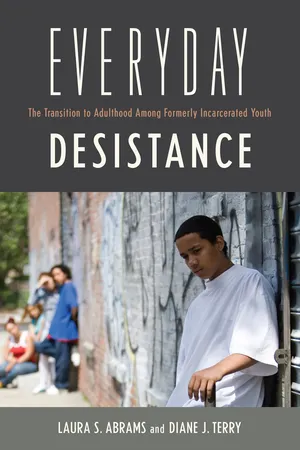
In Everyday Desistance, Laura Abrams and Diane J. Terry examine the lives of young people who spent considerable time in and out of correctional institutions as adolescents. These formerly incarcerated youth often struggle with the onset of adult responsibilities at a much earlier age than their more privileged counterparts. In the context of urban Los Angeles, with a large-scale gang culture and diminished employment prospects, further involvement in crime appears almost inevitable. Yet, as Abrams and Terry point out, these formerly imprisoned youth are often quite resilient and can be successful at creating lives for themselves after months or even years of living in institutions run by the juvenile justice system.
This book narrates the day-to-day experiences of these young men and women, focusing on their attempts to surmount the challenges of adulthood, resisting a return to criminal activity, and formulating long-term goals for a secure adult future.
- 256 pages
- English
- ePUB (mobile friendly)
- Available on iOS & Android
eBook - ePub
Everyday Desistance
About this book
Information
Chapter 1
Introduction
The last ten years have witnessed significant shifts in American juvenile justice policy. As public sentiment has moved away from a primarily punitive discourse regarding young people in trouble with the law, states have increasingly adopted community-based alternatives to incarceration with a focus on rehabilitation. A number of factors have contributed to these changes, including a dramatic decline in juvenile crime rates, a persuasive body of research on adolescent brain development, major philanthropic investments in juvenile justice reform, and widespread documentation of the high costs and poor outcomes associated with juvenile incarceration (Mendel, 2011; Perruti, Schindler, & Zeidenberg, 2014). Underlying this newer discourse is the notion that teenagers do not cognitively or emotionally mature as rapidly as previously believed, making their criminal culpability more akin to children than to adults. Moreover, views from inside the system, documented in works such as Richard Ross’s photo exposé Juvenile-in-Justice (2012) and journalist Nell Bernstein’s (2014) critical book Burning Down the House: The End of Juvenile Prison have fueled public perception that juvenile confinement is unnecessarily harsh, ineffective, and indeed not a suitable place to house children (Mendel, 2011).
As the disturbing economic, social, and psychological consequences of youth incarceration are increasingly publicized, rates of juvenile detention and incarceration have simultaneously plummeted. In 1997, the Office of Juvenile Justice and Delinquency Prevention’s (OJJDP) census of residential placement documented 105,000 youth in US juvenile justice placements on a given day, compared to just over 61,000 in 2011 (Sickmund, Sladky, Kang, & Puzzanchera, 2013). This represents a 40 percent decrease in the confined juvenile population in less than 15 years. Notwithstanding these dramatic changes, a group of young people continues to interface with the juvenile justice system with significant consequences for their future well-being. Members of this group are highly likely to be male youth of color—particularly African American—and to have a history of involvement in public systems, such as child welfare, mental health, and special education (Hager, 2015). They also tend to live in lower-income neighborhoods where they are subject to intensive policing, racial profiling, and monitoring.
For the young people who continue to traverse through the revolving door of probation, detention, and corrections, the juvenile justice system is where they experience a large part of their adolescent development. They often live apart from their families, disconnected from mainstream schools, and exposed to the considerably negative trappings of institutionalization. Several scholars have recently sought to document and unravel the complexities of the experience of juvenile incarceration (Abrams & Anderson-Nathe, 2013; Bernstein, 2014; Fader, 2013). These works have examined the subjective experience of living in a correctional setting, how these institutions shape youth identities, and why correctional programs—even those with a therapeutic leaning—often fail. In this book, we pose a different set of questions: What does everyday life look like for young people who age out of the juvenile justice system? How do young people navigate the transition to adulthood while attempting to stay out of the hands of the law? This book is about everyday desistance: how young adults construct their lives after growing up in the juvenile justice system, neither giving up on their goals nor experiencing a simple or straightforward pathway to success. While the media tends to portray formerly incarcerated youth as either doomed to fail or miraculously able to succeed against all odds, we rarely hear about those whose experiences lie in between these extremes. Our intention is to illustrate how young men and women who were incarcerated during much of their adolescence navigate the challenges and opportunities associated with desistance from crime alongside becoming an adult.
Emerging Adulthood and Formerly Incarcerated Youth
The young people whose stories comprise this book are considered to be “emerging adults,” referring to the developmental period between traditional understandings of adolescence and adulthood (Arnett, 2000). The concept of emerging adulthood itself reflects some of the major demographic shifts of the past fifty years, such as the tendency for young people to delay childbearing and marriage and to live longer under the care of family members (Federal Interagency Forum, 2014; Furstenberg, 2010). Scholarship and popular literature alike have characterized emerging adulthood as a time of rapid change, exploration, and extended opportunity to consider life pathways (Arnett, 2000; Henig & Henig, 2012; Jay, 2012). For economically and racially privileged young adults, this exploratory period often takes place in a college setting, an arena that offers some sense of protection from real-world responsibilities (here we invite you to envision college parties, summer internships, and spring break trips to Florida). However, unlike their more privileged peers, a substantial number of emerging adults are not afforded a protected or nurtured passage to adulthood. By contrast, upon reaching the age of legal maturity, young people with histories of foster care, homelessness, school disruption, and early age of parenthood must fend for themselves, and often their own children and families, to meet even their most basic needs. This group of more marginalized young adults is replete with those who have had contact with the juvenile justice system. For, although juvenile incarceration rates have steadily declined over the past 20 years, the US juvenile justice system still interfaces with more than 1.2 million youth annually, of whom more than 250,000 are detained and roughly 100,000 are placed in out-of-home care annually (Sickmund, Sladky, & Kang, 2015).
As a whole, formerly incarcerated youth enter adulthood with significantly fewer economic and social capital resources than other young people their age, even compared to those from similar socioeconomic backgrounds (Uggen & Wakefield, 2005). This is partially because of time spent in institutional settings that are far removed from real-world circumstances and developmental opportunities. For example, institutionalized young people have far less control over their daily routines and fewer opportunities to learn from their mistakes or to take natural risks than those who remain at home (Chung, Little, & Steinberg, 2005). Yet paradoxically, formerly incarcerated young adults also find themselves navigating major responsibilities at younger ages, as they are more likely to live on their own, work full-time, and become parents than their same-aged peers (Foster & Gifford, 2005). In this sense, the transition to adulthood for formerly incarcerated youth can be viewed as expedited in a context in which many middle-class young people are actually delaying the adoption of adult roles and responsibilities.
To date, researchers have focused on the poor outcomes associated with juvenile incarceration. For example, studies have shown that at least half, and even up to 85 percent, of formerly incarcerated youth will return to the criminal justice system within two to five years of their release from confinement (Trulson, Marquart, Mullings, & Caeti, 2005), and fewer than 20 percent will complete high school (Osgood, Foster, & Courtney, 2010). Even if these young people circumvent the high likelihood of criminal recidivism, they often face the larger realities of resource-poor neighborhoods, a dearth of well-paying jobs, and the dangers of community and police violence (Mears & Travis, 2004). Moreover, many face risks of police profiling in simply going about their daily lives. For formerly incarcerated young people, particularly men, these dangers are amplified and persistent due to the mark of a criminal record (Abrams & Terry, 2014). This research evidence has provided ammunition for advocates to demand action to fix this broken and ineffective system.
With this background, our book takes a different approach to this increasingly familiar script. Although we fully acknowledge that the juvenile justice system continues to create a group of youth who are disadvantaged as they enter adulthood, we contend that these young men and women are a great deal more than just their bleak odds. As such, this book intends to provide a richer, nuanced view of the transition to adulthood among young men and women with histories of juvenile incarceration. Specifically, we focus on the ordinary experiences, decisions, and challenges that these young people encounter as they enter early adulthood and make important decisions concerning crime, friends, partners, work, and school. We find that while these young people’s concerns are partially constructed by the past, they also have high hopes and dreams for their futures. We believe that the crossroads of adulthood is a pivotal juncture, and we hope that our book will contribute to a better understanding of what these young people need in order to thrive.
Research on Desistance from Crime
Criminal desistance, which can be defined as the movement toward the complete termination of offending behavior, is a key concept informing this book. Criminal desistance is a process that involves a multitude of factors, including personal motivation to change, social support, and access to mainstream institutions such as employment and schooling (Maruna, 2001; Mulvey et al., 2004). An extensive body of literature has theorized criminal desistance among adolescent offenders. Most experts have acknowledged that a large percentage of those who were involved in crime as minors end up reducing or ceasing their criminal activity altogether in young adulthood (Laub & Sampson, 2003; Moffitt, 1993). Criminologists also generally concur that desistance for young adults hinges on a blend of internal motivation and external opportunities for change (Mulvey et al., 2004). Despite this agreement, there are still some key debates about how and why previously delinquent youth terminate offending in young adulthood.
One of these points of conversation concerns the degree to which maturation and age play a role in launching a process of desistance for adolescents. From a developmental view, research has found that certain characteristics associated with chronological age appear to reduce young people’s involvement in criminal activity over time. These include biological factors (i.e., impulse control, suppression of aggression) as well as behavioral traits associated with maturity (i.e., increased hopefulness, empathy, and reasoning) (Monahan, Steinberg, Cauffman, & Mulvey, 2009). An emerging body of neuroscience has supported these ideas, finding evidence that the younger brain is more prone to judgment errors, impulse, and peer pressure than the more mature brain (Maroney, 2011). Implicit in this reasoning is the notion that becoming an adult involves becoming more focused and mature, and therefore less drawn to a criminal lifestyle. Thus, desistance in young adulthood can be viewed as a normative process of cognitive and emotional maturity. This science may explain why most adolescents will age out of crime around the transition to adulthood period.
Taking a slightly different view on the age-crime curve, life course theory suggests that it is not age or maturity per se, but rather critical life turning points that can shift the criminal trajectories of adolescent offenders. These turning points may include events such as marriage, parenthood, and employment; events that often occur in the young adulthood period (Sampson & Laub, 1993). These roles and responsibilities operate as social bonds that formerly incarcerated individuals can latch onto to enact desistance. According to the life course perspective, these social bonds work independently of childhood experiences, in that even those young people with risks for persistent offending may terminate criminal activity when they experience these turning points (Laub & Sampson, 2003).
Departing from both maturation and life course theories, criminologists have also attributed desistance to a set of complementary internal and external shifts that facilitate a gradual process of change. For example, Peggy Giordano theorized a set of cognitive transformations that must occur for desistance to take place. These include such shifts as openness to change as well as willingness to latch onto available opportunities, or “hooks,” for change (Giordano, Cernkovich, & Rudolph, 2002). These hooks can include marriage or childbearing, but may also include school, peer groups, or other opportunities to change one’s course. Building on Giordano’s ideas, Shadd Maruna’s (2001) study of criminal persisters and desisters in the United Kingdom found that successful desisters disassociated themselves from their offender identities and actively took on new identities as law-abiding individuals. On the contrary, persisters did not disentangle themselves from criminal identifications and associations in a similar way. Accordingly, he asserted that although young adulthood may be a prime age to terminate offending due to a process of maturity, internal cognitive and identity related shifts must occur in order to set these events in motion.
Scholars have also suggested that environmental and neighborhood context ought to be more fully integrated into theories of criminal desistance (Abrams & Snyder, 2010; Laub & Boonstoppel, 2012). Social and ecological contexts certainly have great influence over criminal patterns, in that young people’s social networks, familial influences, ties with local institutions, and larger disparities in economic opportunity play a significant role in rates of offending and recidivism (Sampson, Raudenbush, & Earls, 1997). The relevance of neighborhood context to desistance is also supported by research finding that communities with high densities of crime, violence, and poverty can contribute to criminally persistent behaviors, even compared to lower-income areas without such intensive risk factors (Grunwald, Lockwood, Harris, & Mennis, 2010; Kubrin & Stewart, 2006; Mennis & Harris, 2011).
For our purposes, this rich set of ideas contributes to an understanding of desistance from crime among formerly incarcerated young men and women who are transitioning to adulthood. From these theories, we understand that factors such as age, maturity, social bonds, internal motivation, external hooks for change, and neighborhood conditions may all converge to facilitate a process of desistance for young adults. Part of the richness of the narrative approach of this book is that we can look at how all of these elements play out in a young person’s life, examining how desistance among these young adults unfolds within their particular life histories and as situated within their relevant social contexts. In this sense, we hope that our book contributes to this important body of theory on mechanisms of desistance in young adulthood.
Gender and Desistance
Within the literature, there are also various perspectives concerning gender differences in the desistance process. Arguably the bulk of desistance research, and particularly large longitudinal studies, have focused mostly on men (Glueck & Glueck, 1950; Sampson & Laub, 1993). Yet although young women have been increasingly represented in all stages of the juvenile justice system over the past two decades, they are still more likely to terminate offending in adulthood than young men (Piquero, Schubert, & Brame, 2014). A significant question thus remains unanswered: How does gender influence desistance mechanisms during this particular life stage?
One perspective attributes gender differences in desistance to young women’s tendency to seek out and make use of supportive social bonds. In this view, women’s desistance is more likely to be facilitated by close relationships than the more formal bonds that often frame men’s desistance experiences, such as employment (Benda, 2005). Yet paradoxically, while the social bond of marriage is important for men’s desistance, it is less clear that marriage operates similarly for young women (Bersani & Doherty, 2013). This may be at least partially attributed to young women’s choice of romantic partners that inadvertently perpetuate their own criminal associations (Leverentz, 2006). Moreover, as the age of marriage continues to rise, this formal social bond may become less critical for young women in regard to triggering desistance.
Other scholars have found desistance to be a largely gender-neutral process, in that life events such as work, marriage, and childbearing operate very similarly for both males and females (Uggen & Krushnitt, 1998). In Giordano’s view, once cognitive transformation has occurred, both men and women may seek out pro-social relationships that are conducive to fully disengaging from crime. Given this understanding, the core elements of desistance, including “readiness to change” and “hooks for change,” operate largely similarly for both men and women (Giordano et al., 2002).
With this background, we understand that far less is known about young women’s desistance compared to the relatively more robust studies on young men. Our intention in this book is to contribute to this important discussion by exploring the mechanisms that play a role in desistance for young men and women within the same developmental period and similar social context of urban Los Angeles.
Goals and Structure of the Book
This book brings to light the words and stories of young men and women who are carving out their pathways to adulthood after spending significant time within the trappings of the juvenile justice system. The young people whose stories comprise the core of this book are marginally employed, sporadically enrolled in school, and often insecurely housed. Some are still involved in crime and spending time in and out of jail and prison, while others, despite major adversities, have changed their lives in significantly positive ways. Although there is a substantial body of knowledge about the failure of formerly incarcerated youth to achieve “normative” (i.e., middle-class) adult milestones, current literature and theory lack a rich description of the everyday challenges that these young people face, the ways they navigate these barriers, and the personal victories they achieve along the way. By bringing these stories into sharper focus, we aim to expose our readers not only to the magnitude of the strength and grit often required to overcome these barriers, but also to the need for social and institutional supports that can help to guide these young people into the futures that they desire.
This book is based on nearly three years of field research, including 70 in-depth interviews with seventeen formerly incarcerated young men and eight young women between the ages of 18 and 25. Situated in Los Angeles County, we began our fieldwork in the winter of 2010, spending an initial period of time gathering the stories of 15 young men who had spent time in a local correctional facility. To gather additional insights, particularly from young women, we then recruited ten additional participants (eight young women and two young men) from community-based programs serving formerly incarcerated youth in Los Angeles County. This second wave had been placed in multiple types of facilities, ranging from detention to the state youth prison. All of the participants took part in two in-depth qualitative interviews and ten participated in three or more interviews over the course of two years. More detail about our methodological approach is provided in the appendix.
This work is organized into several thematic chapters. In chapter 2, The Road to Juvie, we situate the reader in the context of Los Angeles County and introduce the 25 participants who took part in this study. We delve into some of the major race and class disparities in Los Angeles County, such as poverty, child maltreatment, and the education system, while at the same time weaving in the individual stories of these young men and women in order to bring this broader information to life. Related to the overall context of Los Angeles, we describe the young people’s various pathways into delinquency as recounted from their own memories and perspectives. By placing the individual stories in their context, we set the groundwork for the situated life history perspective that undergirds the book as a whole.
In chapter 3, Locked Up and Back Again, we describe the participants’ journeys through the juvenile justice system, from their first forays into the system to their eventual release into adulthood. Most of these young people became trapped in a system that cared little for their safety or personhood, and they were repeatedly incarcerated for probation violations or petty offenses. Others had crossed over from foster care into the juvenile justice system when they f...
Table of contents
- Title Page
- Copyright Page
- Dedication
- Contents
- Foreword by Michelle Inderbitzin, PhD
- Chapter 1. Introduction
- Chapter 2. The Road to Juvie
- Chapter 3. Locked Up and Back Again
- Chapter 4. And Now I’m an Adult
- Chapter 5. Dangers and Decisions: Navigating Desistance as a Young Man
- Chapter 6. You Can Run but You Can’t Hide
- Chapter 7. Finding a Net to Fall Back On: The Young Woman’s Journeys
- Chapter 8. Everyday Desistance: Theory Meets Reality
- Chapter 9. Policy and Practice Reforms: Supporting the Pathway to Adulthood
- Acknowledgments
- Appendix: The Research Process
- Bibliography
- Index
- About the Authors
- Read More in the Series
Trusted by 375,005 students
Access to over 1.5 million titles for a fair monthly price.
Study more efficiently using our study tools.
Frequently asked questions
Yes, you can cancel anytime from the Subscription tab in your account settings on the Perlego website. Your subscription will stay active until the end of your current billing period. Learn how to cancel your subscription
No, books cannot be downloaded as external files, such as PDFs, for use outside of Perlego. However, you can download books within the Perlego app for offline reading on mobile or tablet. Learn how to download books offline
We are an online textbook subscription service, where you can get access to an entire online library for less than the price of a single book per month. With over 1.5 million books across 990+ topics, we’ve got you covered! Learn about our mission
Look out for the read-aloud symbol on your next book to see if you can listen to it. The read-aloud tool reads text aloud for you, highlighting the text as it is being read. You can pause it, speed it up and slow it down. Learn more about Read Aloud
Yes! You can use the Perlego app on both iOS and Android devices to read anytime, anywhere — even offline. Perfect for commutes or when you’re on the go.
Please note we cannot support devices running on iOS 13 and Android 7 or earlier. Learn more about using the app
Please note we cannot support devices running on iOS 13 and Android 7 or earlier. Learn more about using the app
Yes, you can access Everyday Desistance by Laura S. Abrams, Diane Terry in PDF and/or ePUB format, as well as other popular books in Social Sciences & Criminology. We have over 1.5 million books available in our catalogue for you to explore.