Music videos today sample and rework a century’s worth of movies and other pop culture artifacts to offer a plethora of visions and sounds that we have never encountered before.
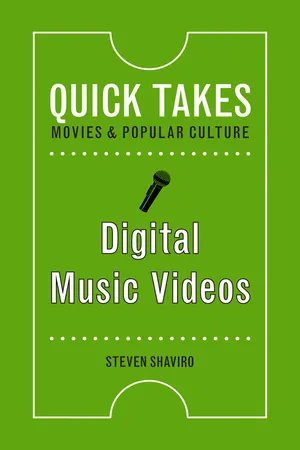
As these videos have proliferated online, they have become more widely accessible than ever before. In Digital Music Videos, Steven Shaviro examines the ways that music videos interact with and change older media like movies and gallery art; the use of technologies like compositing, motion control, morphing software, and other digital special effects in order to create a new organization of time and space; how artists use music videos to project their personas; and how less well known musicians use music videos to extend their range and attract attention.
Surveying a wide range of music videos, Shaviro highlights some of their most striking innovations while illustrating how these videos are creating a whole new digital world for the music industry.
- 140 pages
- English
- ePUB (mobile friendly)
- Available on iOS & Android
eBook - ePub
Digital Music Videos
About this book
Information
Subtopic
Popular Culture in Art1
Superimpositions
LABRINTH, “LET IT BE” (US, 2014)
The camera pans, in silence, over a bare wooden floor. Spotlights illuminate the floor irregularly. The camera encounters a chair and moves upward, just as we hear the opening minor chord of the song. The tones of the chord are echoed by a voice singing, “I, I, I . . .” Labrinth (Timothy McKenzie) is seated in the chair, a pensive expression on his face, writing with a pencil in a notebook. The camera rises above him, circles behind him, and floats away. After a short pause, a lilting reggae beat starts up, introducing the opening verse. The song is called “Let It Be,” but it doesn’t seem to have anything to do with the Beatles anthem and album of that name (or, for that matter, with the Replacements’ identically titled album). The singer admits in an interview that he jacked the title and that it was “a bit ballsy” of him to do so (Songfacts).
The music video for “Let It Be” is directed by the production duo known as Us (Christopher Barrett and Luke Taylor). The video consists of a single long take. We seem to be in an empty warehouse or perhaps a large sound-stage. The camera is continually in motion, exploring the space. It glides and hovers; it pushes in and then pulls back; it circles around, twisting and turning; it swoops up to the ceiling and then back down to the floor. In various parts of the space, there are skeletal groupings of fixtures and furniture. Here’s a kitchen, there’s a corporate board-room, and there’s the sound booth of a recording studio. But all of this décor is sketchy and incomplete, without enclosing walls. Each setting is just a mock-up, a bare-bones simulacrum. The fixtures are always surrounded by empty expanses of floor. The camera roams freely among and around them.
We see Labrinth at work in most of these spaces. Sometimes he is alone and sometimes with others. Mostly we see him composing and recording the very song we are listening to. He sings into a microphone in the recording booth; he plays the guitar while seated on a chair. He rocks the drum set and energetically pounds the keyboards. Each of these is a separate activity, with its own rudimentary set. We also see Labrinth arranging gear in his study, enduring a business meeting and arguing with one of the suits, buying a Rolls Royce, shooting a music video, and being interviewed on a talk show. The composition process involves fatigue and delay, as well as frantic activity. At one point in the video, Labrinth stands alone in a bleak kitchen drinking coffee, while the sink is already filled to the brim with dirty cups. At another, he has fallen asleep with exhaustion on the living-room couch in front of the TV; his girlfriend unsuccessfully tries to rouse him. There are even a couple of tableaux in which Labrinth himself does not appear. In one of them, a postman delivers mail by pushing it through a slot in a free-standing front door. In the other, an eight-person horn section, all of them wearing white shirts and black pants, stand in a row adding their sounds to the song.
Throughout the video, the camera is always in motion. It never stops, until the very end of the video. For the first minute or so, the camera stays close to the action, showing us only one tableau at a time. But as the video goes on, the camera pulls back and widens its focus, so that several tableaux are visible at once. Labrinth may be singing or playing in the foreground, but we also glimpse other iterations of him in the background. We even see the cameras supposedly being used to shoot the music video and the talk show. By the end of the song, the camera has pulled back far enough that we can see the entire warehouse space at once. As the song builds to a crescendo, the lights go out entirely and then flash on and off several times. Now the warehouse is entirely empty; all the sets have disappeared. Only one iteration of Labrinth is left. The camera zooms in on him slowly. He stands alone, on the bare floor, in a circle of spotlights, at the spot where the recording booth used to be. Everything else is darkness. The music ends, but the camera continues to zoom in on Labrinth’s silent and motionless figure.
“Let It Be” is a beautiful, heartfelt, and highly expressive song. It combines jazzy rhythms with neosoul inflections and even with a suggestion of gospel in Labrinth’s booming voice. The music starts plaintively and tentatively, but over the course of three minutes, it builds to a dramatic conclusion. The lyrics suggest a mixture of yearning, struggle, and fatalism. The singer has put out a lot of effort and done his best, but he doesn’t have complete control over his circumstances. Effort and hard work can take you only so far. Labrinth has finally reached the point where he just needs to “let it be” and allow whatever happens to run its course. In this way, the song narrates its own process of composition—though its story of effort, struggle, and finally letting go could just as well apply to many other sorts of life experience.
The music video complements the song’s reflexivity, by depicting the work involved in its composition and production. We see reenactments of the preparation process, of the actual recording of the music, and even of the song’s publicity and marketing. We also get at least some suggestion of the real-life emotions that lie behind the song. Labrinth says in a supplementary “making-of” video that his aim was to give his fans a sense of what he had been up to in the period before he released the song. He also says that a Rolls Royce was included in the video because he had always wanted to drive one. A whole history—the singer’s life, on the one hand, and his specific process of composing, pitching, recording, producing, and releasing the song, on the other—is thus compressed (or, better, seamlessly composited) into a continuous long take, set entirely in a single location. The real star of the video is the motion-control software, which allowed for the computer-controlled execution and precise replication of complex camera movements. All the sets had to be laid out first—together with tracks for the camera, whose route had to be completely programmed in advance. Then, each pass of the camera could capture one tableau or one instance of Labrinth’s performance. The software ensured that the separately shot scenes would fit together into a single continuous, and apparently seamless, long take.
Presumably the different events recounted in the video actually happened at different times and in different places. Labrinth had to compose the song before he could record it and finish recording it before he shot a video for it or promoted it on TV. And yet, despite the logical order of these events, the video reenacts them all at once and places them all in the same location. These events take place simultaneously instead of sequentially. Time collapses into space. The linear thrust of traditional narration is replaced by the circular rhythms and repetitions of the camera’s roving eye—and, indeed, of the music. For we hear the song in its final, completed form, even though the video depicts the process of its construction. The elaborate camera movements of the video follow the preexisting rhythms and articulations of the song, with its repetitions, its alternations of verse and chorus, and its intensification to a final crescendo. The overall process is additive—like when a musician layers different instrumental and vocal tracks on top of one another—rather than teleological. In effect, the incidents of the singer’s life and the elements of his songwriting process are reordered and recombined by the song itself.
This additive process is also true on a formal and technical level. In traditional cinema, long takes work by substituting camera movement for editing. Filmmakers from Alfred Hitchcock (Rope, 1948) to Alejandro González Iñárritu (Birdman, 2014) not only give us long sequences of action in a single shot but also disguise their films’ actual cuts in order to create an even more prolonged impression of uninterrupted camera movement. The impression is somewhat negated by the fact that—as David Bordwell notes in the case of Birdman—the cinematography often still “adheres to standard editing patterns within its long takes” (“Birdman”). But for the most part, the long sequence shot in narrative cinema generally works to capture and render an unbroken block of space-time, corresponding to a single continuous experience of duration. The long take gives us what Gilles Deleuze (himself citing Marcel Proust) calls “time itself, ‘a little time in its pure state’: a direct time-image” (Cinema 2 17). And this pure experience of time is the foundation of the self: for “the only subjectivity is time, . . . and it is we who are internal to time, not the other way round” (82).
However, the long take in “Let It Be” works in a very different manner and thereby gives us a very different sort of audiovisual “image.” As Lev Manovich puts it in his pioneering work on digital media, “where old media relied on montage, new media substitutes the aesthetics of continuity. . . . The logic of replacement, characteristic of cinema, gives way to the logic of addition and co-existence” (143, 325). In “Let It Be,” editing is not replaced by camera movement so much as by digital compositing. Instead of hidden cuts (subtraction), there are hidden layerings (addition). Multiple images present themselves all at once, rather than one after another. Camera movement, for its part, is entirely mechanized and thereby separated from any sort of inner subjective experience. Far from “adher[ing] to standard editing patterns,” the mobile camera in “Let It Be” seems to function autonomously, on its own account. It roves through the space of the warehouse and observes Labrinth’s own emotional ups and downs, but it is untethered to any sort of embodiment or to any particular point of view.
In effect, the camera carves out a new time-volume from an otherwise undifferentiated space. Within this time-volume, events and processes that actually occurred at different moments in different locations are all given to us at once. These events and processes are discontinuous from one another, since they are each displayed separately, in schematized form. And yet these events and processes are all pressed into a unifying global frame-work: one that is provided by the song itself, as well as by the video’s moving camera. They are all happening at the same time—even though they are not instantaneous, in the sense that it takes us a certain amount of time to see them all. In other words, the time of the video—the time it takes for the song to play in its entirety and for the camera to fully explore the space—is a kind of secondary, external time. It is quite different from the subjective, durational time of the events that are depicted and reenacted within the video. That is why we are left, at the very end, after the music has stopped, with the image of Labrinth standing motionless and alone, surrounded by darkness. Letting it be means accepting vulnerability, by opening myself to a time that is not—and that cannot be—mine.
RIHANNA, “DISTURBIA” (ANTHONY MANDLER, 2007)
Anthony Mandler’s video for Rihanna’s song “Disturbia” takes place in what looks like a Victorian insane asylum. The set is overstuffed with odd, large mechanical instruments, cages and chains, and various pieces of bric-a-brac. The overall impression of archaic forms of torture and confinement is reinforced by the sound effects—dissonant arpeggios accompanied by creaks—in the first thirty seconds of the video, before the song proper begins. My students found the video’s décor reminiscent of that in the computer game and movie series Silent Hill, but I think this is a matter not of homage or direct imitation but simply of the fact that both works draw on the same Victorian-asylum imagery.
Rihanna appears in several iterations in the course of the video. In one guise, she seems to be the director of the asylum; the rest of the time, she appears as one or another imprisoned patient. In the former role, she is seated in an enormous rotating chair. She is dressed in what I can only describe as Victorian bondage wear: a stiff black dress and knee-high boots. Her face is made up with heavy dark eye shadow. Her fingers sport rings and long nails in black nail polish; the nail polish actually extends beyond the nails, up to the flesh of the fingers themselves. Rihanna turns slowly around in her chair; or she fans herself with one hand, while holding a cigarette in the other. Sometimes she walks about languidly and pats the head of a docile prisoner. In any case, Rihanna is surrounded by a series of doubles or doppelgängers, as well as by strong, menacing male figures. An enormous white man with an eye patch and a black-and-white-striped prison uniform turns a pair of gigantic, creaky mechanical wheels; another large man, shirtless, perhaps a Pacific Islander, beats out the song’s brutal rhythm on two enormous drums. While sitting in the chair, Rihanna is also assaulted by her own double: a feral female figure, on all fours, with wrists bound together and a punkish shock of blond hair, who snarls and lunges at her, like a bad pet.
Meanwhile, Rihanna takes on multiple guises as a patient-cum-prisoner in the asylum. In one group of shots, she is caged in a jail cell, with straight blond hair and empty zombie eyes; she violently jerks herself back and forth while gripping the bars. In another group, she thrashes about while chained within an empty bed frame. In still another, Rihanna is splayed out, behind lattice-work, seemingly making love to a life-size male mannequin. Then there is the sequence that suggests a slave auction: Rihanna stands on display, chained to a pillar, with a collar around her neck, hands tied to a long stick and bound behind her back, and grease smeared on her naked shoulder. During the song’s bridge, she is trapped in a room with a low, curved ceiling that prevents her from standing up straight; she pulls furiously on chains that bind her ankles together and rivet her arms to a peg in the floor. Most disturbingly of all, perhaps, we also see a true Lovecraftian nightmare: Rihanna hangs immobilized in a corridor, her lower arms stuck inside the walls and her face covered over by a spiderweb; a tarantula crawls on her upper arm.
Most of these images are composed in murky, gloomy tones, tending toward a monochrome dark blue. The general darkness is relieved by the highlighting of Rihanna’s face; her bright red lipstick especially stands out against the darkness. There seem to be electric lights on the ceiling and way back on the far wall. But these lights are generally out of focus and overexposed, so that they appear only as blurry patches, contrasting with the murk but not really cutting through it.
There is, however, one recurring sequence that—in contrast to the rest of the video—is sharply illuminated. Rihanna and a group of backup dancers are silhouetted against a glaring white-and-orange backlight. These dazzlingly lit shots often appear during the first part of the song’s chorus: this is when the melody soars and the lyrics are almost ecstatic, speaking of a wondrous city in which the song’s tormented, jealous protagonist risks being lost. The other dancers hold Rihanna’s prone body up above their heads, into the light, as if they were offering her as a ritual human sacrifice. Perhaps reinforcing this idea, there are also several orange-lit head shots in which Rihanna seems to be wearing some sort of ceremonial headdress.
The bright backlighting and the group of dancers also appear during the song’s “Bum bum be-dum, bum bum be-dum bum” refrain. The music at this point is pounding and inflexible. Rihanna and the other dancers move with spastic, discontinuous jerks of the head or the whole body. Their robotic style responds to the beat’s relentless, inorganic regularity. There is no smooth or graceful movement here; everything is shaped by violent constraints.
The images of Rihanna in the asylum are often interrupted by vertical bars or streaks of light. These intrusions have no discernible source within the set. They seem to erupt directly out of the screen, as if they were artifacts of the video apparatus itself. For a comparison, think of the way that so many recent films and videos add lens flare to the image in order to foreground the presence of the camera or deliberately degrade the image in order to suggest archaic recording technologies (like VHS tape or eight-millimeter film). Similarly, in “Disturbia,” the streaks of light seem like glitches in the very mechanism of video reproduction. They draw our attention away from what the images represent and instead toward the mediating process by means of which they are able to be displayed in the first place. The sort of mental turmoil described by the song, which creeps up on people and consumes them, would seem to have infected not only the singer but also the digitizing process.
During the sequence that suggests a slave auction, from about 1:58 to 2:13, flames rise up in the foreground of the image. However, nothing is actually burned by these flames. This is because they do not fit into the same space as the asylum set in which Rihanna herself appears. Rather, the flames ostentatiously belong to what anyone who has ever used graphics software would recognize as a separate image layer. The flames and Rihanna’s tormented body are equally insistent as components of the image, but they do not interact. The flames might well be described as what used to be called nondiegetic inserts: images that do not belong to the story-world of the movie but instead function as counterpoint, commentary, or metaphor. For instance, in Eisenstein’s October, the fatuous vanity of Prime Minister Kerensky is conveyed by montage: his image is juxtaposed with shots of a peacock displaying its feathers. “Disturbia,” to the contrary, does not show us the flames, which metaphorically consume Rihanna, in separate shots. Rather, they are pasted into the very scenes on which they comment and whose space they do not share.
This use of multiple layers points up two general tendencies of digital music video. The first is that digital media tend to present simultaneously, by compositing, the figurations that traditional movies used to present sequentially, through associative editing. The horizontal and temporal relation of one image to the next (montage) gives way to the vertical relation among disparate elements presented at the same time (collage). The second tendency is that digital video tends to collapse the distinction, generally upheld in the movies, between diegetic and nondiegetic elements, between story and narration, between naturalistic representations and self-conscious formal devices, and ultimately between what Christian Metz (3) calls statement (énoncé) and enunciation (énonciation). In all these cases, the two terms are not on an equal footing, because the second is on a higher level (a metalevel) compared to the first. But digital video generally works to break down the hierarchy; different sounds and images are all presented on the same level, regardless of whether they have been actually captured by the audiovisual apparatus (like Rihanna’s body) or simulated in software (like the flames).
Of course, digital videos like “Disturbia” continue to use montage (aggressive editing) as well as collage (compositing). These two devices are not really opposed. They both contribute to the overwhelming proliferation of images in our media-drenched society. Michel Chion, writing in 1990, already suggests that one reason for the radical difference between movies and music videos is that “the rapid succession of shots” in the latter “creates a sense of visual polyphony and even of simultaneity, even as we see only a single image at a time” (166). Music videos are free to be wildly inventive, Chion says, because their images are redundant, since the music already exists before them and without them. But recent digital music videos push this tendency even further than Chion imagined. “Disturbia” moves more deeply into simultaneity by breaking the barrier of just one image at a time. It is polyphonic—or, better, polyoptic—in the way that it continually layers multiple images over one another. Simultaneity (space) replaces succession (time), as is so often the case in digital, postmodern culture...
Table of contents
- Cover
- Series Page
- Title Page
- Copyright
- Dedication
- Contents
- Introduction
- 1. Superimpositions
- 2. Glitch Aesthetics
- 3. Remediations
- 4. Limits
- Acknowledgments
- Further Reading
- Works Cited
- Videos Cited
- Index
- About the Author
Trusted by 375,005 students
Access to over 1.5 million titles for a fair monthly price.
Study more efficiently using our study tools.
Frequently asked questions
Yes, you can cancel anytime from the Subscription tab in your account settings on the Perlego website. Your subscription will stay active until the end of your current billing period. Learn how to cancel your subscription
No, books cannot be downloaded as external files, such as PDFs, for use outside of Perlego. However, you can download books within the Perlego app for offline reading on mobile or tablet. Learn how to download books offline
We are an online textbook subscription service, where you can get access to an entire online library for less than the price of a single book per month. With over 1.5 million books across 990+ topics, we’ve got you covered! Learn about our mission
Look out for the read-aloud symbol on your next book to see if you can listen to it. The read-aloud tool reads text aloud for you, highlighting the text as it is being read. You can pause it, speed it up and slow it down. Learn more about Read Aloud
Yes! You can use the Perlego app on both iOS and Android devices to read anytime, anywhere — even offline. Perfect for commutes or when you’re on the go.
Please note we cannot support devices running on iOS 13 and Android 7 or earlier. Learn more about using the app
Please note we cannot support devices running on iOS 13 and Android 7 or earlier. Learn more about using the app
Yes, you can access Digital Music Videos by Steven Shaviro in PDF and/or ePUB format, as well as other popular books in Media & Performing Arts & Popular Culture in Art. We have over 1.5 million books available in our catalogue for you to explore.