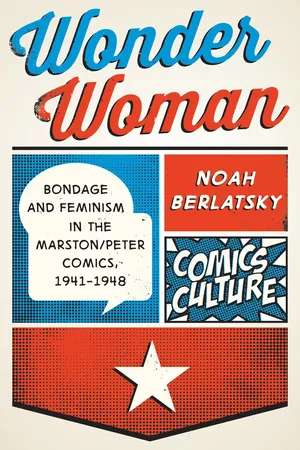
William Marston was an unusual man—a psychologist, a soft-porn pulp novelist, more than a bit of a carny, and the (self-declared) inventor of the lie detector. He was also the creator of Wonder Woman, the comic that he used to express two of his greatest passions: feminism and women in bondage. Comics expert Noah Berlatsky takes us on a wild ride through the Wonder Woman comics of the 1940s, vividly illustrating how Marston’s many quirks and contradictions, along with the odd disproportionate composition created by illustrator Harry Peter, produced a comic that was radically ahead of its time in terms of its bold presentation of female power and sexuality. Himself a committed polyamorist, Marston created a universe that was friendly to queer sexualities and lifestyles, from kink to lesbianism to cross-dressing. Written with a deep affection for the fantastically pulpy elements of the early Wonder Woman comics, from invisible jets to giant multi-lunged space kangaroos, the book also reveals how the comic addressed serious, even taboo issues like rape and incest. Wonder Woman: Bondage and Feminism in the Marston/Peter Comics 1941-1948 reveals how illustrator and writer came together to create a unique, visionary work of art, filled with bizarre ambition, revolutionary fervor, and love, far different from the action hero symbol of the feminist movement many of us recall from television.
- 264 pages
- English
- ePUB (mobile friendly)
- Available on iOS & Android
eBook - ePub
Wonder Woman
About this book
Information
Chapter One
The Pink Bondage Goo of Feminism
The Marston/Peter Wonder Woman comics were both feminist and filled with bondage imagery. This chapter tries to explain how that was possible. Though some critics and feminists see fetishized bondage as disempowering to women, I point out that representations of disempowerment are popular in women’s genre literature such as the romance and the gothic. Images of disempowerment, then, may be popular with women because they mirror women’s actual disempowerment.
I then discuss Wonder Woman #16, perhaps the greatest Marston/Peter story (co-written by Joye Murchison). Wonder Woman #16 is in many ways a gothic story. It also deals directly with women’s disempowerment by exploring themes of rape and incest. I relate the treatment of these issues in Wonder Woman #16 to discussions of incest by Sigmund Freud and Judith Herman in order to show the extent to which Marston/Murchison/Peter sympathize with and try to empower female (and male) victims.
However, the comic’s identification with victims does not prevent it from also fetishizing those victims. Using Twilight and Gale Swiontkowski’s argument that incest fantasies can sometimes be empowering for women, I argue that Marston/Murchison/Peter not only fetishize women but also give women the opportunity to be the fetishizers/objectifiers. Wonder Woman #16 sympathizes with victims but refuses to see women solely as victims or solely as reacting (with heroism or violence) to victimization. Instead, Marston, Murchison, and Peter insist that condemnation of sexual violence can, and must, coexist with an embrace of sexual fantasy.
Bondage and Empowerment
In an introduction to a 1972 collection of Marston and Peter Wonder Woman stories organized by Ms. magazine, Gloria Steinem declared,
Looking back now at these Wonder Woman stories from the forties, I am amazed by the strength of their feminist message. . . .Wonder Woman symbolizes many of the values of the women’s culture that feminists are now trying to introduce into the mainstream: strength and self-reliance for women; sisterhood and mutual support among women; peacefulness and esteem for human life; a diminishment both of “masculine” aggression and of the belief that violence is the only way of solving conflicts. (Introduction to Wonder Woman [1972] n.p.)
For Steinem, then, Wonder Woman was a symbol of the power and independence of women—which is why an image of the heroine graces the cover of the first stand-alone Ms. magazine in July 1972.1
It is not hard to see what Steinem is talking about or why feminists such as Trina Robbins and Lillian Robinson have also expressed enthusiasm for Marston and Peter’s version of the character. All you have to do is read a story like Wonder Woman #13, published in summer 1945 (and partially reprinted in the 1972 Ms. collection). The comic opens with a crisis on Paradise Island, where many young Amazons have started to doubt their own abilities to perform superfeats. Wonder Woman races to the rescue and shows the Amazons how to jump 150 feet in the air, snap the heaviest chains, and lift giant boulders. “You see girls, there’s nothing to it!” she declares. “All you have to do is have confidence in your own strength!” And sure enough, as Marston tells us in a text box, “Under Wonder Woman’s inspiration, the Amazon girls pass their strength tests with flying colors” (3A–5A). Or, as singer Judy Collins said in her introduction to the first Wonder Woman Archive volume, “I am sure that the energy and certainty of women that they can do anything is due in part to Wonder Woman’s great example” (7).
But even in this story, one of Marston’s most schematically ideological feminist lessons for girls, there is a moment or two that has to make even the most forgiving reader wonder whether feminism is really the focus. In one particularly striking panel, the Amazon girls, all dressed in short, flirty skirts, are shown winding ropes and chains around the (as always) be-swimsuited Wonder Woman, tying her fast to a wooden pole; Peter draws some swooping, energized, inky motion, filling the scene with an additional joyful oomph (5A). Everyone looks like they are having a great time, and obviously it is all in the name of sporty athletics and raising women’s self-esteem. But why does raising women’s self-esteem require bondage imagery exactly? Isn’t there a way we could get the feminist message without the cheerful-yet-kinky sexual charge?
The answer to that last question, at least for Marston and Peter, is no. We can’t, and we won’t, have the liberation without the bondage. Gloria Steinem and Judy Collins focus on the feminism and avoid the other thing, but one has to think that even they noticed at some point that the Marston/Peter Wonder Woman is a wall-to-wall bondage-fetish romp. In fact, according to Tim Hanley, fully 27 percent of the Marston/Peter Wonder Woman included bondage, compared to only 3 percent for Captain Marvel, another character who got tied up quite a bit (46).
As an example, let’s look at the first few pages of the last script Marston ever published, Wonder Woman #28, written in collaboration with Joye Murchison while he was dying of cancer.2
- The cover and splash page are notable in that no one is tied up.
- Page 2A: Wonder Woman is shown binding a whole horde of evil Saturnians. The male Saturnians get sent away, so only the women are left, presumably because Marston and Peter don’t really care about men. In any case, the Saturnian women then have Venus girdles strapped on them—magic metal belts that compel “complete obedience to loving authority.”
- Page 3A–4A: The Saturnian leader, Eviless, is shown variously bound with her hands behind her back and/or the Venus girdle around her waist, but despite these impediments, she cleverly plots to escape.
- Page 5A: Eviless escapes and immediately ties up her jailer, “Mistress” Mala.
- Page 6A: More tying up Mala (these things take time). There are some scenes of prisoners begging not to be freed from their Venus girdles.
- Page 7A: There are lots of people in prison clothes on this page, which I’m sure Marston enjoyed, but technically the narrative is devoted to freeing people rather than putting them in chains.
- 8A–9A: After Eviless frees a bunch of supervillains, they all team up to capture Wonder Woman’s mother, Hippolyte, and of course tie her up from head to toe. (Peter gives us a tall, half-page dramatic panel to better see her in her full bondage glory.) Then the villains paralyze all the other Amazons and put Venus girdles on them (Marston loves paralysis).
- 10A: More business with Hippolyte tied up, compelled by Wonder Woman’s lasso to betray her daughter. Marston throws in some begging and pleading to add spice.
- 11A: Not even a hint of bondage here, believe it or not.
- 12A: One villain (in male drag) tries to hypnotize Wonder Woman, which is kinky but doesn’t work. Finally, the villains show Wonder Woman her mother tied up, causing her to surrender. Then she is also tied up. End of chapter.
I could go on, but I think you get the idea. And just to underline this wasn’t simply a deathbed interest for Marston, figure 1 shows one of the most arresting sequences from Wonder Woman #18, cover date of July–August 1946 (page 10C). In case you can’t quite parse the image, or simply can’t believe your eyes, what we have here is a minister dissolving into pink ectoplasmic ropes of phallic goo and binding Wonder Woman and the entire wedding party from top to toe. As Wonder Woman says, “Even an Amazon can’t break ectoplasm.” It’s difficult to avoid wondering if Marston (who worked on this issue in collaboration with Joye Murchison) might not be imagining his ideal marriage night here; what, after all, could be better than a good round of bondage tentacle sex? Certainly, Peter seems to have drawn the detached ectoplasmic bit in the lower left with a kind of bulbous, frolicsome trembling, redolent of suppressed cheer and passion.
Not surprisingly, many critics have looked at this sort of thing—the bondage, the hypnosis, the mind-control girdles, the tentacle sex, the bondage—and have concluded that Marston (and perhaps Peter as well) had an unhealthy and decidedly unfeminist interest in our heroine. Douglas Wolk, for example, says that Wonder Woman was “very specifically an excuse for stories about sexual domination and submission” and suggests that it was only in the 1970s that the character became a vehicle for feminist content (98). Bradford Wright notes that Marston tried to include positive messages for women but concludes that “there was a lot in these stories to suggest that Wonder Woman was not so much a pitch to ambitious girls as an object for male sexual fantasies and fetishes” (21). Harshest of all, perhaps, is Richard Reynolds, who calls Marston’s feminist pretensions disingenuous and argues that the comic was actually “developed as a frank appeal to male fantasies of sexual domination” (34). In his distaste, he echoes Josette Frank, a member of the Child Study Association of America and of the initial Wonder Woman advisory board, who pointed to women wrestling wild boar and turning into cheetahs and concluded, “Personally I would consider an out-and-out strip tease less unwholesome than this kind of symbolism” (qtd. in Valcour 107).

Figure 1. Wonder Woman #18 (1946)
One of Those Odd, Perhaps Unfortunate Men
Ben Saunders insists, in his groundbreaking chapter on Wonder Woman in Do the Gods Wear Capes? that these critics are misguided. By looking closely at Marston’s psychological writing, Saunders concludes that, in Wonder Woman, there is no necessary contradiction between bondage and feminism. Instead, Saunders argues that for Marston, women are superior to men precisely because they are more loving and more submissive (62–63). Men must learn from women the virtues of love and of submission. When they do, and when women rule, the millennium will arrive (59).
I am very sympathetic to Saunders’s argument and, indeed, in many ways to Marston’s, and I will explore both, in one form or another, through most of this book. For the moment, however, I want to take a slightly different tack and acknowledge the force of the criticisms made by Wolk, Wright, Reynolds, and others. Saunders is clearly correct when he points out (quite gently) that none of these writers appears to have really engaged with the full extent of Marston’s theories or (at least in Reynolds’s case) even with the comics themselves (57). Their reading is in many ways a superficial one. But superficial readings are not necessarily wrong. These were after all comic books for children. Most of the original eight- to ten-year-old readers would not have been aware of Marston’s psychological work.
In fact, we have evidence that at least one reader of Wonder Woman took the comics in precisely the way that Wolk, Wright, Reynolds, and Frank suggest. In 1943, a staff sergeant wrote to Marston to thank him for his Wonder Woman stories. He said, “I am one of those odd, perhaps unfortunate men who derive an extreme erotic pleasure from the mere thought of a beautiful girl, chained or bound, or masked, or wearing extreme high-heels or high-laced boots,—in fact, any sort of constriction or strain whatsoever. Your tales of Wonder Woman have fascinated me on account of this queer ‘twist’ in my psychological make-up” (qtd. in Bunn 94). Marston’s publisher, M. C. Gaines, after seeing this letter, told Marston, “This is one of the things I’ve been afraid of without quite being able to put my finger on it” (qtd. in Bunn 94).
Gaines is not the only critic who has had trouble putting his finger on the really remarkably obvious. As I have already mentioned, Gloria Steinem has written a number of essays about Wonder Woman and feminism but never pointed out what struck our staff sergeant at once. Similarly, feminist comics scholar and Marston/Peter fan Trina Robbins insists that there was no more bondage in Wonder Woman than in any other comic from the period (a claim Hanley’s research conclusively refutes). Robbins concludes unconvincingly that “some heroes get tied up more than others,” which is no doubt true but seems to rather dance around the question of why that variation exists and why this hero in particular gets tied up with such frequency, variety, and enthusiasm (Robbins, Great Women 13). Moreover, as Saunders points out, it ignores the fact that Marston’s narrative constantly centers bondage as a political theme and an evangelical good (58).3
The reason for this ringing round of reticence is obvious enough. The bondage aspects of Wonder Woman are embarrassing. They are embarrassing to a publisher who would like to think he is providing wholesome entertainment to children. They are embarrassing to feminists such as Steinem and Robbins who want to celebrate the comic’s message of empowerment.4 But, embarrassing or not, there it is . . . and there . . . and there . . . and, good lord, over there is he actually having a bunch of sorority girls tie up a female gorilla?
There is no way around it: Marston’s bondage imagery is an obsession. More than that, it is a fetish, and men like the enthusiastic staff sergeant are going to consume it as such, yea, even unto the gorilla bondage (in Wonder Woman #9, 5A, if you must know). Thus, Wonder Woman provides images of constricted women (and even female apes) for men’s sexual aggrandizement. The comic not only allows but encourages males—and females too—to take sensual pleasure in women’s disempowerment. If feminism does not mean speaking out against that, what does it mean?
“The Most Popular Fantasy Perversion”
Many second-wave and radical feminists have asked this very question and have concluded, emphatically, that feminism must reject the sexualized subjugation of women. John Stoltenberg, for example, sees the “humiliation and exploitation, chaining and bondage” in gay pornography as embodying the “values that male supremacists [gay or straight] tend to have—taking, using, estranging, dominating—essentially sexual powermongering” (96). For Stoltenberg, bondage imagery such as that used in Wonder Woman validates and promotes an ethic of sexual dominance, teaching those who consume it to treat women as “utterly submissive masochists who enjoy pain and humiliation and who, if they are raped, enjoy it” (114). The mainstreaming of “sexualized beating, mutilation, bondage, dismemberment” is part of a process of “eroticized injustice,” which, Stoltenberg believes, normalizes sexual violence against women (114).
Susan Brownmiller comes to similar conclusions in her classic 1975 feminist discussion of rape, Against Our Will. After a harrowing discussion of sexual assault in the slaveholding American South, Brownmiller says this:
The master-slave relationship is the most popular fantasy perversion in the literature of pornography. The image of a scantily clothed slave girl, always nubile, always beautiful, always docile, who sinks to her knees gracefully and dutifully before her master, who stands with or without boots, with or without whip, is commonly accepted as a scene of titillating sexuality. From the slave harems of the Oriental potentate, celebrated in poetry and dance, to the breathless description of light-skinned fancy women, de rigueur in a particular genre of pulp historical fiction, the glorification of forced sex under slavery, institutional rape, has been a part of our cultural heritage, feeding the egos of men while subverting the egos of women—and doing irreparable damage to healthy sexuality in the process. The very words “slave girl” impart to many a vision of voluptuous sexuality redolent of perfumed gardens and soft music strummed on a lyre. Such is the legacy of male-controlled sexuality, under which we struggle. (169–170)
The adamant antiporn and antimasochism arguments made by Stoltenberg and Brownmiller have been challenged by many writers. As just one pertinent example, Lewis Call has argued that the bondage imagery in Wonder Woman is not violent but on the contrary emphasizes consent, play, and equality in a way that directly challenges the nonconsensual, patriarchal sexualities that Stoltenberg decries (27).
For my part, I’d like to point out a perhaps unavoidable structural issue raised by Brownmiller’s discussion of slave harems. Namely, in order to condemn the history of eroticized bondage, Brownmiller is forced, however briefly, to participate in it. In that paragraph about the evils of images of disempowerment, Brownmiller presents us with scantily clothed...
Table of contents
- Title Page
- Copyright Page
- Dedication
- Contents
- Acknowledgments
- Introduction
- Chapter One
- Chapter Two
- Chapter Three
- Conclusion
- Notes
- Works Cited
- Index
- About the Author
Trusted by 375,005 students
Access to over 1.5 million titles for a fair monthly price.
Study more efficiently using our study tools.
Frequently asked questions
Yes, you can cancel anytime from the Subscription tab in your account settings on the Perlego website. Your subscription will stay active until the end of your current billing period. Learn how to cancel your subscription
No, books cannot be downloaded as external files, such as PDFs, for use outside of Perlego. However, you can download books within the Perlego app for offline reading on mobile or tablet. Learn how to download books offline
Perlego offers two plans: Essential and Complete
- Essential is ideal for learners and professionals who enjoy exploring a wide range of subjects. Access the Essential Library with 800,000+ trusted titles and best-sellers across business, personal growth, and the humanities. Includes unlimited reading time and Standard Read Aloud voice.
- Complete: Perfect for advanced learners and researchers needing full, unrestricted access. Unlock 1.5M+ books across hundreds of subjects, including academic and specialized titles. The Complete Plan also includes advanced features like Premium Read Aloud and Research Assistant.
We are an online textbook subscription service, where you can get access to an entire online library for less than the price of a single book per month. With over 1.5 million books across 990+ topics, we’ve got you covered! Learn about our mission
Look out for the read-aloud symbol on your next book to see if you can listen to it. The read-aloud tool reads text aloud for you, highlighting the text as it is being read. You can pause it, speed it up and slow it down. Learn more about Read Aloud
Yes! You can use the Perlego app on both iOS and Android devices to read anytime, anywhere — even offline. Perfect for commutes or when you’re on the go.
Please note we cannot support devices running on iOS 13 and Android 7 or earlier. Learn more about using the app
Please note we cannot support devices running on iOS 13 and Android 7 or earlier. Learn more about using the app
Yes, you can access Wonder Woman by Noah Berlatsky in PDF and/or ePUB format, as well as other popular books in Social Sciences & Comics & Graphic Novels Literary Criticism. We have over 1.5 million books available in our catalogue for you to explore.