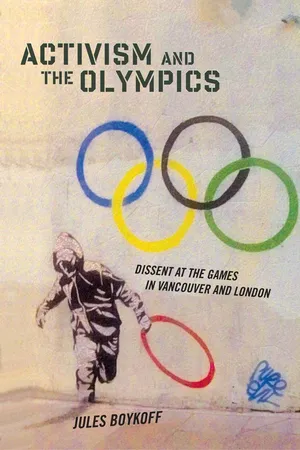
The Olympics have developed into the world's premier sporting event. They are simultaneously a competitive exhibition and a grand display of cooperation that bring together global cultures on ski slopes, shooting ranges, swimming pools, and track ovals. Given their scale in the modern era, the Games are a useful window for better comprehending larger cultural, social, and historical processes, argues Jules Boykoff, an academic social scientist and a former Olympic athlete.In Activism and the Olympics, Boykoff provides a critical overview of the Olympic industry and its political opponents in the modern era. After presenting a brief history of Olympic activism, he turns his attention to on-the-ground activism through the lens of the Vancouver 2010 Winter Olympics and the 2012 Summer Olympics in London. Here we see how anti-Olympic activists deploy a range of approaches to challenge the Olympic machine, from direct action and the seizure of public space to humor-based and online tactics. Drawing on primary evidence from myriad personal interviews with activists, journalists, civil libertarians, and Olympics organizers, Boykoff angles in on the Games from numerous vantages and viewpoints.Although modern Olympic authorities have strived—even through the Cold War era—to appear apolitical, Boykoff notes, the Games have always been the site of hotly contested political actions and competing interests. During the last thirty years, as the Olympics became an economic juggernaut, they also generated numerous reactions from groups that have sought to challenge the event’s triumphalism and pageantry. The 21st century has seen an increased level of activism across the world, from the Occupy Movement in the United States to the Arab Spring in the Middle East. What does this spike in dissent mean for Olympic activists as they prepare for future Games?
- 242 pages
- English
- ePUB (mobile friendly)
- Available on iOS & Android
eBook - ePub
Activism and the Olympics
About this book
Information
1
Understanding the Olympic Games
The Olympic Games are shrouded in an apoliticism that is in fact eminently political. The notion that the Olympics can sidestep politics is one of the guiding fictions of our times, and one propped up by major players in the Olympic movement. Avery Brundage, who headed the International Olympic Committee from 1952 to 1972, chanted the mantra that politics and Olympics shouldn’t mix. For instance, in a 1969 letter he wrote, “we actively combat the introduction of politics into the Olympic movement and are adamant against the use of the Olympic Games as a tool or as a weapon by any organization.”1 More recently, IOC leaders have adopted a subtler approach. While not expressly stating the Olympics are a political juggernaut in and of themselves, IOC president Jacques Rogge remarked at the 113th IOC session in 2002, “sport is closely linked to the political and economic framework within which it develops.”2
In reality, the Olympics are a cauldron of ever-bubbling politics on low boil. At the same time, the Olympics are an important and wildly popular cultural event. As Sir Alan Collins, managing director for Olympic legacy at UK Trade and Investment, remarked as London prepared to host the 2012 Summer Games, the Olympics “is obviously the greatest show on Earth.” He also acknowledged the economic importance of the Games, describing them as “the biggest possible networking opportunity” before concluding “we would be remiss if we didn’t take maximum advantage of that while we have the eyes of the world on us.”3 Over time the Olympics have transmogrified into a gargantuan economic force nestled in a political thicket.
Sport is a site of political struggle. The political complexion of sport crystallized in the case of 1976 Winter Olympics, which were originally slated for Denver, Colorado, until an upsurge of dissent derailed the IOC’s plans. In May 1970, the IOC selected Denver to host the 1976 Winter Games. Upon winning the bid contest, Colorado governor John Love vowed, “It’s going to be a great thing for Colorado” while the president of Denver’s Chamber of Commerce promised the Games would make a “great economic impact,” adding, “It makes us look like we’re alive and we’re recognized worldwide as a major city.”4
Not everyone shared their enthusiasm. After the IOC awarded the Olympics to Denver, activists rallied against hosting the Games for fear of the ecological degradation it could trigger. Groups like Protect Our Mountain Environment and the Rocky Mountain Center on Environment deluged IOC officials with letters laying out the case to move the Games from Denver.5 A range of organizations kicked into action under the umbrella group Citizens for Colorado’s Future, jumpstarting a petition drive and pressing for a state referendum on a $5 million bond issue to fund the Games. They won the public vote in November 1972 with 60 percent of the final tally, thereby shutting off the potential money spigot.6 In undercutting the funding mechanism, Colorado activists rebuffed the 1976 Winter Games. This made Denver the first city to reject the Games after having been granted them by the IOC.
Nonathlete actors in Colorado cobbled together a multifaceted anti-Games rationale that serves as a vital antecedent for Olympics activists today. Citing escalating costs, a tax hike, potential ecological scarring, and a population explosion that could raise the cost of living, these groups banded together to run a hardscrabble grassroots campaign to convince voters that the Olympics would be ruinous for Denver and the surrounding areas. One popular bumper sticker at the time read, “Don’t Californicate Colorado!”7 Although Denver organizers originally asserted the cost of the Olympics would be contained at $14 million and the Games would be geographically limited to the Denver area, projected costs eventually climbed to $35 million and planned venues began to stretch as far as four hours away into the Rocky Mountains.8
Campaigners showered IOC officials with letters demanding reconsideration—the Avery Brundage archive alone contains four full folders with letters from concerned Colorado citizens and elected officials. Richard Lamm, the assistant minority leader in the Colorado House of Representatives, penned a letter to Brundage highlighting fiscal concerns as well as the opportunity costs of hosting the Games. “Colorado, painfully, cannot afford to host the 1976 Olympics,” he wrote. “We are a small state, already on the verge of taxpayer revolt. We cannot afford to do justice to our schools, to our institutions, to our many other pressing needs now; and as we become aware of the vast financial commitment to host the 1976 Olympics we see increasingly that we do not have the will or the tax base to afford the 1976 Olympics.”9 In a subsequent letter to Canadian IOC member James Worrall, Lamm added, “The debate over the ability of our small state to properly host the Games is tearing us apart and dividing our people. Candidates of both parties are lining up to run on the anti-Olympics platform.” He concluded, “I urge you to remove the Games from Colorado. It would be to the benefit of both Colorado and the Olympics.”10
Other letter writers also highlighted the opportunity costs of the Games. Al Nielson wrote Brundage to suggest that instead of spending money on Olympic construction, funds could be spent on “the purchasing of food, medicine, and education for those unfortunate people throughout the world.” He concluded, “It is my opinion that dollars spent in this manner will certainly benefit mankind far greater than a new ski jump in Evergreen, Colorado.” Another private citizen wrote to Brundage suggesting the Games be held in the same facilities every four years: “The millions of dollars that would be saved by such a program might well be channeled into activities which more directly might meet the need for improved health, education, and job training throughout the world.” Activists also criticized the Denver Organizing Committee (DOC) for its lack of transparency and unwillingness to register citizen input. The communications director from Citizens for Colorado’s Future said the local organizing committee “has to date shown itself to be insensitive to citizen opinion, undemocratic and secretive in its operations, and careless to the point of negligence in its management.”11 The messages were getting through. In May 1972, Brundage wrote a memo cataloging activist critiques and logging the number of telephone calls he had received over the matter.12 While in general activists engaged in lawful contention, the New York Times reported that resistance occasionally verged into sabotage: “Somebody even burned down the steep-slope ski jump that towers above town” in Steamboat Springs, “scribbling anti-Olympic obscenities on the charred remains.”13 This persistent mix of legal and transgressive activism proved to be powerful enough to fight back the Olympic machine.
When it came to the November 1972 referendum, pro-Olympics forces held key advantages. They poured more than $175,000 into a slick marketing campaign, relied on big-name Olympians for public endorsement, and enjoyed a generous assist from the press. As Sports Illustrated put it at the time, Olympic supporters “trotted out that old pro-Olympian Jesse Owens and flooded the state with entreaties to ‘light the torch now,’ meanwhile receiving sustenance from the Denver Post, which in the campaign’s final days devoted up to five times more news space to Olympic boosters than to critics.”14 Activists ran a ramshackle campaign—Citizens for Colorado’s Future spent less than $24,000 during its entire existence, with most of those funds secured in $5 to $10 donations. The group’s media budget barely topped $2,000. Yet the activists emerged triumphant, winning the referendum handily: 537,440 to 358,906. Afterwards, the chairman of the DOC conceded defeat, flatly stating, “The voters made their position clear. . . . They don’t want the Olympics.”15 The IOC eventually opted to relocate the 1976 Winter Olympics to Innsbruck, handing the Austrian city a victory by attrition. Sports Illustrated concluded that the activist campaign and referendum in Colorado “was not a vote against the Olympics per se, nor a vote against sport. But it was a vote against sporting facilities that cost taxpayers millions of dollars and work against essential conservation attitudes in the area concerned.”16 This distinction remains important for understanding anti-Olympics activism in the twenty-first century.
To be sure, a great deal has changed since the activist battle in Colorado. The Olympics have evolved from a relatively modest festival of amateur athleticism into a shimmering, capitalist dynamo. By the end of the 1980s the IOC had made great strides in transforming itself into the powerful behemoth we know today. Nonetheless, the case of Denver highlights the possibilities of political dissent that challenges the Games. The activist efforts in Denver spotlight the complex relationship between sport and politics and the strategic interplay between everyday people and those in positions of power. It also helps illuminate aspects of social theory that will be useful as we consider dissident citizenship on the Olympic terrain in the twenty-first century.
A Moment of Movements
Writing in 1992, social-movement scholar Mario Diani synthesized existing conceptualizations of the term social movement before offering his own: “a network of informal interactions between a plurality of individuals, groups, and/or organizations, engaged in a political or cultural conflict, on the basis of a shared collective identity.”17 While Diani’s useful fusion captured many key dimensions of collective action, it deemphasized two elements that are significant to social movements: formalized politics and sustained interaction. Social movements often engage in regularized, formal political activity inside the institutionalized pathways of political power, translating their efforts into crisp demands of elected officials and other authorities. Also, to be a social movement, such activity and organizing cannot be a one-off—it must be sustained through time. Diani’s conceptual work fashioned a pathway for Sidney Tarrow to offer what is now a widely accepted definition of social movements—“collective challenges, based on common purposes and social solidarities, in sustained interactions with elites, opponents, and authorities.”18 While this is a valuable definition, it doesn’t quite fit the sorts of organizing that often emerge to challenge the Olympics since this activism is only barely maintained through time and from site to site.
Writing about the modern-day Global Justice Movement, Tom Mertes has asserted that it’s “useful to conceptualize the relation between the various groups as an ongoing series of alliances and coalitions, whose convergences remain contingent. Genuine solidarity can only be built up through a process of testing and questioning, through a real overlap of affinities and interests.”19 Anti-Olympics activism aligns more with this conception of organizing—which highlights contingency and convergence—than the idea of an old-school social movement, despite the fact that at least one scholar has described anti-Olympics activism as “a quite significant social movement.”20 It would be more correct to call anti-Olympic resistance an “event coalition” than a social movement proper, since the activism is only scarcely sustained through time; protesters hobble on a shoestring budget from Olympic host city to host city. Sidney Tarrow distinguishes movements from event coalitions, or groups coming together for a single event where there is relatively shallow, temporary cooperation between organizations that decreases after the event transpires, when demonstrators return to the “normal activism” surrounding their central issues. As we will see, while the transnational site-to-site activist ties between anti-Olympics activists are becoming stronger, the idea of an event coalition captures the formal aspects of anti-Olympics activism in the early twenty-first century.21 Protesting the Olympics is akin to an activist version of Whac-A-Mole. The Games pop up in one city, generating dissent, and then quickly plunge beneath the discursive surface, rearing their head in another city two years later. Protesters meanwhile fall back into their pre-Games patterns of protest, returning to their main targets and objectives.
Anti-Olympics activism is not so much a “movement of movements” as it is a moment of movements. During the Olympics moment, extant activist groups come together using the Olympics as their fight-back focal point. As we shall see, their efforts are often filtered through tactical and strategic hubs, the coming-together points of loose networks that share a five-ring bête noire. Viewing anti-Olympics activism in this way is not merely an academic exercise in definition construction; it’s a clear reflection of twenty-first-century activist groups finding ways to organize with greater flexibility, spontaneity, and lateral solidarity. Anti-Olympics activism in Vancouver and London provide prime examples of these dynamics.
Social-movement scholars distinguish between contained contention and transgressive contention, with the former meaning activists who are “previously established actors employing well established means of claim making” and the latter indicating contenders who are “newly self-identified political actors” who engage in “innovative political action” that is either unprecedented or outlawed.22 In the conceptually murkier world of boots-to-pavement activism, such dichotomies often don’t hold up, which led Tarrow to delineate multiform activist coalitions that employ traditional and imaginative tactics and strategies both inside and outside the institutional pathways of political power.23 As Jack Goldstone puts it, “the organizations that channel protest and ‘conventional’ political actions, are increasingly intertwined.”24 Anti-Olympics event coalitions are multiform, often adopting traditional forms of dissent, such as testifying at local meetings and lobbying elected leaders, while also making use of novel repertoires of contention with targets outside traditional politics.
While Olympics activists are not strictly speaking part of social movements, social-movement theory nevertheless offers a rich theoretical seam from which we can draw to make sense of anti-Olympics campaigners. One useful conceptual apparatus that can help us organize our thinking in a bigger-picture way is political opportunity structure (POS). POS encompasses both longer-term, relatively fixed institutional structures (for example, the constitutional role of the military in a given country) as well as medium-term, more dynamic structures that can more readily shift (for example, political alignments among elite policymakers).25 POS affects the social receptivity of groups that are challenging dominant power re...
Table of contents
- Title Page
- Copyright Page
- Dedication
- Contents
- List of Illustrations and Tables
- Acknowledgments
- Introduction: The Olympics and Me
- Chapter 1. Understanding the Olympic Games
- Chapter 2. Space Matters: The Vancouver 2010 Winter Olympics
- Chapter 3. London Calling: Activism and the 2012 Summer Olympics
- Chapter 4. Media and the Olympics
- Chapter 5. Looking Ahead through the Rearview Mirror
- Notes
- Bibliography
- Index
- About the Author
Trusted by 375,005 students
Access to over 1.5 million titles for a fair monthly price.
Study more efficiently using our study tools.
Frequently asked questions
Yes, you can cancel anytime from the Subscription tab in your account settings on the Perlego website. Your subscription will stay active until the end of your current billing period. Learn how to cancel your subscription
No, books cannot be downloaded as external files, such as PDFs, for use outside of Perlego. However, you can download books within the Perlego app for offline reading on mobile or tablet. Learn how to download books offline
Perlego offers two plans: Essential and Complete
- Essential is ideal for learners and professionals who enjoy exploring a wide range of subjects. Access the Essential Library with 800,000+ trusted titles and best-sellers across business, personal growth, and the humanities. Includes unlimited reading time and Standard Read Aloud voice.
- Complete: Perfect for advanced learners and researchers needing full, unrestricted access. Unlock 1.5M+ books across hundreds of subjects, including academic and specialized titles. The Complete Plan also includes advanced features like Premium Read Aloud and Research Assistant.
We are an online textbook subscription service, where you can get access to an entire online library for less than the price of a single book per month. With over 1.5 million books across 990+ topics, we’ve got you covered! Learn about our mission
Look out for the read-aloud symbol on your next book to see if you can listen to it. The read-aloud tool reads text aloud for you, highlighting the text as it is being read. You can pause it, speed it up and slow it down. Learn more about Read Aloud
Yes! You can use the Perlego app on both iOS and Android devices to read anytime, anywhere — even offline. Perfect for commutes or when you’re on the go.
Please note we cannot support devices running on iOS 13 and Android 7 or earlier. Learn more about using the app
Please note we cannot support devices running on iOS 13 and Android 7 or earlier. Learn more about using the app
Yes, you can access Activism and the Olympics by Jules Boykoff in PDF and/or ePUB format, as well as other popular books in Social Sciences & Sociology. We have over 1.5 million books available in our catalogue for you to explore.