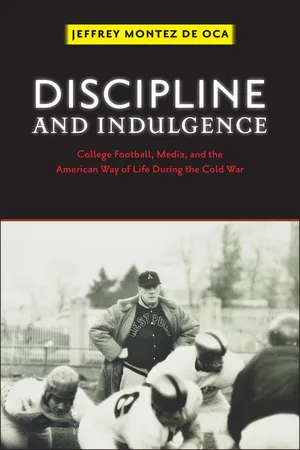
The early Cold War (1947–1964) was a time of optimism in America. Flushed with confidence by the Second World War, many heralded the American Century and saw postwar affluence as proof that capitalism would solve want and poverty. Yet this period also filled people with anxiety. Beyond the specter of nuclear annihilation, the consumerism and affluence of capitalism’s success were seen as turning the sons of pioneers into couch potatoes.In Discipline and Indulgence, Jeffrey Montez de Oca demonstrates how popular culture, especially college football, addressed capitalism’s contradictions by integrating men into the economy of the Cold War as workers, warriors, and consumers. In the dawning television age, college football provided a ritual and spectacle of the American way of life that anyone could participate in from the comfort of his own home. College football formed an ethical space of patriotic pageantry where men could produce themselves as citizens of the Cold War state. Based on a theoretically sophisticated analysis of Cold War media, Discipline and Indulgence assesses the period’s institutional linkage of sport, higher education, media, and militarism and finds the connections of contemporary sport media to today’s War on Terror.
- 188 pages
- English
- ePUB (mobile friendly)
- Available on iOS & Android
eBook - ePub
Discipline and Indulgence
About this book
Information
1
Introduction
On select Saturday mornings, our fall ritual began in the parking lot of Kentucky Fried Chicken on Shattuck Avenue in Berkeley, California. A bucket of golden fried chicken and a jug of Dr Pepper went into a bag that my father and I carried across the University of California campus to Memorial Stadium. Measuring and metering of time as we relocated ourselves in space was central to the ritual. The expedition was timed so that we arrived in the stadium just at noon to watch the boys stretch, jog, and cut crazy patterns on the grass as they warmed up for the one o’clock game. Our postgame walks down the hill gave us time to reflect upon the games and gave my father the opportunity to teach me the requisite knowledge of a competent fan. I learned the difference between a four-three and a three-four defense, when to run a draw play or a blitz, and that Jim Brown was the greatest running back ever. But the knowledge shared was more than simply technical and historical knowledge that I was later quizzed on. For instance, I learned that American Indians like us do not stand up during the national anthem, what to eat when Mom was not around, and, more generally, how to engage intellectually with mass culture. Watching football involves more than sitting with your eyes and mouth open since it is a performance situated in the fabric of social life.1 Despite walking farther to the game than the average fan and boycotting the national anthem, my father and I participated in a larger social process that ties football fans across the nation together on Saturday afternoons. Watching football allowed us to build a shared history, language, and set of values available in good times and bad.
College football is a social institution with its own history, lore, values, norms, rituals, and traditions. In the early Cold War (1947–1964), the period under consideration, college football games were, for the most part, performed simultaneously in regions across the country on Saturday afternoons.2 Since individuals, families, and friends have their own private traditions, experiences, and memories as they participate in the time-space of the national culture, people personalize a general process. Personalizing, or adhering to a national culture in a variety of divergent ways, allows fans to experience a broadly shared lifestyle as their own. For instance, my father’s tradition of sitting during the national anthem allowed us to express agency while participating in an obligatory, overtly patriotic and militaristic moment that we disliked. This means that at the same time that we consciously stood out among the crowd in the stadium, we also integrated ourselves into an imaginary community of resistant American Indians as well as an imagined community of patriotic Americans. So although few of the thousands of people we encountered in stadiums around the country felt the need to express agency in the same way as us, they were simultaneously making their own individual investments and creatively producing their identities in a national process. Personalizing a general process allows participants of a national culture to exercise agency by producing themselves as subjects at the same time that they integrate themselves into the organization of society (Gruneau 1983/1999). Discipline and Indulgence explores this duality of experience—the way that the general, external, and objective is experienced uniquely, internally, and subjectively.
In the process of researching and writing Discipline and Indulgence I came to wonder why I chose to study college football during the early Cold War. Of course, I chose a topic that excited me, but still I asked myself, why the fascination with football? After all, it is a pretty silly game that can foster antisocial behaviors (see Burstyn 1999; Card and Dahl 2010; Curry 1991, 2000; Finley and Finley 2007; Gems 2000; Messner 2002; Messner, Dunbar, and Hunt 2000; Messner and Stevens 2002; Miller 2009; Miller et al. 2006; Sabo 2001; Sabo, Gray, and Moore 2000; Trujillo 1995). Only later did I realize that in many ways those Saturday afternoon rituals animate much of this book. In part, researching Discipline and Indulgence kept me in touch with a childhood and a relationship with my father long since past. But beyond the search for a lost time, sense, and feeling is an important subnarrative of my anecdote. I became a football fan so that my father and I could develop a shared sense of identity. Cheering for the Golden Bears of California in Memorial Stadium created a space of manly bonding and enabled me to develop a sense of “Americanness”—albeit as a hyphenated American. While I like to think of this as an identity handed from father to son, my father did not learn the game from his father. He became a football fan as part of an Americanization program carried out in a New York State boarding school for American Indians.3 Football was used in boarding schools to instill an Anglo-American masculinity in Indian boys so that they could develop a desired sense of manhood and assimilate into “American civilization” (Adams 1995, 184–185; Oriard 1993, 233–235; also Powers-Beck 2001). Our Saturday ritual and its repetition of steps within a rigidly structured leisure schedule is one residual aspect of the forced assimilation program my father experienced. Refusal to recognize the imperialist state during the national anthem at the same time that we participated in it is another.
Michael Messner (2002) argues that sport should always be understood on multiple levels, as interactive, cultural, and institutional. We can see through the anecdote about my father and me that sport is interactive in that people produce themselves by acting upon each other and sport is cultural by adhering to norms, conventions, shared meanings, and collective representations in specific settings. Another aspect of sport fandom that my anecdote reveals, visible in the KFC chicken, the stadium tickets, and the games’ radio and television broadcast rights, is its commercial nature. Sports fans’ desire for creative, agentic expression is constantly managed and contoured by institutional and economic imperatives, especially the need for capital accumulation. Therefore, Discipline and Indulgence is interested in how culture and the production of identities intersect with the political and economic organization of society. Ultimately, Discipline and Indulgence attempts to illuminate how individuals form and perform a sense of self or embodied subjectivity through sport participation within the imperialist history of the United States, which is to say that while we create our histories, we do so in social, historical, and institutional contexts larger than ourselves.
Understanding the Present by Looking to the Past
Discipline and Indulgence owes a tremendous debt to the administrations of George W. Bush and Tony Blair. In late 2001, the United States initiated the Global War on Terror, and the U.S. corporate media widely supported the military operations, including the “apolitical” world of sport. For instance, the National Football League (NFL), always a bellwether of reactionary politics in the United States, responded to the crisis by changing the logo for Super Bowl XXXVI from an innocuous symbol of New Orleans (the site of the game) to an overtly nationalistic symbol. The logo became a calligram that featured a map of the nation overlaid with the U.S. flag. It had “Super Bowl XXXVI” written across it and was encircled by the game’s location and date. The Super Bowl’s broadcast featured surviving past presidents reading speeches from Abraham Lincoln, and the rock band U2 presented a halftime music extravaganza honoring people killed during the September 11, 2001, attacks on the United States. And since 2002, we have witnessed an increased collaboration among the military, the media, and sport (Butterworth and Moskal 2009; Falcous and Silk 2005; King 2008; Kusz 2007).
The increased collaboration of the military, the media, and sport within the Global War on Terror illustrates a broader process of militarization in the early twenty-first century. Michael Geyer defines militarization as “the contradictory and tense social process in which civil society organizes itself for the production of violence” (Geyer 1989, 79). In other words, militarization largely emerges out of civil society and produces a set of interlocking governmental and nongovernmental institutions as well as a system of thought that perceives war as a seemingly normal and logical aspect of life (Geyer 1989). As militarization develops, war becomes defined less in terms of interests than in terms of identities. Militarization turns into militarism when “war is not the continuation of social organization by other means, but [when] war becomes the very basis of social organization” (Geyer 1989, 80). Militarism can thus be understood as a set of values and beliefs in the efficacy of the military and the use of military force to solve issues of domestic and international policy that emerge out of a complex of political and economic institutions and that are generalized throughout a population to the point that militaristic values and beliefs become a banal aspect of everyday life.
In 1956, the eminent sociologist C. Wright Mills argued that following the Second World War the role of the military changed from being suspect in civil society to being a respected institution that directly informed political decisions. Mills found this troubling because military personnel are professionalized within a worldview that sees military force as a logical solution to nonmilitary problems. The military (like sport) claims to be outside of politics; however, military technicians were increasingly making decisions formerly made by civilian leaders. Mills saw the growing role of the military in the governance of society as reversing the historical relations of power between the two spheres of U.S. society. Furthermore, military technicians were increasingly being called upon to comment and advise on political and economic issues beyond just the military. The increasing importance and prestige accorded to the military led to what Mills called “military metaphysics,” or an understanding of the world, reality, and human existence through a framework of militarism (Mills 1956, 202–276). Indeed, when standing for the national anthem and color guard becomes obligatory and when fighter planes flying over stadiums are celebrated, militarism has become a mundane aspect of national culture.
Militarism conceptually and materially links separate and distinct spheres of life to the military, war, and “national interest.” For instance, recent scholarship demonstrates how the sport-media complex fosters cultural and institutional linkages between the NFL and the U.S. government’s War on Terror as in the heroic-scandal-filled coverage of citizen-soldier-athlete Pat Tillman (King 2008; Kusz 2007).4 So although football games are empirically distinct physical events from military battles, the militarization of U.S. society allows them to articulate together as interdependent elements in a larger institution of war (Jansen and Sabo 1994). They become emotionally linked in the popular imagination and in a larger imperialistic social formation via the sport-media complex (Messner, Dunbar, and Hunt 2000).
Most of the recent research on sport, media, and militarism has taken September 11, 2001, as a rupture in modern history when “everything changed.” For instance, Kyle Kusz wrote, “[O]ne notable difference between the post-9/11 incarnation of White cultural nationalism and its dubious forbearers is that the post-9/11 version rests squarely and comfortably in the center of the American mainstream and does not seem to be regarded as an extreme ideological expression at all” (Kusz 2007, 81). Similarly, Samantha King argues that since 2001, “sport culture has moved beyond its customary role as an ideological support to the corporate state” and has become a structural element of the political economy of war (King 2008, 528). While situating contemporary sport media within the Global War on Terror has tremendous value for sport scholars, a dehistoricized approach to U.S. imperialism and the operation of militarism can mistake the current wars as a purely Republican problem rather than an outcome of the structure of U.S. society and history (Bacevich 2005). Indeed, sport was a key institution within civil society that was used to promote militarism and U.S. expansionism long before 2002 (Gems 2000).
For this reason Discipline and Indulgence examines sport media when U.S. militarism was in the process of ascendance, namely the early period of the Cold War (1947–1964). This examination of Cold War popular culture reveals that the militarization of civil society did not begin after September 11, 2001.5 What Discipline and Indulgence reveals is that white cultural nationalism was solidly within the mainstream during the early Cold War. Moreover, because of the intertwined history of sport, media, and the state, sport culture was never merely “an ideological support to the corporate state” but rather part of the interlocking institutional nexus of Cold War militarism.
Discipline and Indulgence explores the relationship between sport and militarism during the early period of the Cold War through an analysis of college football in sport media. This approach is attentive to both the institutional structure and representational strategies of sport media during the early Cold War. Although the linkages between sport and militarism did not begin in the 1940s, focusing on the Cold War makes sense since it was a key moment in the “American Century” when the U.S. ascended to world hegemon. The early Cold War also saw the concomitant emergence of the military-industrial complex and the sport-media complex. Furthermore, the early Cold War and Global War on Terror are intense moments of anxiety, patriotism, conformity, and militarism that saw the rapid proliferation of new media technologies profoundly affect social life. Most importantly, the Cold War and the Global War on Terror are moments when military interventionism as a response to fear of external threats was used to expand U.S. political and economic force abroad as well as to neutralize opposition to expansionism at home.
Since Discipline and Indulgence focuses to such a degree on college football, with some focus on physical education, a reader may reasonably ask why it does not focus more on other sports, such as baseball, the “national pastime,” or the Olympics, that put the United States in direct competition with the Soviet Union. Certainly, there are many ways in which Cold War culture can be studied through sport (see Allison 1994; Beamish and Ritchie 2005; Domer 1976; Hunt 2006; Kemper 2009; Massaro 2003; Thomas 2002; Wagg and Andrews 2006). American Legion baseball, for instance, is a great example. The American Legion was a politically powerful anticommunist movement in the United States during the early to mid-twentieth century (Campbell 2010). The Legion established both youth baseball programs and adult teams that traveled the nation teaching the virtues of Americanism and anticommunism through baseball athleticism (Krause 1998; Nehls 2007). What made Legion baseball so powerful was the way in which this patriotic, anticommunist program affected national politics through grassroots cultural activism. But Discipline and Indulgence is a study of sport media during the Cold War and not a study of grassroots social movements. And while baseball was the national pastime, it was eclipsed during the early Cold War as the dominant spectator sport in the nation. Moreover, football was far and away the most significant and popular spectator sport in the United States, which gave most Americans a qualitatively and quantitatively different relationship with football than with the Olympics. Football’s power was so significant at the collegiate level that the NCAA used it to cartelize during the television age of the 1950s (see chapter 5). And, as is argued throughout Discipline and Indulgence, the symbolism of football that harkens to technology, mass production, territorialization, and militarism is a more powerful metaphor for the Cold War than baseball’s nostalgic imagery of the small town that never really existed (see also Gems 2000; Hoch 1972; Neilson 1995; Phillips 1969; Real 1979; Trujillo 1995; Weales 1959).
A Brief History of College Football and Physical Education in the United States
This section provides a primer on college football and physical education prior to the period under study for readers unfamiliar with those histories. The emergence of the National Collegiate Athletic Association (NCAA) is addressed in more detail in chapter 5. This brief history, beginning in the nineteenth century, shows that in many ways football and physical education ran parallel in their development, even though one is a spectator sport and the other is participatory, before they intersected in the mid-twentieth century. What football and physical education have primarily in common is that both have been associated with building men and the nation. During the Cold War, football and other team sports were viewed as a useful form of physical education, and organized PE was seen as ameliorating excesses of big-time football.
Big-time, that is commercialized and professionalized, collegiate athletics began in the United States in the 1870s. Initially crew attracted the greatest attention and was heavily covered by the media. As the regatta slipped from favor, football became more popular and more commercial (Smith 2001, 7–10), especially the Thanksgiving Day “big games” such as the Harvard-Yale game (see Oriard 1993; Watterson 2000). Football was initially played in the United States at elite northeastern universities that would later form the Ivy League. Students played intramural ball games based on “soccer” before Princeton and Rutgers played the first intercollegiate game in 1869. In the autumn of 1875 Harvard introduced rugby-style football to the United States, which it adopted from McGill University in Montreal (Watterson 2000, 17–18). The fast-paced game of rugby became popular and quickly displaced soccer in the United States. Increasing intercollegiate competition and preference for rugby led to the establishment of a single, standard game during annual rules conventions attended by representatives from Columbia, Harvard, Yale, and Princeton. “Fewer than a dozen young [white] men, all representing elite universities and relatively privileged classes, controlled the game during these crucial early years of its development” (Oriard 1993, 30). For this reason, Michael Oriard argues that “American football” was not born on the field but in the rules conventions of 1880 and 1882, when the line of scrimmage and the five-yard rule were created (Oriard 1993, 25–34; see also Watterson 2000).
The development of college football is characterized by a shift from an informal, student-run cultural formation to a structural component of the political economy of major universities (Oriard 2009). Initially, football was a form of student resistance to the controlling and effete culture of nineteenth-century academia. As such, it created a space for wealthy young men to express and develop a business-class manhood (Oriard 1993). As the game’s popularity grew, it increasingly drew large crowds that were the nucleus for profitable spectacles. And it was not long before colleges began to embrace football as a recruiting tool. Even some faculty supported football since they believed it channeled students’ youthful, manly energy into prosocial behaviors and built loyalty among the alumni (Watterson 2000, 43–45). As football’s popularity continued to grow on university campuses in the late nineteenth century and entrenched football cultures formed, especially at Yale, Princeton, and Harvard, alumni and some faculty increasingly took control of the game from the students.
As the game moved away from student control, it became increasingly institutionalized, bureaucratic, and run as a business adventure by nonstudents. The development of full-time, professional coaches shows the growth of nonstudent authority in college football. Up until the 1880s, team captains (student leaders) prepared their teams for upcoming games, which meant that students expressed authority over other students. This began to change when Walter Camp, “the Father of American Football,” took on the role of “graduate advisor” to the Yale football team in the 1880s. Although coaching was not a full-time, paid occupation for Camp, he helped lead training sessions and design plays that he taught to team leaders. In this sense, Camp was an amateur coach who displaced the student-player-coach (Watterson 2000, 20–21).
Yale was so dominant under Camp that schools around the country emulated his strategies and training regimes. When William Harper, the president of the University of Chicago, wanted to use football as part of a strategy to make Chicago the best-known university in the Midwest, he followed Yale and hired Amos Alonzo Stagg to coach his team. Stagg, an All-American football player at Yale in 1888, became the first full-time professional coach and athletic director in 1892.6 Watterson suggests that Harper made Stagg a tenured member of the faculty and placed him at the head of the athletic department not only to import the Yale system to Chicago but also to maintain a degree of control over Stagg that Yale did not exercise over Camp (Watterson 2000, 40–41). Although ensconcing coaches like Stagg into the university may have been a failed attempt to maintain control over a football program, it was one among several steps that made big-time, profit-oriented football central to major universities and their destiny.
By the 1890s big-time football largely modeled on Yale had spread throughout the United States. For instance, the University of California and Leland Stanford University played the first “Big Game” in San Francisco in 1891, and the University of Georgia played the first “Clean, Old Fashioned-Hate” against the Georgia School of Technology in 1893. By 1896 the Western Conference, later known as the Big Nine before becoming the Big Ten, formed in the Midwest as an attempt to control excesses in big-time football and would serve as a model for oth...
Table of contents
- Title Page
- Copyright Page
- Dedication
- Contents
- Acknowledgments
- 1. Introduction
- 2. Fortifying the City upon a Hill: College Football and Cold War Citizenship
- 3. Duck Walking the Couch Potato: Exercise as Therapy for a Consumer Society
- 4. The Best Seat in the Ballpark: Lifestyle and the Televisual Event
- 5. Fordism in the Airwaves: The NCAA’s Use of Market Regulations to Control College Athletics
- 6. From Neighborhood to Nation: Geographical Imagination of the Cold War in Sports Illustrated
- 7. Conclusion
- Appendix: Note on Methodology
- Notes
- References
- About the Author
Trusted by 375,005 students
Access to over 1.5 million titles for a fair monthly price.
Study more efficiently using our study tools.
Frequently asked questions
Yes, you can cancel anytime from the Subscription tab in your account settings on the Perlego website. Your subscription will stay active until the end of your current billing period. Learn how to cancel your subscription
No, books cannot be downloaded as external files, such as PDFs, for use outside of Perlego. However, you can download books within the Perlego app for offline reading on mobile or tablet. Learn how to download books offline
Perlego offers two plans: Essential and Complete
- Essential is ideal for learners and professionals who enjoy exploring a wide range of subjects. Access the Essential Library with 800,000+ trusted titles and best-sellers across business, personal growth, and the humanities. Includes unlimited reading time and Standard Read Aloud voice.
- Complete: Perfect for advanced learners and researchers needing full, unrestricted access. Unlock 1.5M+ books across hundreds of subjects, including academic and specialized titles. The Complete Plan also includes advanced features like Premium Read Aloud and Research Assistant.
We are an online textbook subscription service, where you can get access to an entire online library for less than the price of a single book per month. With over 1.5 million books across 990+ topics, we’ve got you covered! Learn about our mission
Look out for the read-aloud symbol on your next book to see if you can listen to it. The read-aloud tool reads text aloud for you, highlighting the text as it is being read. You can pause it, speed it up and slow it down. Learn more about Read Aloud
Yes! You can use the Perlego app on both iOS and Android devices to read anytime, anywhere — even offline. Perfect for commutes or when you’re on the go.
Please note we cannot support devices running on iOS 13 and Android 7 or earlier. Learn more about using the app
Please note we cannot support devices running on iOS 13 and Android 7 or earlier. Learn more about using the app
Yes, you can access Discipline and Indulgence by Jeffrey Montez de Oca in PDF and/or ePUB format, as well as other popular books in Social Sciences & Sociology. We have over 1.5 million books available in our catalogue for you to explore.