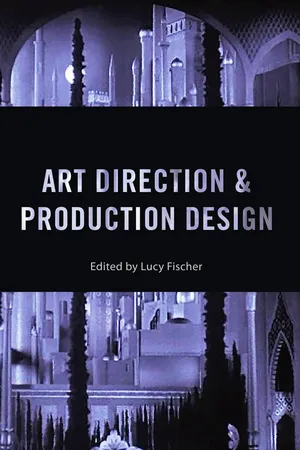
How is the look of a film achieved? In Art Direction and Production Design, six outstanding scholars survey the careers of notable art directors, the influence of specific design styles, the key roles played by particular studios and films in shaping the field, the effect of technological changes on production design, and the shifts in industrial modes of organization.
The craft’s purpose is to produce an overall pictorial “vision” for films, and in 1924 a group of designers formed the Cinemagundi Club—their skills encompassed set design, painting, decoration, construction, and budgeting. A few years later, in recognition of their contributions to filmmaking, the first Academy Awards for art direction were given, a clear indication of just how essential the oversight of production design had become to the so-called majors. The original essays presented in Art Direction and Production Design trace the trajectory from Thomas Edison’s primitive studio, the Black Maria, to the growth of the Hollywood “studio system, ” to the influence of sound, to a discussion of the “auteur theory, ” and to contemporary Hollywood in which computer-generated imagery has become common. By 2000, the Society of Motion Picture Art Directors became the Art Directors Guild, emphasizing the significance of the contributions of art direction and production design to filmmaking.
Art Direction and Production Design is a volume in the Behind the Silver Screen series—other titles in the series include Acting, Animation, Cinematography, Directing, Editing and Special/Visual Effects, Producers, Screenwriting, and Sound.
- 232 pages
- English
- ePUB (mobile friendly)
- Available on iOS & Android
eBook - ePub
Art Direction and Production Design
About this book
Information
Subtopic
Film Direction & Production1
THE SILENT SCREEN, 1895–1927
Lucy Fischer
This chapter considers American production design during the major years of the silent era. However, before starting, the first thing that must be acknowledged is that currently we have only a fraction of the films produced at our disposal. As a recent Library of Congress survey indicates, “Of the nearly 11,000 silent feature films made in America between 1912–30 . . . only 14 percent still exist in their original format.” Of those, about 11 percent take the form of “foreign versions or . . . lower-quality formats.” Despite this handicap, enough films are in circulation to allow us to outline the broad configurations of the period, starting with the birth of cinema in 1896.1
Early Production Design: The East Coast and the Edison Manufacturing Company
To call the creation of scenery for the first films made by U.S. companies “art direction” (or perhaps even to use the term mise-en-scène) would be to invest the enterprise with delusions of grandeur. For the most part, few records exist documenting how such sets were fashioned or by whom; and, clearly, in the early years, the film sets were minimal, functional, and unremarkable—to the extent that they existed at all. Furthermore, the films themselves did not yet include credits for art direction or many other production tasks.2
As we know, the first “studio” was that of Thomas Alva Edison and was called the Black Maria (allegedly because it looked like a police patrol wagon of that name). It was built in 1892 on the grounds of Edison’s research laboratory in West Orange, New Jersey, founded in 1887.3 Construction of the Black Maria cost a total of $637.67. It was fifty feet long and thirteen feet wide and its walls were covered in black tarpaper.4 It had a roof that could be opened to admit daylight for illumination, and the entire structure revolved so as to gain access to the sun as it shifted in the sky. Given the historic and originary role of Edison in early film history, his company’s production serves as a case study for this era.
The first films shot in the Black Maria were deposited for copyright at the Library of Congress in August 1893 by W.K.L. Dickson (Edison’s assistant and the man who produced or shot many of his early films). Originally, the films (photographed by Edison’s Kinetograph camera) were made for his Kinetoscope (a peep-show machine) but later for his Vitascope projector. The earliest film for which there is documentation is Record of a Sneeze (1894) “performed” by an Edison employee, Fred Ott. All told, Dickson and cameraman William Heise filmed over seventy-five motion pictures during the year 1894.
Given that we have very little by way of “production history” for these films (aside from Charles Musser’s masterful and encyclopedic Before the Nickelodeon: Edwin Porter and the Edison Manufacturing Company), we often have to glean information from the cinematic texts themselves. Like many other one-minute works from the Black Maria, Record of a Sneeze is shot against a black background (presumably the walls of the studio). This is also the case for Sandow (1894), depicting a strongman, and Carmencita (1894), depicting a Spanish dancer. Fatima (1897) varies the mise-en-scène a bit by having its subject perform against a backdrop of painted scenery. Some films of this period were hand-colored—like Annabelle Serpentine Dance (1895), decorated with patches of yellow. This clearly adds a post-production element to filmic design. Certainly, even from an early stage, the image of Woman in film was associated with ornamentation.
Interestingly, in A Morning Bath (1896), depicting (according to the Edison catalog) a “mammy” washing her “little pickaninny,” instead of the standard dark background, there is a white one—a change that must have been made in order to ensure that the black woman would be seen.5 A similar strategy was employed for Watermelon Eating Contest (1896), featuring a competition between two black men. These remain rare exceptions to the dark background “rule”; but, of course, few people of color were photographed in this period.
There were films shot at the Black Maria that had a minimal degree of “scenery.” For Annie Oakley (1894), for instance, a target is hung on the wall so we can see the results of her marksmanship (as disks fall to the ground). In Chinese Laundry Scene (1895), an unconvincing theatrical “flat” (with doors that open and close) serves as the site of a chase between a cop and a Chinese man. In Seminary Girls (1897), we view the semblance of a more three-dimensional room (which includes several beds, a nightstand with a wash basin and water pitcher) in which young women in nightgowns have a pillow fight. More elaborate scenery is involved in What Demoralized the Barber Shop (1898), which not only reproduces a basement salon (with haircutting chairs, cabinets, wall signs, and shaving tools) but includes a flight of stairs with a window above through which we can see the legs of several passing women—a sight that throws the male shop customers into paroxysms. Finally, scenery is used in a film that stars Edison himself. In Mr. Edison at Work in His Chemical Laboratory (1897), the inventor is shown amid shelves of jars, puttering with some beakers at a table. According to the Edison catalog (which wrongly implies that Edison was simply “caught in the act”):
This film is remarkable in several respects. In the first place, it is full life-size. Secondly, it is the only accurate recent portrait of the great inventor. The scene is an actual one, showing Mr. Edison in working dress engaged in an interesting chemical experiment in his great Laboratory. There is sufficient movement to lead the spectator through the several processes of mixing, pouring, testing, etc. as if he were side by side with the principal. The lights and shadows are vivid, and the apparatus and other accessories complete a startling picture that will appeal to every beholder.
While many films were shot in the Black Maria, others were photographed outdoors. The Burglar on the Roof (1898) appears to be shot atop an actual building. Here, Edison incorporates the location shooting he honed in actualities such as Herald Square (1896), American Falls from Above, American Side (1896), Stanford University, California (1897), or Freight Train (1898) into his short fiction works.
The Work of Edwin Porter
According to Musser, Edison decided as early as 1900 that he needed a more advanced studio in order to be competitive in the growing industry. He rented space at 41 East Twenty-first Street (in New York’s entertainment district) and, by February 1901, opened a glass-enclosed rooftop studio that provided more protection from the weather than had the Black Maria (which was then closed). The new location gave Edison Studio an advantage over Biograph and Vitagraph, which still maintained open-air facilities. Edwin Porter, Edison’s major director (who was hired in 1900), bragged that he had been given control of “the first skylight studio in the country.”6 It could, however, only accommodate one stage set at a time7—though, as Marc Wanamaker notes, a set was often only a “wood platform with cloth sun diffusers draped above . . . with the walls . . . merely painted flats propped up by braces.” Much, however, could be accomplished in this fashion (including trompe l’oeil) since “everything that could be painted was painted—wall hangings, artworks, furniture and rugs. Every material was imitated from brick, tile, plaster and stucco to stone, wood and all sorts of paneling.” As Wanamaker remarks: “Rubber could be molded and made into bricks or tiles. Resin could be used for prop making, and foam could stand in for rocks.” For further effect, backdrops were frequently used to depict landscapes or city views as seen outside a window.8 By the time that Edison’s New York City studio opened, George S. Fleming had been hired as scenic designer; he started working for the company in January and earned more than Porter.9
Almost immediately one senses greater sophistication in the visual style of the short films produced in the new facility (under Porter’s purview). In The Old Maid Having Her Picture Taken (1901, co-directed by Fleming),10 we find a more three-dimensional set (including several chairs and a prop camera) as well as more set “decoration” in the form of a mirror, a clock, and a wall picture display—all of which will be destroyed in the narrative by dint of the matron’s homeliness. Quite elaborate, though highly theatrical sets (reminiscent of stage melodrama) are used in Jack and the Beanstalk (1902, Porter, co-directed by Fleming).11 The film opens by depicting a mill with faux water flowing. Like most of those to come, the set is somewhat three-dimensional (though a focus on this feature would not truly come into play until the advent of camera movement, which made it a necessity). After a fairy appears and Jack trades a cow (a man in comic costume) for magic beans, he plants them and a prop vine begins to grow to the top of the frame. When we next see Jack asleep in his room, we notice that the set is not completely flat but has corners. When he awakens and finds the vine outside, he climbs to a plateau where a painted background displays the tops of mountains. In a later shot, the fairy reappears (sitting on a crescent moon) and, through a special effect, a circular matte opens center frame depicting a (painted) castle. This is the abode of the ogre from whom Jack will steal a chicken and some gold. When Jack descends the vine to return home, a fairy magically transforms him into a prince and the film ends with an elaborate tableau of women posed in a wondrous fairyland. Clearly, in its look, use of a female figure, and magical actions, the work resembles the féerie films of Pathé and Star Films (the company of Georges Méliès). Models are employed for Spanish ships glimpsed in the background in Sampson-Schley Controversy (1901) and for the steamboat race between the Natchez and the Robert E. Lee in Uncle Tom’s Cabin (1903). Miniatures are used for an animated bed in Dream of a Rarebit Fiend (1906) and a burning house in Kathleen Mavourneen (1906).12
A particularly interesting case of filmic design occurs in European Rest Cure (1904) because of its mixture of location and studio shooting. The film, which chronicles the mishaps of a man on a European vacation tour, opens with real scenes of the New York City harbor as the protagonist walks up an ocean liner’s gangway. Real crowds are seen to wave our hero off. Furthermore, we view documentary shots of the New York City skyline as seen from the moving ship. But these are the last location images we get until the final shot of the film in which the man returns home (more harried and bruised than when he left) and is picked up by a horse and buggy. In between we see rather elaborate theatrical-type sets (in which he stands on a concealed stage, with foreground and background flats augmenting the space) representing such things as touring Paris (shown in a café set), climbing the pyramids (depicted with the Sphinx behind him), being robbed by thieves in Italy (shown with ruins in the background), or taking a mud bath in Germany (sitting in a real tub in a faux landscape). The contrast between the actuality shots of New York (where Edison was located) and the stagey sets of places to which his crew failed to travel is extreme and unsettling to us, but probably more palatable to the viewer of 1904.
After some six years in the new studio, Edison again decided to upgrade facilities. This time he built an indoor, glass-roofed building on Decatur Avenue and Oliver Place in the Bronx—one that also had ample glass windows to provide daylight. The production crew arrived in July of 1907.13 In the interim there had been some staff changes. Fleming left in April 1903 and was replaced by scenic painter William Martinetti, who earned as much as Porter.14 However, a few months after moving to the Bronx studio Martinetti was replaced by set designer Richard Murphy.15 It is after this that the New York Dramatic Mirror stated that “Edison pictures are noted for elaborate scenic productions and the artistic beauty of the scenes, whether natural or painted interiors.”16
A visitor to the Edison facility writing in the Film Index talked about its having a property room (supervised by W. J. Gilroy), which included “18 Springfield rifles and a small armory of other weapons, toys, Roman togas, fairy costumes” and “figures, eagles, and so on.” As for the sets, the author writes:
The scenes painted under Mr. Stevens’ direction by the scenic artists, are in distemper—that is, they use only blacks, browns and whites, with the varying shades of these, as photographs do not take color as color, but only suggest it. Houses or block scenery are built up and the stands and wings constructed as in a theatre, only with much more attention to details and naturalness. For the camera, unlike the eye, can not be easily deceived. “Staginess” is avoided and realism is in every c...
Table of contents
- Cover
- Series Page
- Title Page
- Dedication
- Copyright
- Contents
- Acknowledgments
- Introduction
- 1. The Silent Screen, 1895–1927
- 2. Classical Hollywood, 1928–1946
- Color Plates
- 3. Postwar Hollywood, 1947–1967
- 4. The Auteur Renaissance, 1968–1980
- 5. The New Hollywood, 1981–1999
- 6. Hollywood’s Digital Back Lot, 2000–Present
- Academy Awards for Best Art Direction
- Notes
- Selected Bibliography
- Notes on Contributors
- Index
Trusted by 375,005 students
Access to over 1.5 million titles for a fair monthly price.
Study more efficiently using our study tools.
Frequently asked questions
Yes, you can cancel anytime from the Subscription tab in your account settings on the Perlego website. Your subscription will stay active until the end of your current billing period. Learn how to cancel your subscription
No, books cannot be downloaded as external files, such as PDFs, for use outside of Perlego. However, you can download books within the Perlego app for offline reading on mobile or tablet. Learn how to download books offline
Perlego offers two plans: Essential and Complete
- Essential is ideal for learners and professionals who enjoy exploring a wide range of subjects. Access the Essential Library with 800,000+ trusted titles and best-sellers across business, personal growth, and the humanities. Includes unlimited reading time and Standard Read Aloud voice.
- Complete: Perfect for advanced learners and researchers needing full, unrestricted access. Unlock 1.5M+ books across hundreds of subjects, including academic and specialized titles. The Complete Plan also includes advanced features like Premium Read Aloud and Research Assistant.
We are an online textbook subscription service, where you can get access to an entire online library for less than the price of a single book per month. With over 1.5 million books across 990+ topics, we’ve got you covered! Learn about our mission
Look out for the read-aloud symbol on your next book to see if you can listen to it. The read-aloud tool reads text aloud for you, highlighting the text as it is being read. You can pause it, speed it up and slow it down. Learn more about Read Aloud
Yes! You can use the Perlego app on both iOS and Android devices to read anytime, anywhere — even offline. Perfect for commutes or when you’re on the go.
Please note we cannot support devices running on iOS 13 and Android 7 or earlier. Learn more about using the app
Please note we cannot support devices running on iOS 13 and Android 7 or earlier. Learn more about using the app
Yes, you can access Art Direction and Production Design by Lucy Fischer in PDF and/or ePUB format, as well as other popular books in Media & Performing Arts & Film Direction & Production. We have over 1.5 million books available in our catalogue for you to explore.