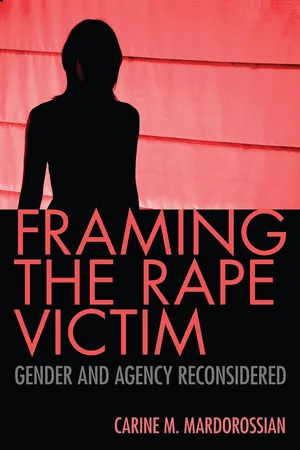
Winner of the 2016 Nonfiction Category from The Authors' Zone In recent years, members of legal, law enforcement, media and academic circles have portrayed rape as a special kind of crime distinct from other forms of violence. In Framing the Rape Victim, Carine M. Mardorossian argues that this differential treatment of rape has exacerbated the ghettoizing of sexual violence along gendered lines and has repeatedly led to women’s being accused of triggering, if not causing, rape through immodest behavior, comportment, passivity, or weakness. Contesting the notion that rape is the result of deviant behaviors of victims or perpetrators, Mardorossian argues that rape saturates our culture and defines masculinity’s relation to femininity, both of which are structural positions rather than biologically derived ones. Using diverse examples throughout, Mardorossian draws from Hollywood film and popular culture to contemporary women’s fiction and hospitalized birth emphasizing that the position of dominant masculinity can be occupied by men, women, or institutions, while structural femininity is a position that may define and subordinate men, minorities, and other marginalized groups just as effectively as it does women. Highlighting the legacies of the politically correct debates of the 1990s and the terrorist attacks of 9/11, the book illustrates how the framing of the term “victim” has played a fundamental role in constructing notions of agency that valorize autonomy and support exclusionary, especially masculine, models of American selfhood. The gendering of rape, including by well-meaning, sometimes feminist, voices that claim to have victims’ best interests at heart, ultimately obscures its true role in our culture. Both a critical analysis and a call to action, Framing the Rape Victim shows that rape is not a special interest issue that pertains just to women but a pervasive one that affects our society as a whole.
- 178 pages
- English
- ePUB (mobile friendly)
- Available on iOS & Android
eBook - ePub
Framing the Rape Victim
About this book
Information
1. Framing the Victim
Frames are mental structures that shape the way we see the world. As a result, they shape the goals we seek, the plans we make, the way we act, and what counts as a good or bad outcome of our actions. In politics, our frames shape our social policies and the institutions we form to carry out policies. To change our frames is to change all of this. Reframing is social change. . . . Reframing is changing the way the public sees the world. It is changing what counts as commonsense. Because language activates frames, new language is required for new frames. Thinking differently requires speaking differently.
—George Lakoff, Don’t Think of an Elephant!
This chapter uses two examples to illustrate how the concept of “victim” in U.S. culture has been framed in discussions that either directly or indirectly pertain to rape. Both events took place in 2004. The first, a particular response to the tragic events of 9/11, is metaphorically linked to sexual violence. The second, the Kobe Bryant rape case, focuses on the legal developments that surrounded a literal case of alleged sexual violence. Both “current events” reveal the hermeneutics of suspicion through which the term “victim” has been framed over the last two decades and the reactionary consequences of this discursive development. They highlight how the critical devaluing of the term “victim” today is represented as a salutary response to previously unreflexive yet ideologically loaded endorsements of the concept. Whereas the underlying assumption in both cases is that the critical assessment of the term “victim” that currently prevails in both the academy and the media corrects the ideological bias that previously defined appropriations of the term, I show how the negative devaluing of the term is itself part of an ideological agenda whose parameters can be traced back to the 1990s political correctness debates. The current distancing trend in discussions of victimization and sexualized violence is no less saturated with a strategic and reappropriative ideology because it is critical. Rather, I argue that far from representing a freeing from ideology, it is actually a reflection of the backlash against the substantial gains made by minority groups over the last few decades.
At the end of March 2004, Karen P. Hughes, one of George W. Bush’s longest-serving and closest advisers, began a sixteen-city tour promoting her book Ten Minutes from Normal, an account of her life as the president’s most trusted employee. Hughes, who had retired from service in 2002, was such a key member of President Bush’s team that in 2005 she was asked to return to office as undersecretary of state for public diplomacy and public affairs, a position created in an attempt to change foreigners’ negative perceptions of the United States. During her 2004 tour, she appeared on numerous TV and radio shows, where her hosts seemed invariably keen on having her discuss the same passage from her memoir, namely the one describing her reaction to 9/11. As she explains in the book, when the time came for the president to give his first speech to the nation after the tragedy, Hughes insisted that he not describe the event in the terms that had been originally planned. To quote Hughes, “When [Ari Fleishman] read it, the first line made me apoplectic: ‘America today was the victim of. . . .’ ‘We are not victims,’ I interrupted, ‘we may have been attacked but we are not victims.’ Ari agreed, and put [White House communications director] Dan [Bartlett] on the phone” (2004, 238). The sentence was subsequently altered to “America today was under attack,” a change that elicited the approval of every radio host and—we can only surmise—listener during Hughes’s interviews.
This example powerfully illustrates the problematic status “victim” has come to occupy in the United States since the 1990s, a status that has everything to do with how the term operates as a representation. In rejecting the term “victim,” Hughes is not suggesting that the United States was not actually the victim of a terrorist attack or that there were no casualties as a result of it. What is at stake in her visceral reaction is how the language might represent the United States as a shamed victim. She is concerned not with the event itself but with the framing of the event in relation to a crisis that was very much perceived and repeatedly cast as a metaphorical form of sexual violence. In light of the fact that 9/11 was a tragedy for which, significantly, the crime of rape served as the “central paradigm for framing events” (Cole 2008, 118; Hawkesworth 2005, 132), it is not surprising that for Hughes, the negative connotations and stigma attached to the concept of victim would similarly taint the target of violence (the United States) rather than its source (the terrorists) in relation to the national tragedy. In other words, Hughes is echoing an understanding of the term “victim” that the political correctness debates of the 1990s turned into common usage and that the response to rape further popularized, namely as the “perception of one who is weak and was overcome or manipulated by an external source possibly due to his/her own negligence or helplessness” (Andrews quoted in Underwood and Edmunds 2002, 5–6). These negative connotations are compounded in cases that are metaphorically or literally associated with sexual violence, a crime for which victim-blaming attitudes are the norm. By insisting that “we [Americans] are not victims,” Hughes thus challenges what was once a tautology, namely that any innocent bystander who is killed in the course of an attack is indeed a legitimate victim, and instead adopts an understanding of the term “victim” as a sign of “individual powerlessness over internal resources and a dependence on others to rectify the situation” (ibid.). She thus embraces a view that reveals the incompatibility of the concept with the U.S. nation and U.S. nationalism. Victims are what the United States and its inhabitants cannot be. That is, victimhood is a condition in opposition to which American identity is defined. Americans help victims, they do not become victims. They may identify with but not as victims.
George Lakoff describes the process that defines what counts as “commonsense” as “framing.” The listeners’ and radio hosts’ tacit approval of Karen Hughes’s rejection of the term “victim” illustrates the kind of “commonsensical” framing of the term Lakoff evokes. Not once was Hughes asked to explain why saying that the United States was “the victim of a terrorist attack” was such an outrageous statement. Not once did the callers ask why people who are killed by a terrorist act are not actually victims. The unavowed logic behind Hughes’s reaction works at the level of her listeners’ collective “cognitive unconscious,” that is, at the level of the “structures in our brains that we cannot consciously access, but know by their consequences: the way we reason and what counts as commonsense” (Lakoff 2004, xv). To Hughes and her listeners, the use of the word automatically suggests an acceptance of defeat and an internalization of failure that are highly gendered and are taken for granted when the term “victim” is used. These associations have now become “simply” incompatible with the myth and “imaginary community” of the nation.
The release of Hughes’s book in 2004 coincided with another current event that showcased a similar rhetorical debate surrounding the concept of victimization. This time, the debate took place in the country’s courts, and it was about a literal rather than metaphorical case of sexualized violence. During the 2004 legal proceedings of the rape trial against the NBA superstar Kobe Bryant, “victim” was the “identity” that, ironically, both the defendant and the accuser were claiming best defined their status in court. In an effort to shift the blame from the basketball star to his accuser, defense attorney Hal Haddon argued that referring to the female plaintiff as a victim would impair jurors’ ability to consider evidence impartially. He insisted that its use would necessarily inculpate their client as the agent behind the deed while denying the accuser’s own sexual agency: “Until Mr. Bryant is acquitted, he is a victim, or at least, arguably is.” Judge W. Terry Ruckriegle granted the defense’s request and ruled that Bryant’s alleged victim could no longer be called “victim.” She had to be referred to by name in the courtroom and as a “person” in jury instructions. Bryant’s team of attorneys also asked the judge to prohibit use of the term “defendant” in reference to the Lakers’ guard, but Ruckriegle rejected that request, because, he thought, the term “defendant” was “an accurate reflection of his legal status” (Cypher 2004).
As Cynthia Stone, a spokeswoman for the Colorado Coalition Against Sexual Assault, noted at the time, this was the first time that what the judge had termed “this semantic debate” had ever become an issue in the courtroom, since until this case, the term victim had been routinely used in the criminal justice system “where legalistic definitions of victim and offender are an important aspect of the system’s functions” (Underwood and Edmunds 2002, 6). However, according to Larry Pozner, former president of the National Association of Criminal Defense Lawyers, this terminology fight was a major issue that went beyond semantics: “In a courtroom, only a jury can decide whether she’s a victim and to call her a victim is to prejudice the jury,” he said. “Only when a jury decides guilt or innocence will her status be decided” (quoted in Cypher 2004). Whether one thinks this semantic dispute is well grounded or not, it shows the discursive power the term “victim” has accrued in the eyes of most Americans today, so much so that routine court proceedings have been altered in reaction to it. In other words, a word that was consistently and inconspicuously used in court is now ascribed an ideological power it never previously had. In what seems like a symptom of what Joan Didion means by magical thinking in her book The Year of Magical Thinking, it is as if the mere use of the term has the power to influence decision making and make things happen.1 Or, to borrow De Lauretis’s terms, it is as if the court suddenly and selectively became aware that the rhetoric of violence may entail the violence of rhetoric, that violence is “engendered in representation” (De Lauretis 1985, 33). Most importantly, however, Bryant’s defense lawyers rejected its use because in questioning the woman’s status as a victim, they corroborated her representation as a sexual agent; that is, a consenting adult whose promiscuity they sought to emphasize through repeated references to her past and subsequent sexual relationships.
Whether we believe, as Bryant’s attorney intimated during the trial, that the white nineteen-year-old’s accusation stemmed from a history of “black men hav[ing] long been falsely accused of rape by white women” (Associated Press 2004) or rather, that Bryant did occupy the position of dominant “white” masculinity in relation to a girl whose class, age, and gender subordinated her to him,2 the mobilization of the agent/victim opposition as a way of undermining rape allegations by the prosecution reveals the contextualized ways that the term “victim” gains visibility as an ideologically loaded word in the twenty-first century. It also echoes Hughes’s visceral and categorical refusal to refer to the U.S. nation as “victim of” a terrorist attack. Hughes’s reaction stemmed from her unwillingness to conceive the United States as both agent and victim. Victimization was incompatible with her view of the United States as a superpower.
It is no coincidence that both of these incidents took place in 2004, the year of the first presidential campaign after 9/11. Presidential races are transitional times when nationalist narratives become magnified, rhetorical strategies surrounding national identity gain visibility, and discursive patterns and structures of feeling are elaborated, refined, repeated, crystallized, and revised for the voting public’s benefit. During the 2012 presidential campaign, for instance, rape was again brought to the forefront of political discussions and became a primary way Republicans and Democrats distinguished their political agendas from one another. When Congressman Todd Akin (Missouri’s 2nd District) claimed that rapes that were “legitimate” would not lead to pregnancy because the woman’s body has a way of “shut[ing] down the whole thing” through a stress response, or when Indiana’s senatorial candidate Robert Mourdock claimed that a pregnancy after rape was “something that God intended to happen,” these comments soon stopped being “a few errant remarks from insensitive politicians” (Filipovic 2012) and became part of a political platform that repeatedly reinforced the view of women as passive vessels of God’s will or man’s sperm.3 Other comments included Wisconsin state representative Roger Rivard’s assertion that “some girls rape easy”; Tennessee state senator Douglas Henry’s comment that “rape, ladies and gentlemen, is not today what rape was. Rape, when I was learning these things, was the violation of a chaste woman, against her will, by some party not her spouse”; Republican activist Phyllis Schlafly’s declaration that marital rape doesn’t exist; and South Dakota Republican Bill Napoli’s contention that “[a] real-life description to me would be a rape victim, brutally raped, savaged. The girl was a virgin. She was religious. She planned on saving her virginity until she was married” (quoted in Filipovic 2012). On 23 January 2013, the Republican lawmaker and state representative in New Mexico, Cathrynn Brown, introduced House bill 206, which would have legally required victims of rape to carry their pregnancies to term in order to use the fetus as evidence for a sexual assault trial. This bill would have charged a rape victim who ended her pregnancy with a third-degree felony for “tampering with evidence” (Bassett 2013). Last but not least, on 1 March 2013, Celeste Greig, the president of the conservative California Republican Assembly, the state’s oldest and largest GOP volunteer organization, and the person Ronald Reagan once called it “the conscience of the Republican Party,” told the San Jose Mercury News that pregnancies by rape are rare “because it’s an act of violence, because the body is traumatized” (quoted in Harmon 2013).4 These examples powerfully show how central rape has become to this country’s cultural narratives about agency and identity.
The narratives of gender identity and social meaning that are constructed around sexual victimization “speak” to voters from all walks of life and are, during election time, routinely appropriated by both the left and the right. During the 2004 presidential campaign, both Republicans and Democrats deployed a strikingly similar narrative in their attempts to convince voters that their party was the most adept at protecting America in the War on Terror. Ironically, at a time when the United States had actually become the victim of a terrorist attack, politicians and presidential candidates from both parties became most keen to distance the country and its citizens from the concept of victimization. Drawing on the anti-victimist discourses that had been popularized during the previous decade, both Republicans and Democrats sought to portray themselves as masculine heroes rather than feminized victims. Bush was represented as the “cowboy” president Ronald Reagan had made popular in the 1980s, while Democrats worked hard to convince Americans that their candidate was the real man “reporting for duty” (Cole 2008, 123). In the context of the War on Terror, the concept of victim came to be mobilized as the condition and representation to mistrust, vilify, abhor, and reject. It is no surprise, then, that one of the legacies of such a rhetorical development is that in the 2012 campaign, politicians no longer had any qualms about publicly and repeatedly making demeaning remarks about rape victims or trying to withdraw heretofore unquestioned bipartisan legal protections reserved for victims of violence. The Violence Against Women Act (VAWA), which was enacted in 1994 to provide greater legal protections and other services to survivors of domestic violence and their families, had passed the House of Representatives uncontested for nearly twenty years, but in January 2013 it expired due to bipartisan gridlock. One could argue that in the aftermath of the War on Terror, the word “victim” simply became pure rhetoric with no content.
The trope of sexual(ized) violence in the United States is now mediated by neoconservative configurations of victimization that work to obscure the gendered and correlatively racialized dimensions of forms of violence. The meaning of the term “victim” over the last few decades has undergone significant rhetorical and ideological developments that have affected victims along deeply gendered and racialized lines. Specifically, since the terrorist attacks on the World Trade Center on 9/11, a renewed sociocultural shift toward a neoconservatism that was initiated in the 1980s has consolidated the view that the United States has been emasculated and its sovereignty rendered vulnerable to attack. In this discursive space, victimhood no longer functions as a political category that can be successfully deployed to support the adoption of policy and law reforms but rather as one that the neoconservative media has successfully reframed as a sign of moral weakness and self-generated failure.
The discursive and ideological processes involved in demarcating “good” and “bad” victims in U.S. culture work, I argue, to reinforce hierarchical relations based on raced, gendered, and classed power. To expose these processes and bridge the divide between representation and reality in representations of sexualized violence requires a contextualization and historical analysis of the anti-victimist stance that has defined discussions of rape. The Hughes and Bryant examples, which mobilize rape as a metaphor on the one hand and as a crime on the other, are cases in point. Significantly, both instances mobilize a particular devaluation of victimhood that has entered the realm of “commonsense” in the U.S. national consciousness.
The Devaluing of Victimhood
To fully understand the negative connotations associated with the concept of victim in the United States today, we need to look back at the “political correctness” debates of the 1990s from which they derive. The last decade of the twentieth century witnessed the emergence of a virulent anti-victimist discourse, notably with the publication of Richard Bernstein’s essay “Ideas and Trends: The Rising Hegemony of the Politically Correct” in an October 1990 issue of the New York Times. The article marked the emergence of the term of “political correctness” in public discourse and the beginning of a rampant devaluation and degendering of victimhood and minority claims in the mainstream. Dinesh D’Souza’s attack on the “victim revolution” (1992) on university campuses was probably one of the most popularized versions of this discourse, and both higher education and radical feminism soon became the prime target of such conservative criticisms. In Tenured Radicals (1990), for instance, Roger Kimball (1990) singled out radical feminism for promoting special interests that were antithetical to the acquisition of the kind of core and universal knowledge needed to shape the future citizens of a modern democracy. Similarly, for Ellen Klein (1998), academic feminism constituted a threat to rigorous scholarship, while Carolyn Mooney (1988) echoed a large number of conservative commentators when she accused feminists of having abandoned rational thought in favor of their own political agenda. As Alyson Convery notes, “Feminist ideas were positioned at the very foundations of the edifice labeled ‘political correctness.’ What has to be stressed here is that these critics created the very entity that they attributed to feminist and other politically progressive theorists. The ‘political correctness’ code emerged as a mechanism for undermining minority challenges to the status quo, firstly by discursively collapsing all claims of disadvantage as being about victimhood and victimization (whether or not such claims were couched in precisely these terms), and then by devaluing victimhood as a morally, and not just a practically, reduced state” (2011, 6).
Convery’s analysis highlights the enduring and homogenizing effect of the encoding strategies of politically correct discourses over the last two decades. Not only is invoking the term “victim” enough to trigger negative and devaluing connotations about a person, but all self-proclaimed victims are now subjected to disapproval (at best) or distrust and condemnation (at worst). The “innocent” victim of the past can now only ever be the victim who rejects ...
Table of contents
- Title Page
- Copyright Page
- Dedication
- Contents
- Acknowledgments
- Introduction
- 1. Framing the Victim
- 2. Rape and Victimology in Feminist Theory
- 3. “Birth Rape”: Laboring Women, Coaching Men, and Natural Childbirth in the Hospital Setting
- 4. Prison Rape, Masculinity, and the Missed Alliances of Hollywood Cinema
- 5. Rape by Proxy in Contemporary Diasporic Women’s Fiction
- Conclusion
- Notes
- Works Cited
- Index
- About the Author
Trusted by 375,005 students
Access to over 1.5 million titles for a fair monthly price.
Study more efficiently using our study tools.
Frequently asked questions
Yes, you can cancel anytime from the Subscription tab in your account settings on the Perlego website. Your subscription will stay active until the end of your current billing period. Learn how to cancel your subscription
No, books cannot be downloaded as external files, such as PDFs, for use outside of Perlego. However, you can download books within the Perlego app for offline reading on mobile or tablet. Learn how to download books offline
Perlego offers two plans: Essential and Complete
- Essential is ideal for learners and professionals who enjoy exploring a wide range of subjects. Access the Essential Library with 800,000+ trusted titles and best-sellers across business, personal growth, and the humanities. Includes unlimited reading time and Standard Read Aloud voice.
- Complete: Perfect for advanced learners and researchers needing full, unrestricted access. Unlock 1.5M+ books across hundreds of subjects, including academic and specialized titles. The Complete Plan also includes advanced features like Premium Read Aloud and Research Assistant.
We are an online textbook subscription service, where you can get access to an entire online library for less than the price of a single book per month. With over 1.5 million books across 990+ topics, we’ve got you covered! Learn about our mission
Look out for the read-aloud symbol on your next book to see if you can listen to it. The read-aloud tool reads text aloud for you, highlighting the text as it is being read. You can pause it, speed it up and slow it down. Learn more about Read Aloud
Yes! You can use the Perlego app on both iOS and Android devices to read anytime, anywhere — even offline. Perfect for commutes or when you’re on the go.
Please note we cannot support devices running on iOS 13 and Android 7 or earlier. Learn more about using the app
Please note we cannot support devices running on iOS 13 and Android 7 or earlier. Learn more about using the app
Yes, you can access Framing the Rape Victim by Carine M. Mardorossian in PDF and/or ePUB format, as well as other popular books in Social Sciences & Gender Studies. We have over 1.5 million books available in our catalogue for you to explore.