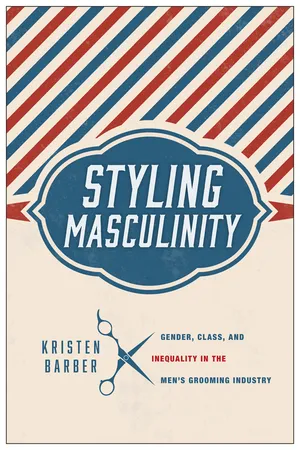
The twenty-first century has seen the emergence of a new style of man: the metrosexual. Overwhelmingly straight, white, and wealthy, these impeccably coiffed urban professionals spend big money on everything from facials to pedicures, all part of a multi-billion-dollar male grooming industry. Yet as this innovative study reveals, even as the industry encourages men to invest more in their appearance, it still relies on women to do much of the work. Styling Masculinity investigates how men’s beauty salons have persuaded their clientele to regard them as masculine spaces. To answer this question, sociologist Kristen Barber goes inside Adonis and The Executive, two upscale men’s salons in Southern California. Conducting detailed observations and extensive interviews with both customers and employees, she shows how female salon workers not only perform the physical labor of snipping, tweezing, waxing, and exfoliating, but also perform the emotional labor of pampering their clients and pumping up their masculine egos. Letting salon employees tell their own stories, Barber not only documents occasions when these workers are objectified and demeaned, but also explores how their jobs allow for creativity and confer a degree of professional dignity. In the process, she traces the vast network of economic and social relations that undergird the burgeoning male beauty industry.
- 258 pages
- English
- ePUB (mobile friendly)
- Available on iOS & Android
eBook - ePub
Styling Masculinity
About this book
Information
1
Men and Beauty
The Historical Expansion of an Industry
The metrosexual burst into popular discussions of men’s bodies in 1994. British journalist Mark Simpson coined the term in an effort to capture what he saw as a new heterosexual masculinity, one rooted in consumption and vanity. He suggested that it is not just women whose gender identities are cultivated through the production of a beautiful self, but rather that there is a growing consciousness among especially straight, class-privileged men to the pleasures of dabbling in cosmetics and shopping, and in showing off their corporeal assets. Soccer star David Beckham has become the poster boy for metrosexuality. He is at the same time Emporio Armani underwear model, retired soccer star, father of four, and husband to Victoria Beckham, the popstar famously known as Posh Spice. In an opinion piece for CNN.com, journalist Ellis Cashmore noted that Beckham “wore a sarong, a headscarf, nail varnish, adorned his body with tattoos and changes his expertly coiffured hair-do practically every week . . . And yet his masculinity was never in doubt.”1 Olympic swimmer and ladies’ dude Ryan Loctche happily admits to spending four to five hours at a time manscaping, shaving his entire body with a hefty, gold-plated razor that looks as if it came out of Liberace’s medicine cabinet.2 At the same time Simpson captures the growing trend of marketing men’s bodies and products, though, he also gives the misimpression that men’s interest in fashion and beauty is a recent phenomenon.
Men have long fretted over their appearances and gone to great lengths to cultivate their embodiments. Julius Caesar, for instance, wore his signature ceremonial wreath to hide the fact that he was balding. Roman men often kept themselves clean-shaven, stopping in the public square where a barber was on hand to whip the stubble from their chins.3 Hannibal, a Carthaginian commander who defeated the Romans, waged war while wearing a wig. He also “kept a second one on hand for social occasions.”4 Hair and the lack thereof is just one aspect of embodiment that has long triggered anxiety and self-consciousness in men. And while Western ideological attachment to individualism suggests men’s body projects grow out of and reflect personal internal self-doubt, these tensions are connected to larger cultural expectations of masculine embodiments and the organization of social relations.
We tend to think men’s participation in beauty brings them closer to women; yet class and race have significantly shaped men’s grooming habits and the meanings of their embodiments throughout history. Today, white men who work construction may tout their weathered skin as a symbol of “real” laborious masculinity,5 and professional-class white men seek out stylish haircuts that distinguish them from and above working-class masculinity.6 The growing consumer culture has created new means by which men can purchase and groom their way into status groups, aligning themselves with particular class, racial, gender, and sexual locations. So although well-to-do men have long fussed over their appearances, what Simpson captures are the ways masculinity is now marketed back to men in a commercialized, post-industrial U.S. and Western Europe.
Men’s consumer participation in the beauty industry is part of the ongoing story of men’s historical treatment of their bodies and emerges from manufacturers’ struggles to make beauty consumption synonymous with men’s identities. While beauty entrepreneurs successfully tied cosmetics to the appropriation of elite femininity in the early twentieth century,7 folding beauty services and products into culturally valorized expressions of masculinity is a more recent accomplishment. As we consider the beauty industry’s evolution to include men as a major consumer sector, it is important to understand men’s historical relationship with fashion and beauty, how the male beauty consumer has come to be, what men’s spending habits look like, what ideologies encourage these habits, and who exactly is on the frontlines to support men’s commercial grooming practices.
Men’s Fashion and Beauty
Class Status and Racial Politics
Fashion and beauty have not always served to distinguish men from women as much as they have been symbols of class. In ancient Greece, Rome, and Egypt, draped and fitted clothing marked differences between privileged and laboring classes; and in Egypt slaves were nearly naked.8 Until the eighteenth century, European men and women of nobility wore ornate and layered fabrics, including intricately designed silk and lace. They donned fine hats and heels that made them similar in height, and they wore jewels, ribbons, embroidery, makeup, and wigs. In the sixteenth century, men began wearing padding to accentuate their shoulders and legs, as well as codpieces that became more exaggerated over time. While establishing gender differences in embodied presentations, snug clothing such as tights and bejeweled blouses constrained noble men’s mobility, and codpieces eroticized these men’s bodies by drawing attention to their genitals.9
Men and women’s relationships to fashion in eighteenth-century America were similarly defined by class location. Both men and women of privileged classes wore powdered wigs with rings of curly hair, dressed in ornate fashions, and painted their faces. This was especially true for urbanites and courtiers, who used professional hairdressers and beautifying elixirs to create a body that “proclaimed nobility and social prestige.”10 The relationship between class, gender, and fashion in the West began to shift after the American Revolution, which ushered in new ways of thinking about the adorned body. Men and women began to eschew the costly artifices of fashion and instead put themselves forth as manly citizens and virtuous women.11 The rejection of an aristocratic lifestyle became a democratic project that emphasized solidarity among and uniformity across classes. Psychoanalyst John Carl Flügel referred to this politically motivated throwing off of men’s beauty regimes as the Great Masculine Renunciation.12 Attempts to be beautiful were popularly criticized as reproducing inequalities among men, and a new value on work emphasized men’s bodies as utilitarian. Republic ideals replaced bouffant masculinity and suggested men need not develop and display their authority because it resided inherently in them. Men’s grooming, however, did not disappear altogether; rather, it went underground and was unacknowledged by a discourse of non-fashion, whereby men’s appearances were considered practical rather than aesthetic.
The fashioned man reemerged in the Regency and Victorian dandies.13 A social climber, the dandy primped and preened to signal his status as an elite man and used appearance for self-creation and the expression of individual excellence. He was a man of leisure who sought the personal feeling and public recognition of distinction through the projection of aesthetic superiority and exquisite taste. He was known for spending copious amounts of time, energy, and money on grooming his body and fashioning his garments: an impeccable three-piece linen suit, a slim tailored coat, tight cuffs, a perfectly knotted silk tie, and perhaps a tall hat and black lacquered cane.14 While the dandy represented an air of aristocracy, the coexistence of the Romantic as an expression of individualism opened the door for men’s current relationships with consumption. The value of the individual rose and became tied less to character and more to the embodied expression of identity and status. “Frequently without occupation, with no regular source of income and generally no wife or family, the dandy lived by his wits,”15 and he signaled his manners and tastes by peacocking, or ostentatiously displaying his corporal assets. He exhibited the performative nature of self-creation, highlighting the fluidity of bodies and class displays. The Romantic, in contrast to the dandy, embodied individualism; and it is individualism that marks contemporary perceptions of consumption and fashion.
While historical analyses of the dandy focus on class, the dandy was also a racialized mode of masculinity. He represented and reinforced the social superiority of whiteness as pampered and privileged. Yet, the zoot suit—initially a black style of dress and later adapted by many Mexican Americans—was what fashion historian Colin McDowell refers to as the “first true dandy fashion of the twentieth century.”16 During World War II, black and Latino men wore sharply tailored and colorful suits, including high-wasted baggy pants that tapered at the ankles. The jackets were long and double-breasted with wide lapels and sharply padded shoulders. Zoot suits flew in the face of oppressive white middle-class norms and constraining community expectations for young men of color.17 Similar to the peacocking dandy, zoot suiters took pride in their appearances and were known to strut down the streets for all to admire. A sign of freedom and self-determination, zoot suits were accessorized with a felt fedora or pork pie hat and feather, French-style wingtip shoes, a shiny pocket watch, and a comb.
The politicized character of the zoot suit was salient during the 1943 Zoot Suit Riots, which first erupted in Los Angeles between white sailors and young Latino men. The riots characterized racial bigotry against Latino youth, whom the press and the police described as “hoodlums” and “gangsters.”18 The riots ignited racial tensions in other parts of the country, too, with whites’ attacks on Latinos spanning from San Diego to New York. Black and Latino men of the World War II-era showed how the fashioning of bodies can help disenfranchised groups to carve out distinct and self-valued racial and ethnic identities in moments of intense racism and xenophobia.
While class and race have long shaped how men relate to, dress, and groom their bodies, they were not marketed masculine identities back to them like we see today. Men purchased their suits and extoled a display of wealth or racial independence via tailored fabrics and particular grooming habits, but there were limits on men’s consumption. These limitations resulted in part from the sheer lack of industrial production. That is, you can’t consume what doesn’t exist. Just as my father had only a few cologne options at the back of a drugstore in the 1940s, the abundance of products designed and sold specifically to men is a recent phenomenon. But also, capitalist-based consumption has been tightly tied to the cultivation of feminine aesthetics and proper womanhood; and because culturally valorized masculinity is defined in opposition to women and femininity, it has been a longer haul for corporations to convince straight men that beauty and fashion can indeed support their gender identities. A close look at manufacturers’ historical attempts to create male consumers by marketing cosmetics, toiletries, and fashion to men reveals that masculinity is not something inherent to men but is a commercial identity they can purchase.
Making Way for the Man of Consumption
Early twentieth-century marketing research suggested men might purchase cosmetics if they saw them as something that enhanced rather than detracted from masculinity. Manufacturers rose to the challenge by evoking language they believed would appeal to men, such as advertising face powder as “talcum” or “aftershave.” In an attempt to convince men their aftershave powder was distinctly unfeminine, a 1934 Foügere Royal advertisement depicted white men in tuxedos with slicked back hair fraternizing and sipping on brandy. The byline of the ad read: “Let’s NOT join the ladies!”19 There is scattered evidence that men dabbled in cosmetics at this time, with gay men signaling sexuality via cologne or subtle makeup,20 wealthy bachelors using aftershave to express sophistication, and black and white working-class men appropriating fashion to parody the man about town. Yet magazines published few men’s grooming product advertisements in the 1930s, and companies struggled to successfully integrate cosmetic consumption into expectations of heterosexual masculinity.21
Esquire magazine emerged in 1933 in the hope of producing a leisuring, consumer-oriented, middle-class masculinity.22 As women won the right to vote and the Great Depression pushed married middle-class women into the workforce, men faced a crisis in masculinity that set the stage for manufacturers to appeal to them as consumers.23 Esquire founders David Smart and William Weintraub saw men as an untapped consumer sector and set out to convince them that differentiating themselves from women did not rest in the avoidance of shopping, but rather in what they purchased and why they shopped. Evoking misogynist rhetoric of women as frivolous shoppers who over decorate and do not know what men like, Esquire essentialized middle-class masculinity by distinguishing men’s taste from women’s. Men were to stock their wet bar with drinks other than the “fluffy, multi-colored abominations” women allegedly favored, and they were to prefer a “clean, functional, machine-base design.”24 Creating sex-categorized interests that could be demonstrated through conspicuous consumption helped to dislodge shopping from femininity and set forth a map by which men could demonstrate class-appropriate, white, masculine taste and identities via their everyday purchases.
Marketers began using women’s bodies in advertisements to further squelch men’s fears that they may be compromising their masculinity by becoming avid and loyal consumers. By sexualizing women and positioning them next to cars, or objectifying them by showing only their legs or breasts, magazines allowed men to maintain a sense of heteromasculine superiority when flipping through advertisements for slacks or pomade. Men did not have to worry about becoming like women while consuming because they could fetishize women served up to them in the glossy pages of new men’s lifestyle magazines.25 Women became both an important corporate tool in creating a confident male consumer and a large part of men’s consumer experiences. It would be another decade, though, before the social context was right to begin making grooming products a key part of men’s social identities and everyday repertoires.
Men and women’s relat...
Table of contents
- Title Page
- Copyright Page
- Dedication
- Contents
- Preface
- Acknowledgments
- Introduction
- Chapter 1. Men and Beauty: The Historical Expansion of an Industry
- Chapter 2. Rocks Glasses and Color Camo: Selling Beauty to Class-Privileged Men
- Chapter 3. Heterosexual Aesthetic Labor: Hiring and Requiring Women Beauty Workers
- Chapter 4. Hair Care: Emotional Labor and Touching Rules in Men’s Grooming
- Chapter 5. “We’re Men’s Women”: Occupational Choice Narratives of Sameness and Difference
- Conclusion
- Appendix A. Class, Gender, and the Economy in the Study of Men’s Salons
- Appendix B. Participant Demographic Information
- Notes
- Bibliography
- Index
- About the Author
Trusted by 375,005 students
Access to over 1.5 million titles for a fair monthly price.
Study more efficiently using our study tools.
Frequently asked questions
Yes, you can cancel anytime from the Subscription tab in your account settings on the Perlego website. Your subscription will stay active until the end of your current billing period. Learn how to cancel your subscription
No, books cannot be downloaded as external files, such as PDFs, for use outside of Perlego. However, you can download books within the Perlego app for offline reading on mobile or tablet. Learn how to download books offline
Perlego offers two plans: Essential and Complete
- Essential is ideal for learners and professionals who enjoy exploring a wide range of subjects. Access the Essential Library with 800,000+ trusted titles and best-sellers across business, personal growth, and the humanities. Includes unlimited reading time and Standard Read Aloud voice.
- Complete: Perfect for advanced learners and researchers needing full, unrestricted access. Unlock 1.5M+ books across hundreds of subjects, including academic and specialized titles. The Complete Plan also includes advanced features like Premium Read Aloud and Research Assistant.
We are an online textbook subscription service, where you can get access to an entire online library for less than the price of a single book per month. With over 1.5 million books across 990+ topics, we’ve got you covered! Learn about our mission
Look out for the read-aloud symbol on your next book to see if you can listen to it. The read-aloud tool reads text aloud for you, highlighting the text as it is being read. You can pause it, speed it up and slow it down. Learn more about Read Aloud
Yes! You can use the Perlego app on both iOS and Android devices to read anytime, anywhere — even offline. Perfect for commutes or when you’re on the go.
Please note we cannot support devices running on iOS 13 and Android 7 or earlier. Learn more about using the app
Please note we cannot support devices running on iOS 13 and Android 7 or earlier. Learn more about using the app
Yes, you can access Styling Masculinity by Kristen Barber in PDF and/or ePUB format, as well as other popular books in Social Sciences & Cultural & Social Anthropology. We have over 1.5 million books available in our catalogue for you to explore.