Rising fossil fuel prices and concerns about greenhouse gas emissions are fostering a nuclear power renaissance and a revitalized uranium mining industry across the American West. In The Price of Nuclear Power, environmental sociologist Stephanie Malin offers an on-the-ground portrait of several uranium communities caught between the harmful legacy of previous mining booms and the potential promise of new economic development. Using this context, she examines how shifting notions of environmental justice inspire divergent views about nuclear power’s sustainability and equally divisive forms of social activism. Drawing on extensive fieldwork conducted in rural isolated towns such as Monticello, Utah, and Nucla and Naturita, Colorado, as well as in upscale communities like Telluride, Colorado, and incorporating interviews with community leaders, environmental activists, radiation regulators, and mining executives, Malin uncovers a fundamental paradox of the nuclear renaissance: the communities most hurt by uranium’s legacy—such as high rates of cancers, respiratory ailments, and reproductive disorders—were actually quick to support industry renewal. She shows that many impoverished communities support mining not only because of the employment opportunities, but also out of a personal identification with uranium, a sense of patriotism, and new notions of environmentalism. But other communities, such as Telluride, have become sites of resistance, skeptical of industry and government promises of safe mining, fearing that regulatory enforcement won’t be strong enough. Indeed, Malin shows that the nuclear renaissance has exacerbated social divisions across the Colorado Plateau, threatening social cohesion. Malin further illustrates ways in which renewed uranium production is not a socially sustainable form of energy development for rural communities, as it is utterly dependent on unstable global markets.
The Price of Nuclear Power is an insightful portrait of the local impact of the nuclear renaissance and the social and environmental tensions inherent in the rebirth of uranium mining.
- 238 pages
- English
- ePUB (mobile friendly)
- Available on iOS & Android
eBook - ePub
The Price of Nuclear Power
About this book
Information
1
Introduction
The Paradox of Uranium Production in a Neoliberal Era
It’s a midwinter day on the Colorado Plateau; dry, whipping mountain winds add a chill to the sunshine. I am with Fritz and Barbara Pipkin, lifelong residents of rural Monticello, Utah, and leaders of Monticello’s Victims of Mill Tailings Exposure, an environmental justice organization. Today the Pipkins and I are driving around Salt Lake City, attending various meetings with state public health officials and political aids. I listen to heated discussions about contested cancer clusters found among Monticello’s 1,900 residents. In Fritz and Barbara’s isolated, tight-knit town, cancer or chronic illness is a reality in nearly every household. While the federal government denies a connection, most residents link their diseases to uranium exposure from the Monticello Uranium Mill and two related Superfund sites.
Although the community’s plight remains invisible to most contemporary Americans, Monticello played a key role in establishing the United States as an atomic superpower during World War II and the Cold War. The federal government-owned Monticello Uranium Mill, which operated adjacent to residential areas of town from 1942 through 1960, created the town’s primary Superfund site.1 The second site encompassed four square miles of the community, including residential and commercial buildings constructed by residents using radioactive remnants of uranium tailings piles from the primary site.2 Though the federal government remediated both sites by the late 1990s, the environmental justice and health concerns of community members who were not directly employed by the industry remain largely unaddressed.3
Given this context, most people would expect Fritz and Barbara Pipkin to reject contemporary expansion of the uranium industry. But they do not. Despite spending years lobbying politicians for both healthcare and an acknowledgment of the industry’s legacies in Monticello, the Pipkins tentatively support renewed uranium development.
Amid global concerns about climate change and fuel availability, nations such as China, India, and the United States are turning to nuclear power as part of an “all of the above” approach to energy policy. In the words of the World Nuclear Association, “increasing energy demand, plus concerns over climate change and dependence on overseas supplies of fossil fuels coincide to make the case for increased use of nuclear power,” driving increased uranium production in communities of the Colorado Plateau.4 Nuclear renaissance has ample political support and economic potential in rapidly developing contexts such as China. Efforts to define and fund nuclear power as a renewable energy source in the United States have increased as well and are equally motivated by substantial political-economic interests. For example, in 2009, Utah state legislator Aaron Tilton worked to have nuclear power officially defined and funded as renewable energy in the state; at that time, his company, Blue Castle Holdings, was seeking approval to build a nuclear reactor in the town of Green River, despite public outcry against the project.5
This is the fundamental paradox of renewed uranium development: the people and the communities that are most damaged by the legacy of uranium production are often constrained by historical and economic circumstances to support industry renewal. Such structural violence is brought into stark relief when we consider the persistent poverty of these communities. Further, because nuclear power’s ability to provide socially sustainable energy remains in question (and because the legacies of U.S. uranium production remain chronically underaddressed), politicizing and expanding the industry as a source of renewable energy that is nonetheless characterized by policymakers as socially sustainable is ethically dubious. This is particularly true when such moves implicate uranium communities in consequent production expansion and its accompanying social dislocation, natural resource dependence, and potential environmental risk.
As I listen to Fritz and Barbara’s ambivalent support for renewed uranium production, I cannot overcome my surprise and confusion. By this point in 2007, I have spent two years conducting fieldwork in southern Utah uranium communities. After witnessing so much suffering, I am shocked by even tentative support for industry renewal. Yet as I continue my fieldwork during the next four years, I will come to understand, even empathize with, the nuances of poverty, dependence on natural resource economies, and notions of environmental justice that may emerge when people with so little economic privilege are surrounded by land with such abundant mineral wealth.6
Still, the question persists. Why do the very people most affected by uranium’s legacies even tentatively support nuclear renaissance? Why do some of them see industry expansion as a chance for environmental justice? After nearly twenty years of conducting health surveys, mapping cancer clusters street by street, and holding late-night meetings around their kitchen tables, Monticello’s Victims of Mill Tailings Exposure are still fighting to gain federal recognition and community-wide compensation for the town’s high rates of cancer, respiratory ailments, blood and reproductive disorders, and bankrupting medical bills—all of which residents link to long-term uranium exposure.7 Monticello is no isolated case, and throughout this book I will show that similar environmental justice and health outcomes have emerged in many other communities affected by Cold War–era nuclear technologies.
The summer before our trip to Salt Lake City, I had visited with the Pipkins in their living room, a space peppered with reminders of their activism: a carefully crafted six-by-six-foot map of cancer clusters in Monticello, pictures of community children lost to leukemia, a work station for organizing temporary cancer screening clinics. Barbara explained, “Listen, we realize how strange it sounds. But we live in a poor place built on uranium, a place that needs it. And we have to have faith that regulations are better. We’re just this little dot in the middle of nowhere. How could we say no?”
Uranium communities such as Monticello must negotiate between historical legacies and contemporary energy development, between environmental health issues and economic justice, between spatial isolation and global energy markets. What conditions lead to mobilized sites of acceptance or sites of resistance to uranium production’s renewal? What opportunities and constraints feed activism and shape its goals? What do conflicts reveal about nuclear energy’s social sustainability as well as shifts in the meanings of environmental justice in the United States and other neoliberal political economies? To illustrate: recently, and controversially, Energy Fuels Resources has emerged as a significant driver behind nuclear renaissance on the Colorado Plateau. The corporation’s proposed Piñon Ridge Uranium Mill has been zoned into Paradox Valley, an agricultural pocket in southwestern Colorado hugged by red-rock mesas. The decision will be politically significant because Piñon Ridge is the first U.S. uranium mill to receive a permit since the end of the Cold War. Further, Energy Fuels Resources’ recent merger with Denison Mines has made the corporation the largest, most powerful uranium producer in the United States. Reactions to the mill continue to unfold, a signal of the contentious notions surrounding the nation’s sustainable energy development and our ideas about environmental justice.
The situation extends beyond one permitted mill in a rural pocket of the United States. It represents general patterns in energy policy, as nations scramble to address worldwide climate change within a complex nexus of technological innovations and globalized markets. Similar patterns of vulnerability and divergent activism accompany hydraulic fracturing, coal mining, and offshore oil and gas drilling—all of them mobilizing in spaces where communities and energy production intersect. Energy policy is at a critical historical juncture, one that demands an ethic of social justice toward the communities that provide its raw materials. Yet the residents themselves express varying notions of justice, illustrating the impact of hegemonic neoliberal ideologies, policy approaches, and subject formation on notions of environmental justice and expressions of social activism.8
These shifts in uranium communities and what they signal about energy development and transformative social change are my focus in this book. By way of the histories and narratives of uranium community residents, past and present, I demonstrate that framing nuclear energy as a socially sustainable energy source is ethically problematic and sociologically unreliable. The industry’s environmental justice and health legacies continue to plague persistently poor and isolated communities in the Southwest, even as corporations and political allies assure them that nuclear renaissance will bring economic revitalization and energy innovation. But these claims remain suspect, given the industry’s historic economic volatility, the massive expense of current projects and repairs, public discomfort with nuclear power since Japan’s Fukushima tragedy, and the potential effects on uranium communities that struggle with the structural constraints of persistent poverty, spatial isolation, and natural resource dependence.
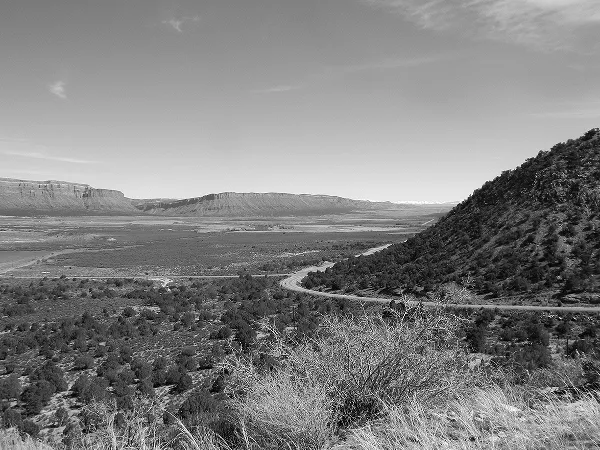
Photo 1. Paradox Valley, home of the proposed Piñon Ridge Uranium Mill, epitomizes the vast spatial isolation of the Four Corners region. (Photo by Matthew Kazy)
Nuclear Renaissance Comes to Life
Today, several years after my conversations began with Fritz and Barbara about renewed uranium production, industry renewal is no longer an abstraction but a reality. In 2011, the government gave Energy Fuels Resources initial permits for the construction of Piñon Ridge Uranium Mill, and thus far all legal challenges been have surmounted. The corporation still plans to build the mill in Paradox Valley, Colorado, just a few miles from the towns of Nucla and Naturita. Although the permit remains contested and uranium markets are unstable, people in these nearby communities have overwhelmingly accepted Piñon Ridge’s presence, making the mill a significant and controversial symbol of renewed uranium production and nuclear renaissance.9
To investigate the newly permitted mill and the vociferous community response it had created, one hot summer day I found myself driving down an empty two-lane state highway in southwestern Colorado. In this hostile, isolated region, a few mining communities still survive, but others have become contaminated ghost towns. As I traveled from Telluride’s ski-town luxury into Nucla’s and Naturita’s rough and rugged sparseness, I bisected family ranches and green grasslands before descending into an arid landscape dominated by red-yellow dust, flat-top mesas, curving canyons, and surprising pops of green where irrigation canals sustain life. Within a mere sixty miles, I had visited two distinct worlds, one privileged and one impoverished, though each depends on natural resources for economic survival.
Telluride’s crowded main street overflows with upscale clothing and recreational equipment boutiques, vegan and organic eateries, and tourists in Cloudveil ski gear driving luxury sedans and SUVs. A free gondola lifts happy vacationers to their second or third multimillion-dollar mountainside homes. Oxygen bars and microbreweries cater to skiers, snowboarders, and the occasional celebrity. On Naturita’s modest Main Street, several storefronts sit vacant, a few bars and small diners compete for steady business, and rusting pickups meander along empty roads. Social dislocation—the patterned experiences of instability and powerlessness among residents of rapidly changing market-based economies—permeates the daily lives of community members.10 Bungalows, doublewide trailers, and modest single-family homes line a few in-town streets, but paved roads give way to gravel almost as soon as I turn my car off Main Street. Although the sister cities of Nucla and Naturita share water treatment services and other infrastructure to conserve public spending, the local governments remain resource-poor. A for-sale sign hangs on the local middle school; reduced funding and enrollment numbers have forced the towns to consolidate students into one building.
Cheerful gardens and mowed lawns do not disguise the social dislocation that plagues most of the households. Fewer than 50 percent of the children in Nucla and Naturita live in two-parent homes, and nearly 20 percent receive special education services. Approved applications show that close to 60 percent of local school-aged children depend on free lunch programs, and recent figures indicate that the high school dropout rate in Nucla ranges from 10 to 27 percent. Older students and other residents contend with rampant drug use, and the communities have growing reputations for crystal methamphetamine use and manufacture.11
Many community residents, particularly those who describe themselves as ‘fourth generation’, are strongly in favor of the mill, largely due to the employment opportunities they believe it will provide. But their support extends beyond basic economic identities; personal and community identification with uranium, attachment to place, and a sense of patriotism also motivate their acceptance. As I visited with Naturita’s bar patrons, grocery store customers, and diner employees, my casual questions uncovered stronger support for renewed uranium production than I’d heard from Fritz, Barbara, and other Monticello residents. After the bust of the second U.S. uranium boom in the early 1980s, Nucla and Naturita found themselves dealing with chronic recession, environmental health problems, and even more spatial isolation than Monticello. Nonetheless, support for industry renewal has mobilized residents’ social activism and dominates their built environment. When I walked into the visitor center’s simple prefab building, my eyes were immediately drawn to a neon orange sign high on the wall: “Yes to the Mill!” As I talked with the center’s employees, I heard one after another speak in favor of the Piñon Ridge Mill and identify with the uranium industry as part of their communities. But even as residents’ historical and economic realities were mobilizing community support, they were continuing to marginalize the communities, constrain economic opportunities, and limit people’s ability to challenge the effects of the privatized industry.
Structural Violence in America’s Sacrifice Zones
Renewed uranium production in the United States remains invisible to most Americans.12 This is understandable: the vast Colorado Plateau is cloaked in desert mystery and has long been a sacrifice zone for American atomic ambitions.13 The plateau covers 140,000 square miles in the Four Corners region, a landscape defined by its stark beauty and sparse human population. Yet the region is uranium-rich, so the area is continually affected by global nuclear trends.14 Today, even after the Fukushima disaster, nuclear power retains its image as a climate-friendly energy source, and increasing demand for uranium from developing countries such as China is pushing global ma...
Table of contents
- Title Page
- Copyright Page
- Dedication
- Epigraph
- Contents
- List of Illustrations
- Acknowledgments
- Chapter 1. Introduction: The Paradox of Uranium Production in a Neoliberal Era
- Chapter 2. Booms, Busts, and Bombs: Uranium’s Economic and Environmental Justice History in the United States
- Chapter 3. Lethal Legacies: Left in the Dust in Monticello, Utah
- Chapter 4. The Piñon Ridge Uranium Mill: A Transnational Corporation Comes Home
- Chapter 5. “Just Hanging on by a Thread”: Isolation, Poverty, and Social Dislocation
- Chapter 6. “Better Regs” in an Era of Deregulation: Neoliberalized Narratives of Regulatory Compliance
- Chapter 7. Conclusions and Solutions: Social Sustainability and Localized Energy Justice
- Appendix: Research Methods and Data Collection
- Notes
- Selected Bibliography
- Index
- About the Author
Trusted by 375,005 students
Access to over 1.5 million titles for a fair monthly price.
Study more efficiently using our study tools.
Frequently asked questions
Yes, you can cancel anytime from the Subscription tab in your account settings on the Perlego website. Your subscription will stay active until the end of your current billing period. Learn how to cancel your subscription
No, books cannot be downloaded as external files, such as PDFs, for use outside of Perlego. However, you can download books within the Perlego app for offline reading on mobile or tablet. Learn how to download books offline
Perlego offers two plans: Essential and Complete
- Essential is ideal for learners and professionals who enjoy exploring a wide range of subjects. Access the Essential Library with 800,000+ trusted titles and best-sellers across business, personal growth, and the humanities. Includes unlimited reading time and Standard Read Aloud voice.
- Complete: Perfect for advanced learners and researchers needing full, unrestricted access. Unlock 1.5M+ books across hundreds of subjects, including academic and specialized titles. The Complete Plan also includes advanced features like Premium Read Aloud and Research Assistant.
We are an online textbook subscription service, where you can get access to an entire online library for less than the price of a single book per month. With over 1.5 million books across 990+ topics, we’ve got you covered! Learn about our mission
Look out for the read-aloud symbol on your next book to see if you can listen to it. The read-aloud tool reads text aloud for you, highlighting the text as it is being read. You can pause it, speed it up and slow it down. Learn more about Read Aloud
Yes! You can use the Perlego app on both iOS and Android devices to read anytime, anywhere — even offline. Perfect for commutes or when you’re on the go.
Please note we cannot support devices running on iOS 13 and Android 7 or earlier. Learn more about using the app
Please note we cannot support devices running on iOS 13 and Android 7 or earlier. Learn more about using the app
Yes, you can access The Price of Nuclear Power by Stephanie A. Malin in PDF and/or ePUB format, as well as other popular books in Biological Sciences & Ecology. We have over 1.5 million books available in our catalogue for you to explore.